Thank you for visiting SNEWPapers!
Sign up free
Story
December 12, 1877
Vermont Watchman And State Journal
Montpelier, Washington County, Vermont
What is this article about?
Hans Christian Andersen's tale of a grandmother whose withered rose evokes a vision of her youthful love, her peaceful death, burial with the psalm-book, and eternal life symbolized by blooming roses on her grave.
Clipping
OCR Quality
100%
Excellent
Full Text
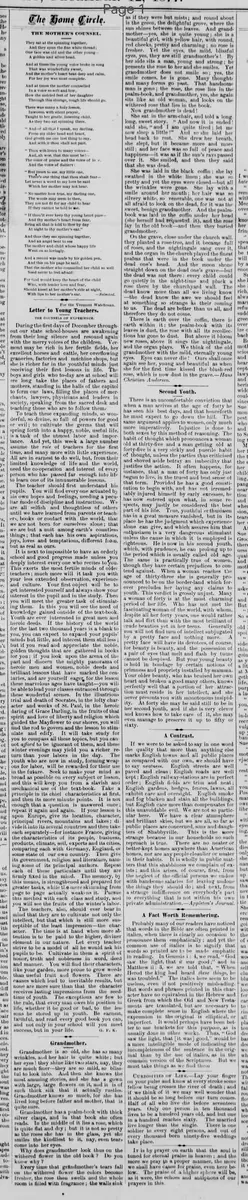
Grandmother is so old, she has so many wrinkles, and her hair is quite white; but her eyes! they shine like two stars, nay, they are much finer—they are so mild, so blissful to look into. And then she knows the most amusing stories, and she has a gown with large, large flowers on it, and it is of such thick silk that it actually rustles.
Grandmother knows so much, for she has lived long before father and mother, that is quite sure. Grandmother has a psalm-book with thick silver clasps, and in that book she often reads. In the middle of it lies a rose, which is quite flat and dry; but it is not so pretty as the roses she has in the glass, yet she smiles the kindliest to it, nay, even tears come into her eyes.
Why does grandmother look thus on the withered flower in the old book? Do you know why? Every time that grandmother's tears fall on the withered flower the colors become fresher, the rose then swells and the whole room is filled with fragrance; the walls sink as if they were but mists; and round about is the green, the delightful grove, where the sun shines between the leaves.
And grandmother—yes, she is quite young; she is a beautiful girl, with yellow hair, with round, red cheeks, pretty and charming: no rose is fresher. Yet the eyes, the mild, blissful eyes, yes, they are still grandmother's! By her side sits a man, young and strong; he presents the rose to her and she smiles. Yet grandmother does not smile so; yes, the smile comes, he is gone. Many thoughts and many forms go past. That handsome man is gone; the rose, the rose lies in the psalm-book, and grandmother, yes, she again sits like an old woman, and looks on the withered rose that lies in the book.
Now grandmother is dead! She sat in the arm-chair, and told a long long, sweet story. "And now it is ended said she, "and I am quite tired; let me now sleep a little!" And so she laid her head back to rest. She drew her breath, she slept, but it became more and more still; and her face was so full of peace and happiness—it was as if the sun's rays passed over it. She smiled, and then they said that she was dead.
She was laid in the black coffin; she lay swathed in the white linen: she was so pretty and yet the eyes were closed—but all the wrinkles were gone. She lay with a smile around her mouth; her hair was so silvery white, so venerable, one was not at all afraid to look on the dead, for it was the sweet, benign grandmother. And the psalm-book was laid in the coffin under her head (she herself had requested it), and the rose lay in the old book—and then they buried grandmother.
On the grave, close under the church wall, they planted a rose-tree, and it became full of roses, and the nightingale sang over it, and the organ in the church played the finest psalms that were in the book under the dead one's head. And the moon shone straight down on the dead one's grave—but the dead was not there: every child could go quietly in the night-time and pluck a rose there by the churchyard wall.
The dead know more than all we living know -the dead know the awe we should feel at something so strange as their coming to us. The dead are better than us all, and therefore they do not come. There is earth over the coffin, there is earth within it; the psalm-book with its leaves is dust, the rose with all its recollections has gone to dust. But above it bloom new roses, above it sings the nightingale, and the organ plays. We think of the old grandmother with the mild, eternally young eyes. Eyes can never die! Ours shall once again see her, young and beautiful as when she for the first time kissed the blush-red rose, which is now dust in the grave.-Hans Christian Andersen.
Grandmother knows so much, for she has lived long before father and mother, that is quite sure. Grandmother has a psalm-book with thick silver clasps, and in that book she often reads. In the middle of it lies a rose, which is quite flat and dry; but it is not so pretty as the roses she has in the glass, yet she smiles the kindliest to it, nay, even tears come into her eyes.
Why does grandmother look thus on the withered flower in the old book? Do you know why? Every time that grandmother's tears fall on the withered flower the colors become fresher, the rose then swells and the whole room is filled with fragrance; the walls sink as if they were but mists; and round about is the green, the delightful grove, where the sun shines between the leaves.
And grandmother—yes, she is quite young; she is a beautiful girl, with yellow hair, with round, red cheeks, pretty and charming: no rose is fresher. Yet the eyes, the mild, blissful eyes, yes, they are still grandmother's! By her side sits a man, young and strong; he presents the rose to her and she smiles. Yet grandmother does not smile so; yes, the smile comes, he is gone. Many thoughts and many forms go past. That handsome man is gone; the rose, the rose lies in the psalm-book, and grandmother, yes, she again sits like an old woman, and looks on the withered rose that lies in the book.
Now grandmother is dead! She sat in the arm-chair, and told a long long, sweet story. "And now it is ended said she, "and I am quite tired; let me now sleep a little!" And so she laid her head back to rest. She drew her breath, she slept, but it became more and more still; and her face was so full of peace and happiness—it was as if the sun's rays passed over it. She smiled, and then they said that she was dead.
She was laid in the black coffin; she lay swathed in the white linen: she was so pretty and yet the eyes were closed—but all the wrinkles were gone. She lay with a smile around her mouth; her hair was so silvery white, so venerable, one was not at all afraid to look on the dead, for it was the sweet, benign grandmother. And the psalm-book was laid in the coffin under her head (she herself had requested it), and the rose lay in the old book—and then they buried grandmother.
On the grave, close under the church wall, they planted a rose-tree, and it became full of roses, and the nightingale sang over it, and the organ in the church played the finest psalms that were in the book under the dead one's head. And the moon shone straight down on the dead one's grave—but the dead was not there: every child could go quietly in the night-time and pluck a rose there by the churchyard wall.
The dead know more than all we living know -the dead know the awe we should feel at something so strange as their coming to us. The dead are better than us all, and therefore they do not come. There is earth over the coffin, there is earth within it; the psalm-book with its leaves is dust, the rose with all its recollections has gone to dust. But above it bloom new roses, above it sings the nightingale, and the organ plays. We think of the old grandmother with the mild, eternally young eyes. Eyes can never die! Ours shall once again see her, young and beautiful as when she for the first time kissed the blush-red rose, which is now dust in the grave.-Hans Christian Andersen.
What sub-type of article is it?
Supernatural
Dream Vision
Tragedy
What themes does it cover?
Providence Divine
Tragedy
Love
What keywords are associated?
Grandmother's Death
Withered Rose
Magical Vision
Eternal Eyes
Andersen Tale
What entities or persons were involved?
Grandmother
Where did it happen?
Home And Churchyard
Story Details
Key Persons
Grandmother
Location
Home And Churchyard
Story Details
A child describes their grandmother's appearance and stories, a magical vision of her youth from a withered rose in her psalm-book, her peaceful death, burial with the book and rose, and roses blooming on her grave symbolizing eternal youth.