Thank you for visiting SNEWPapers!
Sign up free
The Arkansas Farmer
Little Rock, Pulaski County, Arkansas
What is this article about?
Economists in the U.S. Department of Agriculture calculate that the 1933 cotton reduction program will add about $246 million to Southern cotton producers' income this season by limiting supply, raising prices from an estimated 5.5 cents to 9 cents per pound, plus $110 million in cash payments and $36 million in profits on government-held cotton.
Clipping
OCR Quality
Full Text
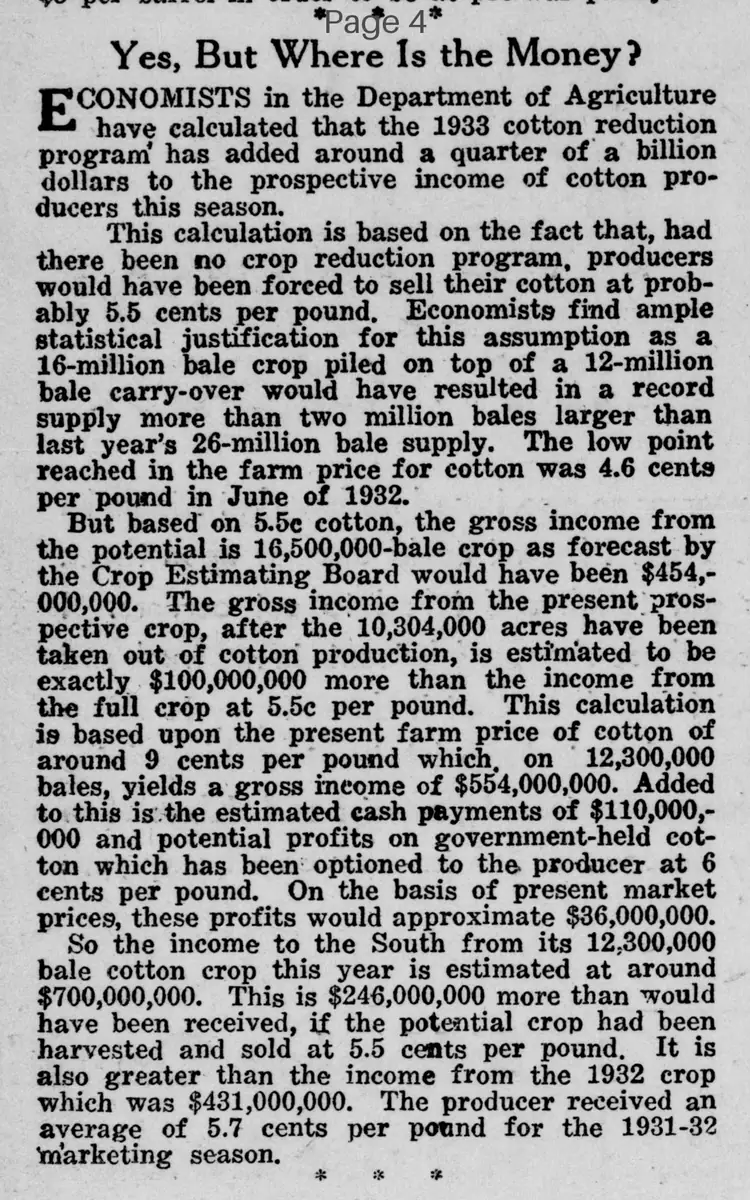
ECONOMISTS in the Department of Agriculture have calculated that the 1933 cotton reduction program has added around a quarter of a billion dollars to the prospective income of cotton producers this season.
This calculation is based on the fact that, had there been no crop reduction program, producers would have been forced to sell their cotton at probably 5.5 cents per pound. Economists find ample statistical justification for this assumption as a 16-million bale crop piled on top of a 12-million bale carry-over would have resulted in a record supply more than two million bales larger than last year's 26-million bale supply. The low point reached in the farm price for cotton was 4.6 cents per pound in June of 1932.
But based on 5.5c cotton, the gross income from the potential 16,500,000-bale crop as forecast by the Crop Estimating Board would have been $454,000,000. The gross income from the present prospective crop, after the 10,304,000 acres have been taken out of cotton production, is estimated to be exactly $100,000,000 more than the income from the full crop at 5.5c per pound. This calculation is based upon the present farm price of cotton of around 9 cents per pound which, on 12,300,000 bales, yields a gross income of $554,000,000. Added to this is the estimated cash payments of $110,000,000 and potential profits on government-held cotton which has been optioned to the producer at 6 cents per pound. On the basis of present market prices, these profits would approximate $36,000,000.
So the income to the South from its 12,300,000 bale cotton crop this year is estimated at around $700,000,000. This is $246,000,000 more than would have been received, if the potential crop had been harvested and sold at 5.5 cents per pound. It is also greater than the income from the 1932 crop which was $431,000,000. The producer received an average of 5.7 cents per pound for the 1931-32 marketing season.
What sub-type of article is it?
What themes does it cover?
What keywords are associated?
Where did it happen?
Story Details
Location
The South
Event Date
1933
Story Details
The 1933 cotton reduction program removed 10,304,000 acres from production, reducing the crop to 12,300,000 bales and raising the price to 9 cents per pound, yielding $554 million gross income plus $110 million cash payments and $36 million profits, totaling $700 million—$246 million more than the projected $454 million from a full 16.5 million bale crop at 5.5 cents.