Thank you for visiting SNEWPapers!
Sign up free
Letter to Editor
October 12, 1797
Gazette Of The United States, & Philadelphia Daily Advertiser
Philadelphia, Philadelphia County, Pennsylvania
What is this article about?
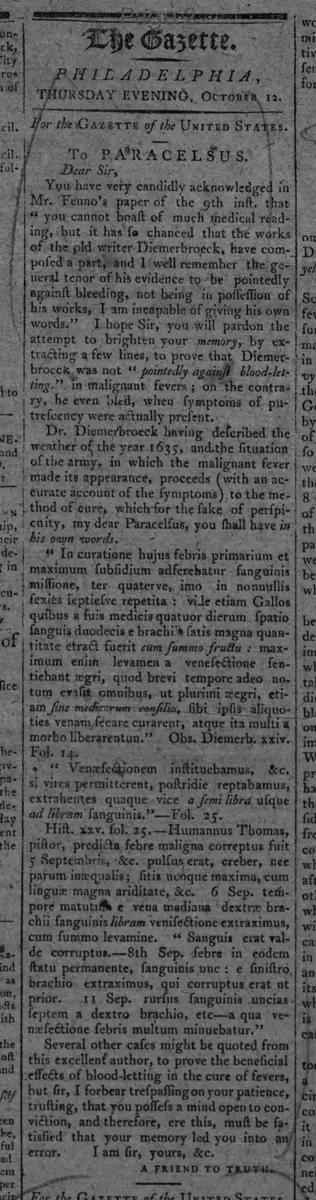
A letter in the Gazette of the United States corrects Paracelsus's misremembrance of Dr. Diemerbroeck's views, quoting Latin passages to demonstrate that Diemerbroeck advocated repeated blood-letting as a primary remedy for malignant fevers in 1635, even with putrescence symptoms.
Clipping
OCR Quality
98%
Excellent
Full Text
THE GAZETTE.
PHILADELPHIA
THURSDAY EVENING, OCTOBER 12.
For the Gazette of the United States.
TO PARACELSUS.
Dear Sir,
You have very candidly acknowledged in Mr. Fenno's paper of the 9th inst. that "you cannot boast of much medical reading, but it has so chanced that the works of the old writer Diemerbroeck, have composed a part, and I well remember the general tenor of his evidence to be pointedly against bleeding, not being in possession of his works, I am incapable of giving his own words." I hope Sir, you will pardon the attempt to brighten your memory, by extracting a few lines, to prove that Diemerbroeck was not "pointedly against blood-letting." in malignant fevers; on the contrary, he even bled, when symptoms of putrescence were actually present.
Dr. Diemerbroeck having described the weather of the year 1635, and the situation of the army, in which the malignant fever made its appearance, proceeds (with an accurate account of the symptoms), to the method of cure, which for the sake of perspicuity, my dear Paracelsus, you shall have in his own words.
"In curatione hujus febris primarium et maximum remedium adferebatur sanguinis missione, ter quaterque, imo in nonnullis sexies septiesve repetita: vide etiam Gallos quibus a suis medicis quatuor dierum spatio sanguis duodecim ex brachii atis magna quantitate extractus fuerit cum summo fructu: maximum enim levamen a venesectione sentiebant aegri, quod brevi tempore adeo notum evadit, omnibus, ut plurimi aegri, etiam inæ medicorum consilio, ibi ipsi aliquoties venam secare curarent, atque ita multi a morbo liberarentur." Obs. Diemerb. xxiv. Fol. 14.
"Venesectionem instituebamus, &c. si vires permitterent, postridie repetebamus, extrahentes quaque vice a semi libra usque ad libram sanguinis." Fol. 25. Hist. xxv. fol. 25.-Humannus Thomas, pictor, predicta febre maligna correptus fuit 5 Septembris, '&c. pulsus erat, creber, nec parum inæqualis; sitis quoque maxima, cum linguæ magna ariditate, &c. 6 Sep. tempore matutino e vena mediana dextra brachii sanguinis libram venesectione extraximus, cum summo levamine." Sanguis erat valde corruptus.-8th Sep. febre in eodem statu permanente, sanguinis uncias e sinistro brachio extraximus, qui corruptus erat ut prior. 11 Sep. rursus sanguinis uncias septem a dextro brachio, etc-a qua venesectione febris multum minuebatur."
Several other cases might be quoted from this excellent author, to prove the beneficial effects of blood-letting in the cure of fevers, but Sir, I forbear trespassing on your patience, trusting, that you possess a mind open to conviction, and therefore, ere this, must be satisfied that your memory led you into an error.
I am sir, yours, &c.
A FRIEND TO TRUTH.
PHILADELPHIA
THURSDAY EVENING, OCTOBER 12.
For the Gazette of the United States.
TO PARACELSUS.
Dear Sir,
You have very candidly acknowledged in Mr. Fenno's paper of the 9th inst. that "you cannot boast of much medical reading, but it has so chanced that the works of the old writer Diemerbroeck, have composed a part, and I well remember the general tenor of his evidence to be pointedly against bleeding, not being in possession of his works, I am incapable of giving his own words." I hope Sir, you will pardon the attempt to brighten your memory, by extracting a few lines, to prove that Diemerbroeck was not "pointedly against blood-letting." in malignant fevers; on the contrary, he even bled, when symptoms of putrescence were actually present.
Dr. Diemerbroeck having described the weather of the year 1635, and the situation of the army, in which the malignant fever made its appearance, proceeds (with an accurate account of the symptoms), to the method of cure, which for the sake of perspicuity, my dear Paracelsus, you shall have in his own words.
"In curatione hujus febris primarium et maximum remedium adferebatur sanguinis missione, ter quaterque, imo in nonnullis sexies septiesve repetita: vide etiam Gallos quibus a suis medicis quatuor dierum spatio sanguis duodecim ex brachii atis magna quantitate extractus fuerit cum summo fructu: maximum enim levamen a venesectione sentiebant aegri, quod brevi tempore adeo notum evadit, omnibus, ut plurimi aegri, etiam inæ medicorum consilio, ibi ipsi aliquoties venam secare curarent, atque ita multi a morbo liberarentur." Obs. Diemerb. xxiv. Fol. 14.
"Venesectionem instituebamus, &c. si vires permitterent, postridie repetebamus, extrahentes quaque vice a semi libra usque ad libram sanguinis." Fol. 25. Hist. xxv. fol. 25.-Humannus Thomas, pictor, predicta febre maligna correptus fuit 5 Septembris, '&c. pulsus erat, creber, nec parum inæqualis; sitis quoque maxima, cum linguæ magna ariditate, &c. 6 Sep. tempore matutino e vena mediana dextra brachii sanguinis libram venesectione extraximus, cum summo levamine." Sanguis erat valde corruptus.-8th Sep. febre in eodem statu permanente, sanguinis uncias e sinistro brachio extraximus, qui corruptus erat ut prior. 11 Sep. rursus sanguinis uncias septem a dextro brachio, etc-a qua venesectione febris multum minuebatur."
Several other cases might be quoted from this excellent author, to prove the beneficial effects of blood-letting in the cure of fevers, but Sir, I forbear trespassing on your patience, trusting, that you possess a mind open to conviction, and therefore, ere this, must be satisfied that your memory led you into an error.
I am sir, yours, &c.
A FRIEND TO TRUTH.
What sub-type of article is it?
Informative
Persuasive
Historical
What themes does it cover?
Health Medicine
What keywords are associated?
Blood Letting
Malignant Fevers
Diemerbroeck
Venesection
Medical History
What entities or persons were involved?
A Friend To Truth
Paracelsus
Letter to Editor Details
Author
A Friend To Truth
Recipient
Paracelsus
Main Argument
diemerbroeck advocated repeated blood-letting as the primary remedy for malignant fevers, even in cases with putrescence symptoms, contrary to paracelsus's recollection.
Notable Details
Quotes Latin Passages From Diemerbroeck's Works On Blood Letting Treatments
References Specific Case Of Patient Humannus Thomas Treated With Multiple Venesections