Thank you for visiting SNEWPapers!
Sign up free
Letter to Editor
May 20, 1818
Alexandria Gazette & Daily Advertiser
Alexandria, Virginia
What is this article about?
A letter to the Alexandria Gazette responding to 'Z.' defends the idea that the Christian spirit, unchanging and present since creation, has influenced all people, including Socrates and pre-Christian figures, against sectarian claims of exclusivity. It cites biblical passages to argue God's impartiality and the universality of divine light.
Clipping
OCR Quality
95%
Excellent
Full Text
For the ALEXANDRIA GAZETTE.
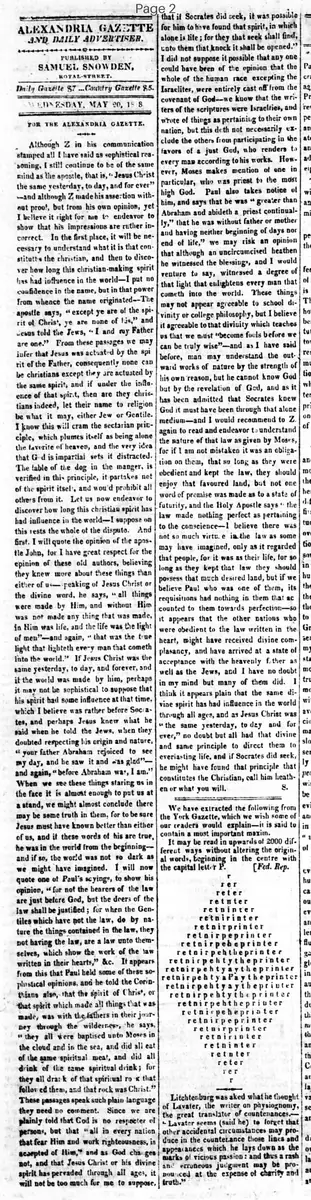
Although Z. in his communication stamped all I have said as sophistical reasoning, I still continue to be of the same mind as the apostle, that is, "Jesus Christ the same yesterday, to day, and for ever" -and although Z made his assertion without proof, but from his own opinion, yet I believe it right for me to endeavor to show that his impressions are rather incorrect. In the first place, it will be necessary to understand what it is that constitutes the christian, and then to discover how long this christian-making spirit has had influence in the world-I put no confidence in the name, but in that power from whence the name originated--The apostle says, "except ye are of the spirit of Christ, ye are none of his," and Jesus told the Jews," I and my Father are one." From these passages we may infer that Jesus was actuated by the spirit of the Father, consequently none can be christians except they are actuated by the same spirit, and if under the influence of that spirit, then are they christians indeed, let their name to religion be what it may, either Jew or Gentile. I know this will cramp the sectarian principle, which plumes itself as being alone the favorite of heaven, and the very idea that God is impartial sets it distracted. The fable of the dog in the manger, is verified in this principle, it partakes not of the spirit itself, and would prohibit all others from it. Let us now endeavor to discover how long this christian spirit has had influence in the world-I suppose on this rests the whole of the dispute. And first, I will quote the opinion of the apostle John, for I have great respect for the opinion of these old authors, believing they knew more about these things than either of us--speaking of Jesus Christ or the divine word, he says, "all things were made by Him, and without Him was not made any thing that was made, in Him was life, and the life was the light of men" and again, "that was the true light that lighteth every man that cometh into the world." If Jesus Christ was the same yesterday, to day, and forever, and if the world was made by him, perhaps it may not be sophistical to suppose that his spirit had some influence at that time, which I believe was rather before Socrates, and perhaps Jesus knew what he said when he told the Jews, when they doubted respecting his origin and nature, "your father Abraham rejoiced to see my day, and he saw it and was glad"- and again, "before Abraham was, I am." When we see these things staring us in the face it is almost enough to put us at a stand, we might almost conclude there may be some truth in them, for to be sure Jesus must have known better than either of us, and if these words of his are true, he was in the world from the beginning- and if so, the world was not so dark as we might have imagined. I will now quote one of Paul's sayings, to show his opinion, "or not the hearers of the law are just before God, but the doers of the law shall be justified; for when the Gentiles which have not the law, do by nature the things contained in the law, they not having the law, are a law unto themselves, which show the work of the law written in their hearts," &c. It appears from this that Paul held some of these sophistical opinions, and he told the Corinthians also,-that the spirit of Christ, or that spirit which made all things that was made, was with the fathers in their journey through the wilderness, he says, "they all were baptised unto Moses in the cloud and in the sea, and did all eat of the same spiritual meat, and did all drink of the same spiritual drink; for they all drank of that spiritual rock that followed them, and that rock was Christ." These passages speak such plain language they need no comment. Since we are plainly told that God is no respecter of persons, but that "all in every nation that fear Him and work righteousness, is accepted of Him," and as God changes not, and that Jesus Christ or his divine spirit has pervaded through all ages, it will not be too much for me to suppose that if Socrates did seek, it was possible for him to have found that spirit, in which alone is life; for they that seek shall find, unto them that knock it shall be opened. I did not suppose it possible that any one could have been of the opinion that the whole of the human race excepting the Israelites, were entirely cast off from the covenant of God--we know that the writers of the scriptures were Israelites, and wrote of things as pertaining to their own nation, but this doth not necessarily exclude the others from participating in the favors of a just God, who renders to every man according to his works. However, Moses makes mention of one in particular, who was priest to the most high God. Paul also takes notice of him, and says that he was "greater than Abraham and abideth a priest continually," that he was without father or mother and having neither beginning of days nor end of life," we may risk an opinion that although an uncircumcised heathen he witnessed the blessings, and I would venture to say, witnessed a degree of that light that enlightens every man that cometh into the world. These things may not appear agreeable to school divinity or college philosophy, but I believe it agreeable to that divinity which teaches us that we must "become fools before we can be truly wise"-and as I have said before, man may understand the outward works of nature by the strength of his own reason, but he cannot know God but by the revelation of God, and as it has been admitted that Socrates knew God it must have been through that alone medium-and I would recommend to Z. again to read and endeavor to understand the nature of that law as given by Moses, for if I am not mistaken it was an obligation on them, that so long as they were obedient and kept the law, they should enjoy that favoured land, but not one word of promise was made as to a state of futurity, and the Holy Apostle says "the law made nothing perfect as pertaining to the conscience-I believe there was not so much virtue in the law as some may have imagined, only as it regarded that people, for it was as their life, for so long as they kept that law they should possess that much desired land, but if we believe Paul who was one of them, its requisitions had nothing in them that accounted to them towards perfection--so it appears that the other nations who were obedient to the law written in the heart, might have received divine complacency, and have arrived at a state of acceptance with the heavenly Father as well as the Jews, and I have no doubt in my mind but many of them did. I think it appears plain that the same divine spirit has had influence in the world through all ages, and as Jesus Christ was "the same yesterday, to day and for ever," no doubt but all had that divine and same principle to direct them to everlasting life, and if Socrates did seek, he might have found that principle that constitutes the Christian, call him heathen or what you will.
s.
Although Z. in his communication stamped all I have said as sophistical reasoning, I still continue to be of the same mind as the apostle, that is, "Jesus Christ the same yesterday, to day, and for ever" -and although Z made his assertion without proof, but from his own opinion, yet I believe it right for me to endeavor to show that his impressions are rather incorrect. In the first place, it will be necessary to understand what it is that constitutes the christian, and then to discover how long this christian-making spirit has had influence in the world-I put no confidence in the name, but in that power from whence the name originated--The apostle says, "except ye are of the spirit of Christ, ye are none of his," and Jesus told the Jews," I and my Father are one." From these passages we may infer that Jesus was actuated by the spirit of the Father, consequently none can be christians except they are actuated by the same spirit, and if under the influence of that spirit, then are they christians indeed, let their name to religion be what it may, either Jew or Gentile. I know this will cramp the sectarian principle, which plumes itself as being alone the favorite of heaven, and the very idea that God is impartial sets it distracted. The fable of the dog in the manger, is verified in this principle, it partakes not of the spirit itself, and would prohibit all others from it. Let us now endeavor to discover how long this christian spirit has had influence in the world-I suppose on this rests the whole of the dispute. And first, I will quote the opinion of the apostle John, for I have great respect for the opinion of these old authors, believing they knew more about these things than either of us--speaking of Jesus Christ or the divine word, he says, "all things were made by Him, and without Him was not made any thing that was made, in Him was life, and the life was the light of men" and again, "that was the true light that lighteth every man that cometh into the world." If Jesus Christ was the same yesterday, to day, and forever, and if the world was made by him, perhaps it may not be sophistical to suppose that his spirit had some influence at that time, which I believe was rather before Socrates, and perhaps Jesus knew what he said when he told the Jews, when they doubted respecting his origin and nature, "your father Abraham rejoiced to see my day, and he saw it and was glad"- and again, "before Abraham was, I am." When we see these things staring us in the face it is almost enough to put us at a stand, we might almost conclude there may be some truth in them, for to be sure Jesus must have known better than either of us, and if these words of his are true, he was in the world from the beginning- and if so, the world was not so dark as we might have imagined. I will now quote one of Paul's sayings, to show his opinion, "or not the hearers of the law are just before God, but the doers of the law shall be justified; for when the Gentiles which have not the law, do by nature the things contained in the law, they not having the law, are a law unto themselves, which show the work of the law written in their hearts," &c. It appears from this that Paul held some of these sophistical opinions, and he told the Corinthians also,-that the spirit of Christ, or that spirit which made all things that was made, was with the fathers in their journey through the wilderness, he says, "they all were baptised unto Moses in the cloud and in the sea, and did all eat of the same spiritual meat, and did all drink of the same spiritual drink; for they all drank of that spiritual rock that followed them, and that rock was Christ." These passages speak such plain language they need no comment. Since we are plainly told that God is no respecter of persons, but that "all in every nation that fear Him and work righteousness, is accepted of Him," and as God changes not, and that Jesus Christ or his divine spirit has pervaded through all ages, it will not be too much for me to suppose that if Socrates did seek, it was possible for him to have found that spirit, in which alone is life; for they that seek shall find, unto them that knock it shall be opened. I did not suppose it possible that any one could have been of the opinion that the whole of the human race excepting the Israelites, were entirely cast off from the covenant of God--we know that the writers of the scriptures were Israelites, and wrote of things as pertaining to their own nation, but this doth not necessarily exclude the others from participating in the favors of a just God, who renders to every man according to his works. However, Moses makes mention of one in particular, who was priest to the most high God. Paul also takes notice of him, and says that he was "greater than Abraham and abideth a priest continually," that he was without father or mother and having neither beginning of days nor end of life," we may risk an opinion that although an uncircumcised heathen he witnessed the blessings, and I would venture to say, witnessed a degree of that light that enlightens every man that cometh into the world. These things may not appear agreeable to school divinity or college philosophy, but I believe it agreeable to that divinity which teaches us that we must "become fools before we can be truly wise"-and as I have said before, man may understand the outward works of nature by the strength of his own reason, but he cannot know God but by the revelation of God, and as it has been admitted that Socrates knew God it must have been through that alone medium-and I would recommend to Z. again to read and endeavor to understand the nature of that law as given by Moses, for if I am not mistaken it was an obligation on them, that so long as they were obedient and kept the law, they should enjoy that favoured land, but not one word of promise was made as to a state of futurity, and the Holy Apostle says "the law made nothing perfect as pertaining to the conscience-I believe there was not so much virtue in the law as some may have imagined, only as it regarded that people, for it was as their life, for so long as they kept that law they should possess that much desired land, but if we believe Paul who was one of them, its requisitions had nothing in them that accounted to them towards perfection--so it appears that the other nations who were obedient to the law written in the heart, might have received divine complacency, and have arrived at a state of acceptance with the heavenly Father as well as the Jews, and I have no doubt in my mind but many of them did. I think it appears plain that the same divine spirit has had influence in the world through all ages, and as Jesus Christ was "the same yesterday, to day and for ever," no doubt but all had that divine and same principle to direct them to everlasting life, and if Socrates did seek, he might have found that principle that constitutes the Christian, call him heathen or what you will.
s.
What sub-type of article is it?
Religious
Philosophical
Persuasive
What themes does it cover?
Religion
Morality
What keywords are associated?
Christian Spirit
Socrates
Bible Quotes
Sectarianism
Divine Impartiality
Gentiles
Melchizedek
Mosaic Law
What entities or persons were involved?
S.
Alexandria Gazette
Letter to Editor Details
Author
S.
Recipient
Alexandria Gazette
Main Argument
the christian spirit, embodied by jesus christ who is unchanging and present since creation, has influenced all humanity across ages, including socrates and gentiles, emphasizing god's impartiality and rejecting sectarian exclusivity.
Notable Details
Quotes Apostle John On Christ As Creator And Light Of All Men
References Jesus' Words To Jews About Abraham
Cites Paul On Gentiles As A Law Unto Themselves
Mentions Melchizedek As Priest Without Genealogy
Critiques Mosaic Law's Limitations For Future State