Thank you for visiting SNEWPapers!
Sign up free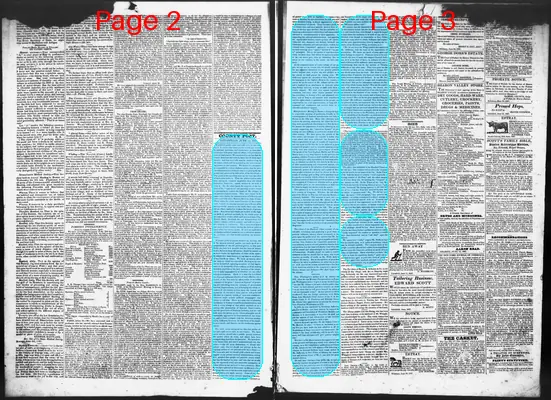
The Litchfield County Post
Litchfield, Litchfield County, Connecticut
What is this article about?
Editorial from Litchfield County Post, June 21, 1827, defends Adams administration against Jackson opposition, supports American System of protecting domestic industry and internal improvements, critiques old party labels, and responds to Hartford Times attacks. Includes opinions from Washington, Jefferson on Adams and Jackson.
Merged-components note: Long editorial on political parties, American System, and responses to critics, spanning multiple components and pages.
Clippings
1 of 2
OCR Quality
Full Text
LITCHFIELD. JUNE 21. 1827.
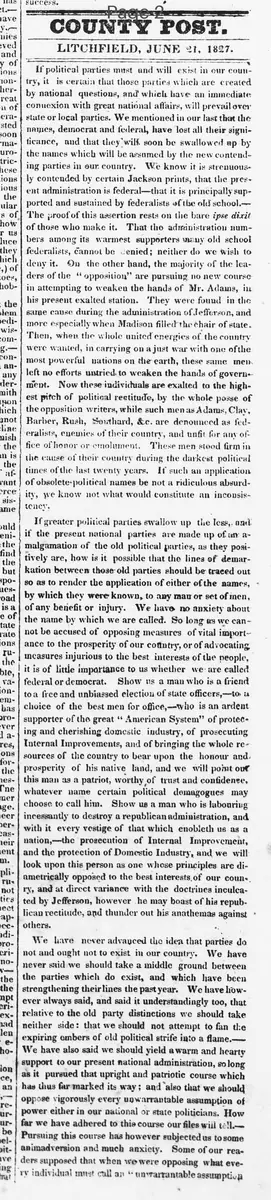
If political parties must and will exist in our country, it is certain that those parties which are created by national questions, and which have an immediate connexion with great national affairs, will prevail over state or local parties. We mentioned in our last that the names, democrat and federal, have lost all their significance, and that they will soon be swallowed up by the names which will be assumed by the new contending parties in our country. We know it is strenuously contended by certain Jackson prints, that the present administration is federal-that it is principally supported and sustained by federalists of the old school.- The proof of this assertion rests on the bare ipse dixit of those who make it. That the administration numbers among its warmest supporters many old school federalists, cannot be denied; neither do we wish to deny it. On the other hand, the majority of the leaders of the "opposition" are pursuing no new course in attempting to weaken the hands of Mr. Adams, in his present exalted station. They were found in the same cause during the administration of Jefferson, and more especially when Madison filled the chair of state. Then, when the whole united energies of the country were wanted, in carrying on a just war with one of the most powerful nations on the earth, these same men left no efforts untried to weaken the hands of government. Now these individuals are exalted to the highest pitch of political rectitude, by the whole posse of the opposition writers, while such men as Adams, Clay, Barber, Rush, Southard, &c. are denounced as federalists, enemies of their country, and unfit for any office of honor or emolument. These men stood firm in the cause of their country during the darkest political times of the last twenty years. If such an application of obsolete political names be not a ridiculous absurdity, we know not what would constitute an inconsistency.
If greater political parties swallow up the less., and if the present national parties are made up of an amalgamation of the old political parties, as they positively are, how is it possible that the lines of demarkation between those old parties should be traced out so as to render the application of either of the names, by which they were known, to any man or set of men, of any benefit or injury. We have no anxiety about the name by which we are called. So long as we cannot be accused of opposing measures of vital importance to the prosperity of our country, or of advocating measures injurious to the best interests of the people, it is of little importance to us whether we are called federal or democrat. Show us a man who is a friend to a free and unbiased election of state officers,-to a choice of the best men for office,--who is an ardent supporter of the great "American System" of protecting and cherishing domestic industry, of prosecuting Internal Improvements, and of bringing the whole resources of the country to bear upon the honour and prosperity of his native land, and we will point out this man as a patriot, worthy of trust and confidence, whatever name certain political demagogues may choose to call him. Show us a man who is labouring incessantly to destroy a republican administration, and with it every vestige of that which enobleth us as a nation,--the prosecution of Internal Improvement, and the protection of Domestic Industry, and we will look upon this person as one whose principles are diametrically opposed to the best interests of our country, and at direct variance with the doctrines inculcated by Jefferson, however he may boast of his republican rectitude, and thunder out his anathemas against others.
We have never advanced the idea that parties do not and ought not to exist in our country. We have never said we should take a middle ground between the parties which do exist, and which have been strengthening their lines the past year. We have however always said, and said it understandingly too, that relative to the old party distinctions we should take neither side: that we should not attempt to fan the expiring embers of old political strife into a flame.-- We have also said we should yield a warm and hearty support to our present national administration, so long as it pursued that upright and patriotic course which has thus far marked its way; and also that we should oppose vigorously every unwarrantable assumption of power either in our national or state politicians. How far we have adhered to this course our files will tell.- Pursuing this course has however subjected us to some animadversion and much anxiety. Some of our readers supposed that when we were opposing what every individual must call an "unwarrantable assumption
of power'—we refer to legislative caucuses,—we were contending for men rather than for measures, and were therefore acting in direct opposition to professions previously advanced. True, we had a partiality for certain men, and most ardently desired their success, at the late state election; but this partiality was based upon the measures which these individuals would advocate in contradistinction to their opponents. In supporting the national administration, and opposing the unprincipled faction, made up from all parties, whig and tory, democrat and federal, bucktail and Clintonian, toleration and anti-toleration,—which has recently been "organized" against it, we have been accused of acting upon "party," instead of "no party" principles. But in the pursuit of both these measures, we have done that which we have ever meant to do; we never gave even an intimation that we meant to act contrary to the course we have pursued.
In the commencement of a new volume of our paper, we can see no reason why we should apologise for any supposed aberrations in our general political course the past year, or give any new pledges as to the course we shall pursue the coming year. We shall ever oppose the elevation of Gen. Jackson and his harpagons to the highest offices in the country,—and so far as the course of Mr. Adams and his cabinet is marked by an attachment to domestic rather than foreign interests, so long we shall yield them a hearty support. We shall ever oppose legislative caucuses, and every other similar measure which has a tendency to destroy a free and unbiassed election; and so long as our present state constitution and the rights which it guarantees to the people, are respected by our state administration, so long will it command our confidence, and receive from us a cheerful and liberal support.
Manufacturers' Meeting in Boston.—A large & highly respectable meeting of gentlemen, friendly to the encouragement of domestic manufactures was held in Boston on the fifth inst. Many able addresses were made to the meeting, supporting the object for which they were assembled, & elucidating in a clear & forcible manner the importance of strictly adhering to, and warmly supporting, the "American System" of protecting our own industry, in preference to that of another country. We have given the speech of Mr. Otis entire; not because we consider it better than many others that were delivered; but because Mr. Otis is a gentleman of age, of wealth, of experience, and has spent his life thus far in the midst of a great commercial people; and we consider opinions advanced by such men entitled to a great degree of credit.
The people of the New-England, Middle and Western States, have a very deep interest in the question now pending, whether Congress shall establish such a system as shall give safety and stability to American industry, or whether we shall be left entirely to the mercy of older manufacturing and commercial nations, who strenuously persist in the adoption of such measures as exclusively protect the industry and capital of their own people—whether we shall be driven to the necessity of sending gold to England to purchase woollen goods,—a country which refuses to receive any important article of American growth or industry, with the exception of Cotton—or whether such a protection shall be given to our manufacturers as shall enable them to supply our market with the article.
This question is to be decided in the Senate at the next session of Congress. Whether the bill which passed the House in May last will pass the Senate, is extremely doubtful. The measure is now, and ever has been, a favourite one with Mr. Adams and Mr. Clay, and so entirely devoid of principle are the efforts made by the "Jackson Combination," that no means will be left untried to defeat the bill. The people however will be heard upon this subject; and already has a spirit of enquiry gone abroad among the freemen of certain states, deeply interested in the manufacturing question, who were recently opposed to Mr. Adams, that augers well not only for the "American System," but also for the re-election of our present Chief Magistrate.
The editor of the Hartford Times, a paper of considerable circulation, and possessing a good share of political influence, labours almost incessantly to impress upon the public mind the opinion that Mr. Adams is unworthy of trust in the great republican family, and that Gen. Jackson, his competitor, possesses almost infinitely more worth and patriotism than he does; and predicts, that the time will shortly come when this will be owned and acknowledged by the republicans of Connecticut. Possibly should we make a counter statement to this we should find as many who would consider us worthy of credit, as Mr. Wells finds to support his theory. But as the opinions of great men will ever be taken in preference to either his or ours, we shall give below certain extracts from a late New York American relative to the comparative merits of Messrs. Adams and Jackson.—We shall begin with Mr. Adams.
OPINIONS.
Gen. Washington's opinion of J. Q. Adams.—In 1797, when he was Minister Plenipotentiary to Portugal, Washington said—“I give it as my decided opinion that Mr. Adams is the most valuable public character we have abroad, and there remains no doubt on my mind that he will prove himself the ablest of all our diplomatic corps.” At that period it will be recollected, that our foreign ministers, were Rufus King, John Marshall, Chief Justice of the U. S. Supreme Court, C. C. Pinckney, and Elbridge Gerry.
Mr. Adams' first appointment as minister he received from President Washington in 1791.
In 1807, he was appointed by President Jefferson, minister to Russia; and how entirely he enjoyed the confidence and friendship of Presidents Madison and Monroe, it is unnecessary to say—but we shall just add the opinion of one whom some people consider highly competent to judge in such a case.
General Jackson's opinion.—In his famous letter to Mr. Monroe, he says: "I have no hesitation in saying that you have made the best selection to fill the Department of State that could have been made. Mr. Adams in the hour of difficulty, will be an able helpmate, and I am convinced will give general satisfaction."
We have in the above extracts the opinions of some of the greatest and best men which ever adorned our country, as to the competency, qualifications and fitness of Mr. Adams for any civil station.—The following in relation to General Jackson were words spoken by Mr. Jefferson, to Gov. Coles, of Illinois, the connextion and intimate friend of Mr. J., just after the presidential election.
He said that "during a long public life, he had attentively watched the progress of events in the United States, with the particular view of satisfying his mind, that mankind were competent to self-government, to believe which his principles inclined him; and that during the whole of his political observation, the disposition of the American people to elect General Jack
son President, was the single circumstance that had shaken his faith, and made him fear that the American Republic was soon to follow the fate of all others, and fall under military rule."
We cannot, says the American, better comment upon this opinion (which has not been denied, because it is well known that, even though it might be hoped to bear down the testimony to its truth of any one individual, even though as respectable as Gov. Coles, there are many others to whom Jefferson had expressed the same apprehensions,) than by copying the remarks of the Richmond Whig, in relation to it—
"We do not (says the Whig) publish this opinion of Mr. Jefferson, with the hope or the expectation of proselytism. We know too much of party spirit and party feelings to expect it. Fools are never to be convinced—the men of sense who support General Jackson, do it in the face of facts; in defiance of a thousand evidences of his unfitness, more imposing and overwhelming, than can be the opinion of Thomas Jefferson or any other man. They have gone too far to recede—or they are too infatuated to change, tho' one should come from the dead. But there is a numerous class of neutrals, who have yet come to no decision between Adams and Jackson. Is not Mr. Jefferson's opinion entitled to weight and consideration with them? Did not his information embrace the history of the whole human family? Was not his experience and observation, the longest, the closest, the most profound and philosophical of any who has taken an interest in the destinies of our country? Will any doubt his devotion to his country and to human liberty every where? Was not he the great apostle of Republicanism? Mr. Jefferson respected Gen. Jackson for his personal merits, and honoured him for his public services—yet did he think and say, and at a time when he no longer had any personal interest how the affairs of the United States were managed, that he viewed the prospect of his election to the Presidency, as a bad omen for the durability of the Republic—as evidence that the American people, like their Republican predecessors in Europe, were ready to run after a military leader, and surrender their liberties to the first aspiring military chieftain who could dazzle them with the lustre of his glory."
"The Litchfield County Post, due some three weeks since, has not yet come to hand. It has been suggested that there were certain strictures on a correspondent in that number of the paper, and the modest Editor has withheld his sheet in consequence. This we cannot believe of the courteous gentleman—some Post Master must have hooked it—or some thief must have broached the mail-bag and laid violent hands on that paper, as the most valuable thing in it. Mr. Smith withhold his papers from us! No indeed. He is said to be the most honest man in all Litchfield County—devoid of low-cunning, deceit, hypocrisy, and all manner of evil—divested of even that cursed bane which engendereth strife, ycleped party spirit. We consider him one of the fairest specimens of Adams' democracy—a strange congregation of words—vinegar and oil—but Mr. Smith is honest. We wish he would send us another paper in place of the missing, stolen, stray-ed, lost number."
The above was published in the Hartford Times on the 4th inst. Our readers will recollect the remarks upon the article in our paper of the 7th. In the Times of the 11th the above is called a "civil request for a missing number of the Post," and the editor accuses us of every thing vile, for noticing his "request" in the manner we did. In the Times of the 18th, Mr. Wells boasts bravely of having detected us in a "palpable falsehood," for having asserted in our first notice of him, that the Post was received by him, and the article in question read," &c. We did not consider the above "civil paragraph," any proof to the contrary; we rather considered it a direct attempt at picking an editorial quarrel with us. It surely carries very much of that appearance on the face of it, and we did not act counter to human weakness in viewing it in that light, especially since we were warned some two or three months ago, that immediately after the close of the Legislature, an attack would be made upon us by this paragon of republican excellence.
We considered it impossible that the editor of the Times alone should miss his paper, when all our sheets sent to Hartford are covered in the same envelope; and we also considered it almost impossible that the whole package should be lost. Such however appears to have been the fact; and had the editor in reality "civilly requested" the number in question, it would have been forwarded and no "ink shed" upon the subject.
We again very "civilly" request Mr. Wells to confine his attacks upon us to political questions, which may be debated candidly. The common sense of the people is neither pleased nor edified by such indefinite attacks upon the character, political or moral, of each other as individuals. Show wherefore you have "discarded us from the republican family;" point out our political heresy; give us your own views of political rectitude; place your standard and stick to it, and we will either contend with you, or publicly acknowledge your political infallibility.
What sub-type of article is it?
What keywords are associated?
What entities or persons were involved?
Editorial Details
Primary Topic
Support For Adams Administration And American System Against Jackson Opposition
Stance / Tone
Supportive Of Adams And Protective Tariffs, Critical Of Jackson And Old Party Labels
Key Figures
Key Arguments