Thank you for visiting SNEWPapers!
Sign up free
The National Intelligencer And Washington Advertiser
Washington, District Of Columbia
What is this article about?
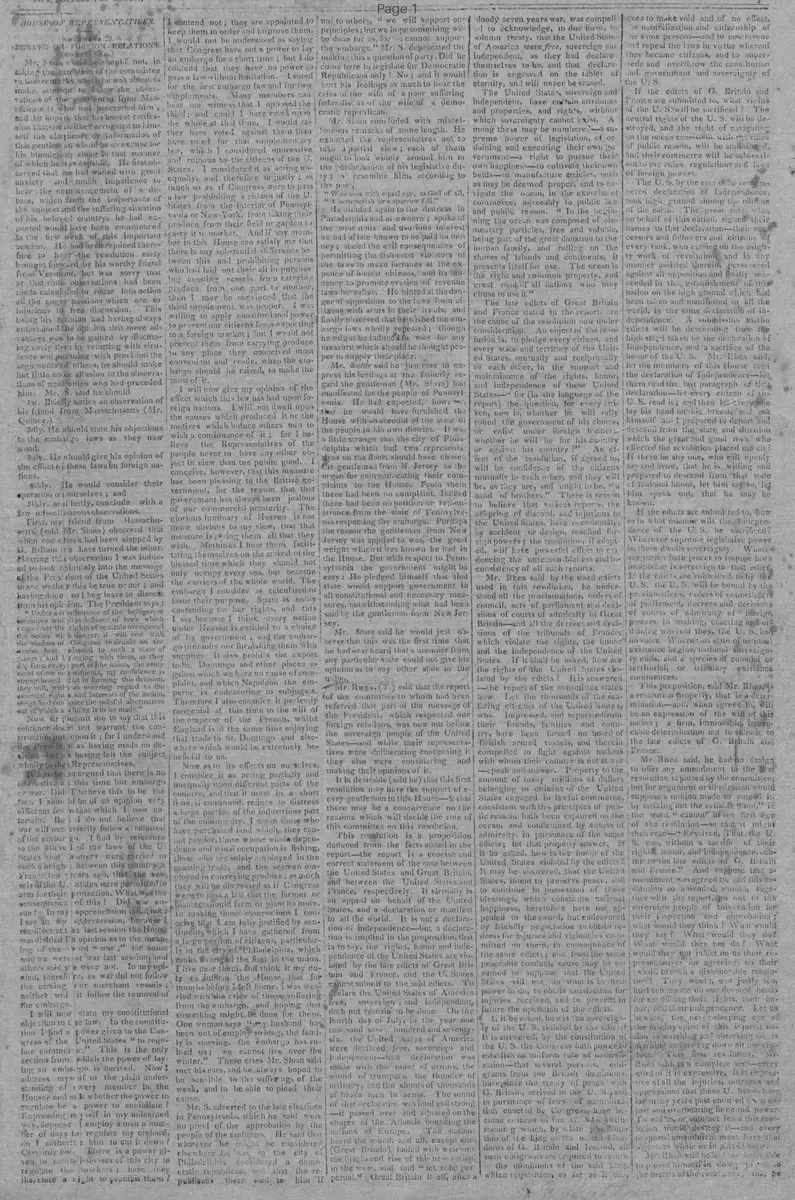
Transcript of a U.S. House of Representatives debate on December 1807, featuring speeches by Rep. Sloan opposing the embargo's constitutionality and effects, Rep. Smilie defending Pennsylvania's support, Rep. Rhea affirming U.S. sovereignty against British and French edicts, and Rep. Randolph detailing British aggressions and justifying the embargo as coercion.
Merged-components note: Merged sequential components across pages 1-3 forming a single continuous congressional debate on foreign relations and the embargo, all originally labeled as story.
Clippings
1 of 3
OCR Quality
Full Text
1st. Briefly notice an observation of his friend from Massachusetts (Mr. Quincy.)
2dly. He should state his objections to the embargo laws as they now stood.
3dly. He should give his opinion of the effect of these laws on foreign nations.
4thly. He would consider their operation on ourselves; and
5thly. and lastly, conclude with a few miscellaneous observations.
First, my friend from Massachusetts, (said Mr. Sloan) observed that when one cheek had been slapped by G. Britain we have turned the other. Hearing this observation I was induced to look minutely into the message of the President of the United States to see whether this be true or not; and having done so I beg leave to dissent from his opinion. The President says:
"Under a continuance of the belligerent measures which in defiance of laws which consecrate the rights of neutrals overspread the ocean with danger, it will rest with the wisdom of Congress to decide on the course best adapted to such a state of things; and bringing with them, as they do, from every part of the union, the sentiment of our constituents, my confidence is strengthened that in forming this decision, they will, with an unerring regard to the essential rights and interests of the nation, weigh and compare the painful alternatives out of which a choice is to be made."
Now sir permit me to say that this sentence does not warrant the construction put upon it; for I understand the President it as having made no decision but as having left the subject wholly to the Representatives. It has been argued that there is no alternative at this time but embargo or war. Did I believe this to be the fact, I should be of an opinion very different from that which I now entertain. But I do not believe that war will necessarily follow a removal of the embargo. I find by reference to the 4th vol. of the laws of the U. States that matters were carried to such a height between this country & France ten years ago, that the vessels of the U. States were permitted to arm for their protection. What was the consequence of this? Did war ensue? In my apprehension it did not; I say in my apprehension, because I recollect at the last session the House was divided in opinion as to the meaning of the word "war;" for some said we were at war last session, and others said we were not. In my opinion, therefore, as war did not follow the arming of our merchant vessels; neither will it follow the removal of the embargo.
3.
I will now state my constitutional objection to the law. In the constitution I find a power given to the Congress of the United States "to regulate. Commerce." This is the only section from which the power of laying an embargo is derived. Now I address myself to the plain understanding of every member in the House and ask whether the power to regulate be a power to annihilate? Expressing myself in my unlearned way, suppose I employ a man a number of days to regulate my orchard, to authorize him to cut it down? Certainly not. There is a power given to commissioners of this city to regulate the markets; have they the right to prohibit them?
I contend not: they are appointed to keep them in order and improve them. I would not be understood as saying that Congress have not a power to lay an embargo for a short time; but I do contend that they have no power to pass a law without limitation. I voted for the first embargo law and for two supplements. Many members can bear me witness that I opposed the third: and could I have voted upon the whole at that time, I would rather have voted against them than have voted for that supplementary law, which I considered oppressive and ruinous to the citizens of the U. States. I considered it as acting unequally, and therefore unjustly; as much so as if Congress were to pass a law prohibiting a citizen of the U. States from the interior of Pennsylvania or New-York, from taking their produce from their field or garden to carry it to market. And if any member in this House can satisfy me that there is any substantial difference between this and prohibiting persons who had laid out their all in purchasing coasting vessels from carrying produce from one port to another, then I may be convinced that the third supplement was proper. I was willing to apply constitutional power to prevent our citizens from exporting to a foreign market; but I would not prevent them from carrying produce to any place they conceived most convenient and ready, when the embargo should be raised, to make the most of it.
I will now give my opinion of the effect which this law has had upon foreign nations. I will not dwell upon the causes which produced it or the motives which induce others now to wish a continuance of it; for I believe the Representatives of the people never to have any other object in view than the public good. I conceive, however, that this measure has been pleasing to the British government, for the reason that that government has always been jealous of our commercial prosperity. The glorious luminary of Heaven is not more obvious to my view, than that that measure is giving them all that they wish. Methinks I hear them felicitating themselves on the arrival of the blessed time which they should not only occupy every sea, but become the carriers of the whole world. The embargo I consider as calculated to favor their purpose. Spain is nobly contending for her rights, and this I say because I think every nation under Heaven is entitled to a choice of its government; and the embargo prohibits our furnishing them with supplies. It also prohibits the export to St. Domingo and other places against which we have no cause of complaint, and which Napoleon the emperor is endeavoring to subjugate. Therefore I also consider it perfectly congenial at this time to the will of the emperor of the French, whilst England is at the same time enjoying that trade to St. Domingo and elsewhere which would be extremely beneficial to us.
Now as to its effects on ourselves, I consider it as acting partially and unequally upon different parts of the country, and that it must in a short time, if continued, reduce to distress a large portion of the industrious part of the community. I mean those who have purchased land which they cannot pay for, those whose whole dependence and usual occupation is fishing, those who are solely employed in the coasting trade, and the seamen employed in conveying produce; as much they will be distressed as if Congress were to pass a law that the farmer or planter should farm or plant no more. In making these observations I conceive that I am fully justified by sentiments which I have gathered from a large portion of citizens, particularly in the city of Philadelphia, which ranks as one of the first in the union. I live near them, and think it my duty to inform the House that for months before I left home, I was wearied with the cries of those suffering from the embargo, and hoping that something might be done for them. One woman says "my husband has been out of employ so long, the family is starving, the embargo has ruined us; we cannot live over the winter." These cries Mr. Sloan said met his ears, and he always hoped to be sensible to the sufferings of the weak, and to be able to plead their cause.
Mr. S. adverted to the late elections in Pennsylvania, which he said were no proof of the approbation by the people of the embargo. He said that whatever he might be considered elsewhere he was in the city of Philadelphia considered a democratic republican, and that the republicans there said to him if not to others, "we will support our principles; but we hope something will be done for us, for we cannot support the embargo." Mr. S. deprecated the making this a question of party. Did he come here to legislate for Democratic Republicans only? No; and it would hurt his feelings as much to hear the cries of the wife of a poor suffering federalist as of the wife of a democratic republican.
Mr. Sloan concluded with miscellaneous remarks of some length. He exhorted the representatives not to take a partial view; each of them ought to look widely around him in the performance of his legislative duty; to resemble him, according to the poet,
"Who sees with equal eye, as God of all,
A hero perish or a sparrow fall."
He alluded again to the distress in Philadelphia and elsewhere; spoke of the enormous and usurious interest he had of late known to be paid on money; stated the evil consequences of permitting the dishonest violators of the laws to make fortunes at the expense of honest citizens, and its tendency to promote evasion of revenue laws hereafter. He hinted at the danger of opposition to the laws from citizens with arms in their hands, and finally observed that he wished the embargo laws wholly repealed; though he might be induced to vote for any measure which should be thought proper to supply their place.
Mr. Smilie said he just rose to express his feelings at the fatherly regard the gentleman (Mr. Sloan) had manifested for the people of Pennsylvania. He had expected, however, that he would have furnished the House with an account of the state of the people in his own district. It was a little strange that the city of Philadelphia which had two representatives on the floor, should have chosen the gentleman from N. Jersey as the organ for communicating their complaints to the House. From them there had been no complaint. Indeed there had been no petition or remonstrance from the state of Pennsylvania respecting the embargo. Perhaps the reason the gentleman from New Jersey was applied to was, the great weight which it was known he had in the House. But with respect to Pennsylvania the government might be easy: He pledged himself that that state would support government in all constitutional and necessary measures, notwithstanding what had been said by the gentleman from New Jersey.
Mr. Sloan said he would just observe that this was the first time that he had ever heard that a member from any particular state could not give his opinion as to any other state in the union.
Mr. Rhea. (T.) said that the report of the committee to whom had been referred that part of the message of the President, which respected our foreign relations, was now out before the sovereign people of the United States-and while their representatives were deliberating concerning it they also were considering and making their opinions of it.
It is desirable (said he) that this first resolution may have the support of every gentleman in this House-& that there may be a concurrence on the reasons which will decide the vote of this committee on this resolution.
This resolution is a proposition deduced from the facts stated in the report-the report is a concise and correct statement of the case between the United States and Great Britain, and between the United States and France, respectively. It virtually is an appeal on behalf of the United States, and a declaration or manifest to all the world. It is not a declaration of independence--but a declaration is implied in the proposition, that is to say, the rights, honor and independence of the United States are violated by the late edicts of Great Britain and France, and the U. States cannot submit to the said edicts. To declare the United States of America free, sovereign and independent, doth not remain to be done. On the fourth day of July, in the year one thousand seven hundred and seventy-six, the United States of America were declared free, sovereign and independent-that declaration was made with the noise of drums, the sound of trumpets, the thunder of artillery, and the shouts of thousands of brave men in arms. The sound of that declaration was loud and strong-it passed over and vibrated on the shores of the Atlantic bounding the nations of Europe. The nations heard the sound, and all, except one, (Great Britain) hailed with welcome the origin and rise of this new nation in the west, and said "let it be perpetual." Great Britain herself, after a bloody seven years war, was compelled to acknowledge, in due form, by solemn treaty, that the United States of America were free, sovereign and independent, as they had declared themselves to be, and that declaration is engraved on the tablet of eternity, and will never be erased.
The United States, sovereign and independent, have certain attributes and properties, and rights, without which sovereignty cannot exist. Among these may be numbered--a supreme power of legislation, of ordaining and executing their own government-a right to pursue their own happiness-to cultivate their own fields-to manufacture articles, such as may be deemed proper, and to navigate the ocean, in the exercise of commerce, agreeably to public law and public reason. "In the beginning the ocean was composed of elementary particles, free and voluble, being part of the great donation to the human family, and rolling on the shores of islands and continents, it presents itself for use. The ocean is the right and common property, and great road of all nations who may choose to use it."
The late edicts of Great Britain and France stated in the report, are the cause of the resolution now under consideration. An object of the resolution is, to pledge every citizen, and every state and territory of the United States, mutually and reciprocally to each other, in the support and maintenance of the rights, honor, and independence of these United States-—"for (in the language of the report) the question, for every citizen, now is, whether he will rally round the government of his choice, or enlist under foreign banners. whether he will be for his country or against his country?"
An effect of the resolution, if agreed to, will be confidence of the citizens mutually in each other, and they will be, as they are, and ought to be, "a band of brothers." There is reason to believe that various reports, the offspring of discord, and injurious to the United States, have occasionally, by accident or design, reached foreign powers; the resolution, if adopted, will have powerful effect in evidencing the unreasonableness and inconsistency of all such reports.
Mr. Rhea said by the word edicts used in this resolution, he understood all the proclamations, orders of council, acts of parliament and decisions of courts of admiralty of Great Britain-and all the decrees and decisions of the tribunals of France, which violate the rights, the honor and the independence of the United States. If it shall be asked, how are the rights of the United States violated by the edicts? It is answered--the report of the committee states how. Let the thousands of the seafaring citizens of the United States, who, impressed, and separated from their friends, families and country, have been forced on board of British armed vessels, and therein compelled to fight against nations with whom their country is not at war--speak and answer. Property to the amount of many millions of dollars belonging to citizens of the United States engaged in lawful commerce, consistent with the principles of public reason, hath been captured on the ocean, and condemned by courts of admiralty, in pursuance of the same edicts; let that property answer, if it be asked, how is the honor of the United States violated by the edicts? It may be answered, that the United States, intent to preserve peace, and to continue in possession of those blessings, which constitute national happiness, heretofore have not appealed to the sword, but endeavored by friendly negociation to obtain redress for injuries and violences committed on them, in consequence of the same edicts; and from the same peaceable conduct, cause may be assumed to suppose that the United States will not do what is in their power to do, to obtain satisfaction for injuries received, and to prevent in future the operation of the edicts. If it be asked, how is the sovereignty of the U. S. violated by the edicts? It is answered, by the constitution of the U. S. the Congress hath power to establish an uniform rule of naturalization--that several persons, emigrants from the British dominions, have since the treaty of peace with G. Britain, arrived in the U. S. and in pursuance of laws of naturalization enacted by Congress, have become citizens of the U. States: notwithstanding which, by a late proclamation of the king of the united kingdoms of G. Britain and Ireland, all such emigrants are required to return to the dominions of the said king,
goes to make void and of no effect. the naturalization and citizenship of the same persons--and to contravene and repeal the laws in virtue whereof they became citizens, and to supersede and overthrow the constitution and government and sovereignty of the U. S.
If the edicts of G. Britain and France are submitted to, what rights of the U. S. shall be sacrificed? The neutral rights of the U. S. will be destroyed, and the right of navigating on the ocean consistent with the rules of public reason, will be annihilated, and their commerce will be subservient to the rules, regulations and laws of foreign powers.
The U.S. by the ever to be remembered declaration of Independence, took high ground among the nations of the earth. The great men who, on behalf of this nation, signed their names to that declaration--their successors and followers and citizens of every rank, who carried on the mighty work of revolution, and in any manner assisted therein, persevered against all opposition and finally succeeded in the establishment of this nation on the high ground which had been taken and manifested to all the world, in the same declaration of independence. A submission to the edicts will be descending from the high ground taken by the declaration of Independence, and a sacrifice of the honor of the U. S. Mr. Rhea said, let the members of this House read the declaration of Independence--let them read the last paragraph of that declaration-let every citizen of the U.S. read it; and then let every one lay his hand on his breast, and ask himself am I prepared to depart and descend from the state and situation which the great and good men who effected the revolution placed me on? If there be any one, who will openly say and avow, that he is willing and prepared to descend from that state of national honor, let him say so, let him speak out, that he may be known.
If the edicts are submitted to. how or in what manner will the Independence of the U. S. be sacrificed? Wherever supreme legislative power is, there dwells sovereignty. Whatever nation hath power to impose laws on another is sovereign to that other. If the edicts are submitted to by the U. S. the U. S. will be bound by the proclamations, orders of council, acts of parliament, decrees and decisions of courts of admiralty of foreign powers, in making, enacting and ordaining whereof they, the U. S. had no voice. Where this state of national existence begins, national sovereignty ends, and a species of colonial or territorial, or tributary existence commences.
This proposition, said Mr. Rhea, is a resolution properly, that is a determination--and, when agreed to, will be an expression of the will of this nation; a firm, immovable, irrevocable determination not to submit to the late edicts of G. Britain and France.
Mr. Rhea said, he had no design to offer any amendment to the 1st resolution reported by the committee; but for argument or illustration would suppose a motion made to amend it. by striking out the syllable "not," in the word "cannot" in the first line of the resolution-so that it might then read-"Resolved, That, the U. S. can, without a sacrifice of their rights, honor, and independence, submit to the late edicts of G. Britain and France." And suppose that amendment was agreed to, and this resolution so amended, should, together with the report, go out to the sovereign people of this nation for their inspection and approbation; what would they think? What would they say? What would they do? What would they not do? What would they not inflict on us their representatives for agreeing, on their behalf to such a dishonorable resolution? They would, and justly too, hurl vengeance on our devoted heads for sanctioning their rights, their honor, and their independence. Let us beware, the never-sleeping eye of the mighty spirit of this imperious nation is watching and observing us. Is marking and noting down all our conduct. This first resolution, Mr. Rhea said, is a complete text-every word of it is expressive, it is expressive of all the injuries, outrages and oppressions that these U. S. have for many years past endured from unjust and overbearing force and power. To add to, or subtract from this resolution would destroy it--and every proposed amendment must have that object, in whole or in part it now.
had stated only some of its great outlines, and must submit a further elucidation of it to any gentleman better prepared who may think proper to do it. He said he considered the resolution under consideration all important, at this particular time more peculiarly so, and that it would have his support.
Mr. Rhea said he did not wish to make a text of any observation of any gentleman, but as the word tribute had been mentioned, and some gentleman had said that that word ought to be vindicated & dismissed from the debate, it was not his inclination to dismiss or discard that word. He thought the term appropriate--that the word tribute was nearly synonymous with the word tax or toll--that if a man is authorized by law to fix a turnpike on a highway or great road, and to collect from travellers a certain sum of money that is called tax or toll. If a man is possessed of force and power sufficient to enable him arbitrarily or despotically to establish a turnpike gate on a highway, and to compel every passenger to pay to him a sum of money, say one dollar, for liberty to travel on the road to pass through that gate--that dollar in that case may properly be called tribute.
Mr. Rhea said, he contended that the ocean was a highway of nations, and if any one nation, for instance G. Britain, was possessed of maritime power & force sufficient to compel any other nation engaged in commerce to land its produce and pay tax or duty for it, to have liberty to convey it on the ocean to any third nation--that tax or duty may be properly denominated tribute: because the nation, paying it, is by superior force and power compelled to pay it to that nation who by force hath arbitrarily & despotically, and contrary to public reason, erected an imaginary turnpike on the ocean to the complete destruction of all neutral commerce, and to effect and establish a perfect system of universal commercial monopoly. Mr. Rhea said he admitted that the maritime power of G. Britain was superior--that it extended over the ocean from the rising to the setting sun, and from the frozen ocean in the South to the frozen ocean in the North; but that notwithstanding this, he never would agree that the U. States shall submit to the edicts of Great Britain. He said he also admitted that the power of France on the continent of Europe was superior; notwithstanding that, he would never agree that the United States shall submit to the edicts of France. He said it was his opinion, and he firmly believed, that the sovereignty and independence of the U. States were placed on a firm and immovable foundation, and could not be overturned, and that they would be rising in virtue, honor, in greatness, in power, and in national happiness and felicity, when some of the nations who now oppress them, would be sinking into corruption, mouldering into ruin and blasted out, except in remembrance. Nations, in respect to existence, he said, are as trees in the forest; the loftiest, proudest oak, that had stood firm against the storms of ages, originating from an acorn, vegetating to greatness and lifting its high head to the Heavens, at length all aims its utmost--decay begins, corruption progresses, it tumbles down from its height and lays prostrate on parent earth, there it dissolves and returns to its pristine indiscriminate condition.
NOVEMBER 30.
Mr. Randolph said that in discussing this subject he should consider the whole subject of foreign relations before the committee. The first resolution he considered of primary importance as containing a certain declaration that the edicts of the two mighty belligerents of Europe were violations of our honor, our independence and our sovereignty. An unanimous expression of this sentiment (said he) would give us confidence in each other; it will be a sacred pledge of all parties to resist these degrading encroachments; difference of opinion would then be manifested but as the means of saving this nation from the impending calamity. The whole nation would understand this declaration that he who is not for us is against us--no neutrals. There can be no middle ground. The line should be drawn, that the friends and enemies of this country should be known; that the persecuted foreigner who left his native home to escape the iron yoke of despotism, may be distinguished from foreign agents and emissaries settled among us for the purposes of disaffection; and that American news-papers differing only as to the means of national security may be known from the seditious hirelings of foreign gold, whose daily avocation is the abuse of our government, and the justification of foreign aggression.
To prove the great design of the French Emperor we refer to the execution of the Berlin decree, unfriendly vexations of our trade in the Mediterranean and the English channel; the destruction of our merchant vessels upon the high seas by fire; the Milan and Bayonne decrees, under which our seamen have been detained and their cargoes confiscated.
As to the deliberate hostility of
the British cabinet towards the U. States, we refer to a catalogue of outrages of still deeper dye, and, as to the quantum of ten fold in magnitude--but hostility coeval with the birth of this nation.
Without magnanimity in prosperity,--unanimous by adversity, her conduct has been the same. Talk not of her conflict for existence. In the year 1791, 2, 3, 4, when she led to battle the combined powers of Europe against France, haughty and imperious, our commerce fell a sacrifice to the cupidity of her cruisers, and our seamen were dragged into slavery upon British ships of war. And since the scene has been changed and Napoleon leads the same continental confederacy against England, her conduct has been the same; our seamen still impressed, and our commerce put under tribute.
I am more than astonished to see this House therefore inundated by every mail with publications from the East, declaring that we have no cause of complaint against G. Britain; that we should seize the proclamation of interdict against British armed vessels; that we should repeal the non-importation law; that the embargo should be taken off as to G. Britain; that we should go to war with France; that punctilio prevents a settlement of our differences with G. Britain: inviting the people to violate and disregard the embargo, to put the laws and the constitution at defiance, and rise in rebellion.
These considerations induced me to examine this matter, and to prove to every honest American, what we all believe in this place, that the object of one power is to destroy our neutrality and involve us in the convulsing wars of Europe; and the object of the other a monopoly of our commerce, and the destruction of our freedom and independence. Let evidence as conclusive as holy writ put the enemies of this insulted country to shame. We are informed by our minister in London (Mr. Monroe) in a communication dated August 1807, that a war party of powerful combination and influence existed in G. Britain, who wanted to extend their ravages to this country; that we could not make calculations upon the justice of G. Britain; that in her many assumptions of power and principle, she would yield but from absolute necessity. Who is this war party? The British navy, to whom we have opened our ports, and extended all the hospitalities of a generous nation; while in the enjoyment of which that very navy waged war against our unoffending citizens. The ship owners, the East and West India merchants, and what cause have they for war? The enterprising citizens of the U. States have been their rivals and superiors in a lawful and profitable commerce; and lastly, political characters of high consideration. These compose this war party. In January, 1804, in an official communication of Mr. Madison, Mr. Monroe is charged with the suppression of impressment as his primary object; 2, the definition of blockade; 3d, the reduction of the list of contraband; 4th, the enlargement of our trade with hostile colonies. The negotiation opens, and what is done? With industry and exertion our minister was unable to bring the British cabinet to any amicable arrangement. Lords Hawkesbury, Harrowby, Mulgrave and Mr. Fox succeeded each other, and every attempt to negotiate was in vain. Each of them brings expressions of good will, and good disposition towards the U. States, and a wish for amicable arrangement. But these professions & dispositions evaporate in invitations to the country and the city---in promises and procrastinations. To-day we are amused with a conversation at the foreign office, which animates with a lively hope--to-morrow hope is swallowed up in despair. and the third day announces some new injury--affairs on the continent now call the attention of the British ministry, and with every disposition of good will there must be a cause. In this amicable pause business required that our minister should go to old Spain; but upon his return to England, what astonishment seized his mind at the sad spectacle the changing scenes presented. Under the old rule of '56 and other interpolations upon public law, our merchant vessels are swept from the bosom of the ocean without notice, by British cruisers, and carried into British ports for condemnation. But why this change? A coalition had been formed in the North against France. British gold effected it. Russia and Austria had combined against France, and here the hopes of England rested. But we all know her hopes were blasted. This is the reason why the blow was aimed, and your commerce sacrificed. The remonstrances of our minister could not keep pace with new aggressions. This temporising policy of England and the destruction of our commerce buried party spirit in America for the moment, and produced an indignant protest against her conduct from the great commercial cities in the union, in which their lives and their property were pledged to support the government in measures of just retaliation. And on this occasion the merchants of Boston requested the President to send a special envoy to England, to give greater solemnity to our claims of indemnity and future security. The cause of the merchants became a common cause; and the non-importation law was enacted; and Mr. Pinkney sent as a special minister, agreeably to request. Let the commercial interest cease to complain. It is for them principally that we now suffer. These deeply inflicted wounds upon the commerce of America, engulfed for a moment the consideration of the primary object of Mr. Monroe's mission--the impressment of seamen-- and it would seem that when our minister pressed one great subject of complaint, some greater outrage was committed to draw our attention from the former injury. Thus the unavailing exertions of our minister for upwards of two years at the court of St. James's, eventuated in an extraordinary mission, and the non-importation law; a measure of retaliation, and which rendered us less dependent upon a foreign government or such articles as can be manufactured at home. To bring further evidence of British hostility, let us attend a little to the administration of Mr. Fox. He came into office about the 1st of Feb. On the 31st of May, information was received in London of the extra mission of Mr. Pinkney. Mr. Monroe, therefore, had an opportunity of about four months with Mr, Fox to settle our differences, without any interruption, not even the ideal one which has been suggested, as giving a temporary stay to the negotiation, viz. the waiting the arrival of Mr. Pinkney. The United States had a right to expect something like justice from this able minister; because he entertained a sincere desire to conciliate the friendship of this nation by acts of justice.
But in this just expectation we were disappointed. The hostility of other members of the cabinet with whom he was associated, was the real cause of difficulty, joined perhaps with his sudden indisposition and death. Mr. Fox acknowledged our right to the colonial trade--he promised to stop the capture and condemnation of our merchant vessels--but when pressed to answer our complaints in writing, he promised, but broke that promise, and ultimately refused to give any orders with respect to the capture and condemnation of our vessels. Thus the golden apple was presented to our grasp and then snatched for ever from our sight.
Now let the committee attend to the chapter of negotiation, which produced the rejected treaty. 1. The subject of blockade is proposed, and a definition demanded. We denied the doctrine of paper breast works, spurious and illegitimate blockades, to be executed in every sea by the British navy, of which our neutral rights were the victims. Such as the blockade of the coast of Europe from the Elbe to Brest, of the Elbe the Weser and Ems. The whole coast of old Spain, of the Dardanelles and Smyrna, and of Curacao. Upon this subject Great Britain would yield nothing.
2. No duty can be laid upon American exports, but Great Britain imposes a duty of four per cent upon her exports to the United States, under the name of a convoy duty; by which duty the citizens of the United States pay to Great Britain an annual amount of 1,300,000 dollars--but upon this unfriendly discrimination she will yield nothing.
3. Upon the search of merchant vessels she would yield nothing.
4. Upon the colonial trade she imposed new restrictions. She would yield nothing--a trade which produced the United States revenue to the amount of 1,500,000 dollars per annum and furnished exports from the United States of 50,000,000 dolls. annually.
5. Upon West India trade she would yield nothing, and upon the East India trade she imposed new restrictions.
6. Upon the impressment of seamen,--the subject was too delicate--she was fighting for her existence-- she would yield nothing.
7. Upon the mutual navigation of the St. Lawrence. so important to the northern states, they would yield nothing : but would demand a monopoly of the fur trade, and influence over the Indians within our own limits—
Thus ended the chapter of negotiation.
I turn with indignation from this to a new species of injury, involving the events connected with and preceding the President's proclamation interdicting the armed vessels of Great Britain from our waters. I allude to the conduct of the officers of the British navy, and the evident connivance of the British government. I will only mention three prominent cases.
1st. The Cambrian, and other British cruisers, commanded by captain Bradley, who entered the port of New York, and in defiance of the government arrested a merchant vessel, and impressed into the ships of war a number of seamen and passengers, refused to surrender them upon demand, and resisted the officers, served with regular process of law, for the purpose of arresting the offenders.
2. The case of the Leander, capt.
Whitby, with other British armed vessels, hovering about New-York, vexing the trade of that port, arresting a coasting vessel of the United States, by firing a cannon, which entered the vessel, and killed John Pierce. The murder of Pierce, a fact so notorious, could not be proved in a sham trial in England, though the most unexceptionable characters are sent as witnesses from the United States; and not even an explanation is made to satisfy this country for the murder of a citizen. Call upon the citizens of New-York, who saw the body of their slaughtered countryman—ask the mourning relatives of the murdered Pierce, whether he was slain or not. But from this tragic scene we must turn to one of a deeper hue.
The attack upon the Chesapeake. This vessel had just left the shores of Virginia, leaving the British ship of war, the Leopard, enjoying the hospitalities of our laws. The Chesapeake was bound to the Mediterranean in defence of our rights. 170 American tars were on board, who had undertaken this honorable enterprise. Unsuspicious of harm, whilst their rough cheeks were bedewed with tears in parting from their friends and country, their powder horns empty, rods mislaid, wads too large, guns not primed--all was confusion. In this unhappy moment the messenger of death comes. The unfortunate Barron refuses to permit his men to be mustered by any but an American officer. His government had given the command. This is the provocation. The vessel is attacked, and without resistance eight are wounded, three killed, and four taken and carried into British service, one of whom has been hung as a malefactor in Nova Scotia. It has been said, that the Goddess of Liberty was born of the ocean. At this solemn crisis, when the blood of these American seamen mingled with the waves, then this sea nymph arose indignant from the angry billows, and like a redeeming spirit, kindled in every bosom indignation and resentment. A nation of patriots have expressed their resentment, and the sound has reached the utmost bounds of the habitable world. Let a reasoning world judge whether the President's proclamation was too strong for this state of things, and whether it should be rescinded without atonement.
Do the wrongs of this nation end with this outrage? No. Clouds thicken upon us--our wrongs are still increased during the sensibility of this nation; and without atonement for the attack upon the Chesapeake, on the 16th Oct. 1807, a proclamation issues from the British cabinet respecting sea-faring persons, enlarging the principles of former encroachments upon the practice of impressment. This proclamation makes it the indispensable duty of her naval officers to enter the unarmed merchant vessels of the U. S. and impress as many of the crew as a petty and interested naval officer may without trial point out as British subjects. The pretension is not confined to the search after deserters, but extended to masters, carpenters and naturalised citizens of the U. S. Thus extending their municipal laws to our merchant vessels and this country, and denying us the right of making laws upon the subject of naturalization. The mariners of British and Scotch merchants can cover their property and their merchandize from other nations under the neutral flag of the U. S. to Leghorn, Amsterdam, Hamburg, &c. But the patriotic Irishman or Englishman who has sought this protecting asylum of liberty are not secured by our flag from the ruthless fangs of a British press gang. And at this very moment our native citizens and adopted brethren, to a considerable number, are doomed to the most intolerable thraldom in the British navy by this degrading practice. There the freedom of our citizens depends upon the mercy of naval officers of G. Britain; and upon this subject every proposition or arrangement is trampled down by these unjust pretensions. Information was just received of the execution of the Berlin decree; when the papers from every quarter announced the existence of the British orders in council, making a sweeping dash at our rightful commerce. Something must be done. The events which have been retraced, all pressed upon us. The treatment of our minister and his unavailing exertions-- the result of the negotiation which gave birth to the rejected treaty--the memorials of the merchants--the outrageous conduct of the British naval officers upon our sea board--the connivance at their conduct by the British government--the proclamation of Oct. 16th, 1807--the execution of the Berlin decree, and the orders in Council. These considerations required the arm of government; and at this inauspicious period when the clouds which had so long threatened and darkened our political horizon, gathered o'er a thick and horrific tempest, which now seemed about to burst upon our devoted nation, the embargo snatched our property from the storm, and deprived the thunderbolt of its real calamities. The effects of this measure at home and abroad, notwithstanding its inconveniences, which will be decreased in its efficacy by a total non-importation law, As a measure of coercion upon other nations, I not only have the strongest hopes, but a rational confidence in it, founded upon the most conclusive evidence. The misrepresentations in this country, the violations of the embargo, and the hope of changing the parties in the U. S. or of producing a separation of the states--these miscalculations have destroyed wholly the efficacy of this measure, and been a main cause why G. Britain has not relaxed in her injustice toward America. And if we can rigidly enforce this system my confidence is undiminished, my faith strong, that the U. S. will have reasonable terms offered to them. Yet the violators of your laws have been the great cause why the present state of things has been protracted. They are as infamous as the cow-boy in the revolution, who embodied the militia to feed our enemies with the only cow of a weeping widow, of a poor soldier who was fighting for his country. The commerce of the U. S. with the West-Indies, the continent of Europe and G. Britain will present to this committee the evidence upon which this faith is bottomed. The U. S. have furnished the West-Indies with the essentials of existence, and also have afforded a market for the colonial produce of those islands. In fact they cannot live without provisions from the U. S. in the present state of the world. These islands have been reduced to wretchedness and want already, notwithstanding the violations of the embargo, and flour we learn has been as high as 20, 30, 40, 50 and 60 s per barrel. The vast importance of these possessions alone to the mother country might have been sufficient to have produced a settlement of our differences, if other considerations had not prevented. Attend to the trade with England and the continent previous to the orders in council. The annual exports of British manufactures to the U. S. amount to twelve million pounds sterling. In exchange for these manufactured articles, G. Britain receives to the amount of four million pounds sterling in tobacco, cotton, wheat and the substantials of life. The eight millions which remain due, must be paid in money or bills. To raise this money, the American merchants carry to the continent of Europe produce of the U. S. to the amount of this eight millions, which is sold, the amount remitted to the merchants in London, to pay the debts of our merchants. This trade is now destroyed by the orders in Council, and not the embargo; for this very measure has saved our vessels from capture, our merchandise from condemnation and our seamen from impressment.
Admit for one moment that our embargo was raised to-morrow, and the merchants were permitted to carry on their commerce, keeping out of view the disgrace of submitting to British and French edicts, and what would be the result. If the merchants directed their course to any other port than those of the British dominions and countries in alliance and friendship with her, and your property must only float upon the ocean as materials for British plunder. If they were to direct their course to the ports of the British dominions they would be subject to capture by the French privateers. But admit that our vessels would escape these privateers, what price would our merchants get for their produce in British warehouses, when the British dominions would not consume millions of our exports which have amounted altogether, foreign and domestic, to 108 millions. In this state of things our merchants would see their merchandise rotting in the British warehouse with expenses of carriage upon it, without a possibility of relieving it from that situation. The orders in council and not the embargo have destroyed the commerce of the world.
The commerce of the U. S. is of infinite importance to G. Britain. The whole manufacturing interest the merchant, the laboring poor, are deeply injured by its suspension. We shall no longer furnish a market for her manufacturers, nor furnish her the raw material and other exports important to her.
Mr. R. then adverted to a statement of the exports from G. Britain to all the world, which had the stamp of authority upon it amounting to 87 million pounds sterling; and after deducting the exports to places from which G. Britain is now entirely excluded, including America, her exports would amount only to about six millions pounds sterling. Could a nation countenance a system like this, when her very existence depended upon commerce? She might brave the storm for a season, and the immense capital thrown into the island of G. Britain for want of commerce might enable the cabinet to facilitate their loans: but a change must take place, if this nation would persevere. Attend (said he) to London and Liverpool merchants and Mr. Brougham, in the House of Commons, against the orders in council, and this statement will be confirmed. It was proven that before the orders in council the
exports from G. Britain to the U. S. were 12 millions, and that now they were reduced to 2 millions, and that the orders in council had destroyed the trade between G. Britain and America, and that the American market was of vast importance to British manufacturers.
Unusual activity in trade existed. The merchants received the same remittances; the premium on insurance was the same. But when the orders in council were issued, the premiums on insurances amounted to a prohibition of trade. Merchants who had received remittances to the amount of 100,000 pounds monthly received nothing. Men of business reduced their hands from the number of 50 to 12, and others reduced the wages which they paid for labor, from L 200 per week to L 50. Orders were protested, and the orders in council assigned as the real reason. Notwithstanding these facts, the cry is, take off the embargo! All the evils which afflict this nation are ascribed to the embargo, when in fact it protects our commerce from plunder.
To your address, sir, to the interior of G. Britain. The embargo has produced other effects. The weavers and Taylors assembled by hundreds and by thousands in a peaceable way to remonstrate, against the orders in council; but they would welcome home to see their darlings starve by the sound of the cannon, and some of them killed; and when these effects are seen, Mr. Canning tells us that he would gladly remove the embargo as a measure of inconvenient restriction upon the American citizens, if it could be done without a great sacrifice, or without seeming to interfere in measures of our internal regulation. The evidence of his majesty is very conspicuous, and his tenderness truly paternal. But recollect the proclamation which issued from the British cabinet inviting and encouraging the violators of the embargo. The arms of his Britannic majesty opened to receive smugglers. Come in, all ye heavy laden with provisions, and I will give you rest; whether you have papers or not you shall not be molested. Thus protection is offered to the smuggler whilst the bona fide merchant must be driven from the ocean or fall a sacrifice to the orders in council.
We have been admonished by gentlemen not to use the word tribute. If I should not be able to forget words which some gentlemen consider mere declamation, but which upon my mind make an awful impression, I hope to be excused. The British orders in council do fix a tax upon our commerce, as much as if it were imposed upon the wheat in your barn, the horse you ride, or the corn in the field—and submit to one on account of the superiority of the British navy, the other will soon follow, and be enforced by a standing army. A merchant vessel loads with cotton for the continent of Europe—the ship and cargo, the property of an American citizen. Great Britain has said by her orders, confirmed by an act of Parliament, that the merchant shall enter a British port and pay tonnage duty. A tax of nine pence per pound on the cotton, and then pay for a license, a pass to sail to Europe. Is this taxation or not? And an attempt has been made to evade the force of this statement, by saying that the tax would not be paid, because France had said if we pay this infamous tribute, our property shall be confiscated, on its arrival at the continent.
Thus, the indignity of the orders in council is washed away by a declaration from Napoleon, that we shall not pay this tribute under the penalty of confiscation. But, sir, suppose our merchant should refuse to go by a British port and pay this tax, what follows? British cruisers will capture the vessels, and a British court of admiralty will condemn your cargo, under these blessed orders in council.
It is time that party spirit should sleep in oblivion. Exhort gentlemen to recollect the importance of Union. At the most alarming crisis that ever convulsed the political world, when empires and kingdoms have changed with the season, and America buffeted on every side has maintained the ground of perfect neutrality, this nation should make a pause on this high eminence before they plunge into the dread conflict. One false step might irretrievably involve the country in the common broil. If war becomes necessary, and the present measure should fail to coerce our enemies, the object in view is worth the conflict. But between the non-intercourse system and war there is no alternative. A Republican government should never seek or invite war, but they will never abandon their independence, or yield to the unjust demands of imperial despotism or monopolizing monarchy.
We have been told not to invoke the spirit of 75, and that it would come a tormentor to the embargo system. Sir, let us invoke and hail that spirit. When it comes it will only frown on the enemies of our country.
The parallel between the times preceding the declaration of independence and the times preceding this is awfully impressive. In both cases, as far as England is concerned, this nation had to resist taxation of a British parliament. Without money or revenue, without ammunition, without clothing, the people of America resisted, and they were successful: and in 1808, their posterity, with a full treasury, with ammunition and every desirable object, will not sell their birthright for a mess of pottage. In 76 the gentleman says we had an army. Before the colonies had an army, a British army occupied the Legislative Hall of Boston, and the streets were drenched with the blood of its citizens. By saying this the gentleman mean war? Let him speak out; for the same spirit of slaughter which roused the Americans at the battle of Lexington can now look you in the teeth and demands of you submission. Let not the gentleman talk of local jealousies. They do not exist. The cause is a common cause.
In the conflict with Great-Britain to the revolution, when Boston was to be the devoted victim of parliamentary vengeance, did her patriotic sisters desert in the hour of danger? No, sir; Virginia declared the cause a common one, & her example was followed by other states. As early as 1770, Virginia recommended a non-importation agreement to resist foreign taxation. Did Massachusetts consider this as submission? No; she adopted the system and was the last to abandon it. The enthusiasm of liberty was general, and men, women and children joined in its execution. The Union is one and indivisible. Inflict a wound upon the right hand in Massachusetts, and the blow is equally felt in the left in Kentucky. Though an interior state, and distant perhaps from the ravages of war, she will stand firm in the cause of freedom. For her firmness and patriotism I am on hand pledged. The western country never will relinquish the lawful commerce of the U. States. Away then with those infamous publications which speak of enemies to commerce.
The imaginations of some gentlemen create ideal dangers. I neither fear the conscripts of Napoleon nor the navy of Great-Britain. Upon terra firma we know we are safe. And though a thousand evils may result from war, the spark of liberty can never be extinguished in America. Armies might mow down our citizens, as the mower his grass, but another race of men more powerful than these would rise up and defend the soil where the fathers of our independence reposed. Events are rolling on, the crisis of which human wisdom cannot foresee. This is not the cause of an individual. It is the cause of seventeen sovereign and independent states and their territories. Not the present generation alone, but posterity is deeply interested, and must rejoice or mourn the result of our present struggles.
(Debate to be continued.)
What sub-type of article is it?
What themes does it cover?
What keywords are associated?
What entities or persons were involved?
Where did it happen?
Story Details
Key Persons
Location
U.S. House Of Representatives
Event Date
1807 12
Story Details
Debate on embargo laws and foreign relations; Sloan criticizes embargo's constitutionality and domestic distress; Smilie defends Pennsylvania's support; Rhea asserts U.S. independence against edicts; Randolph details British aggressions like impressment and Chesapeake attack, justifies embargo as protective coercion.