Thank you for visiting SNEWPapers!
Sign up free
Domestic News
April 30, 1836
The Liberator
Boston, Suffolk County, Massachusetts
What is this article about?
Anti-slavery article excerpt criticizing the annexation of Texas as a scheme to expand slavery, boost slave prices, and potentially lead to war with Mexico, highlighting political and economic motivations of slaveholders and speculators.
Clipping
OCR Quality
98%
Excellent
Full Text
SLAVERY.
[From the Quarterly Anti-Slavery Magazine.]
TEXAS.
BY DAVID LEE CHILD, ESQ
[Concluded.]
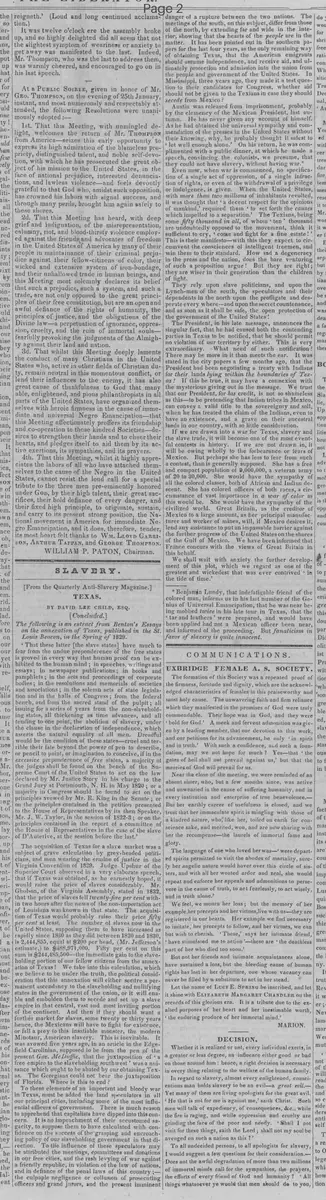
The following is an extract from Benton's Essays on the annexation of Texas, published in the St. Louis Beacon, in the Spring of 1829. That these latter [the slave states] have much to fear from the undue preponderance of the free states is proved in every way that human proof can be exhibited to the human mind; in speeches, writings and essays; in newspaper publications; in books and pamphlets; in the acts and proceedings of corporate bodies; in the resolutions and memorials of societies and associations; in the solemn acts of state legislation and in the halls of Congress; from the federal bench, and from the sacred stand of the pulpit; all issuing for a series of years from the non-slaveholding states, all thickening as time advances, and all tending to one point, the abolition of slavery, under the clause in the declaration of independence, which asserts the natural equality of all men. Dreadful would be the condition of these states—cruel and terrible their fate beyond the power of pen to describe, or pencil to paint, or imagination to conceive, if in the excessive preponderance of free states, a majority of the judges shall be found on the bench of the Supreme Court of the United States to act on the law declared by Mr. Justice Story in his charge to the Grand Jury at Portsmouth, N. H. in May 1820; or a majority in Congress should be found to act on the principles avowed by Mr. R. King in the Senate; or on the principles contained in the petition presented to the House of Representatives by its then Speaker, Mr. J. W. Taylor, in the session of 1822-3; or on the principles contained in the report of a committee of the House of Representatives in the case of the slave of D'Auterive, at the session before the last. The acquisition of Texas for a slave market was a subject of grave calculation by grey-headed politicians, and men wearing the ermine of justice in the Virginia Convention of 1829. Judge Upshur of the Superior Court observed in a very elaborate speech, that if Texas was obtained, as he earnestly hoped, it would raise the price of slaves considerably. Mr. Gholson, of the Virginia Assembly, stated in 1832, that the price of slaves fell twenty-five per cent within two hours after the news of the non-importation act of Louisiana was known in that state. The acquisition of Texas would probably raise their price fifty per cent at least. The number of slaves now in the United States, supposing them to have increased as rapidly since 1830 as they did between 1820 and 1830, is 2,444,855, equal at $200 per head, (Mr. Jefferson's estimate,) to $488,971,000. Fifty per cent on this sum is $244,485,500—the immediate gain to the slave-holding portion of our fellow citizens from the annexation of Texas! We take into this calculation, which we believe to be under the truth, the political consideration that this annexation will either secure a permanent ascendancy to the slaveholding and nullifying states in the government of the union, or it will enable and embolden them to secede and set up a slave empire in that central, vast and most inviting portion of the continent. And then if they should want a further market for slaves, some twenty or thirty years hence, the Mexicans will have to fight for existence, or fall a prey to this insatiable monster, the modern Minotaur, American slavery. This is inevitable. It was avowed five years ago, in an article in the Edge-field Carolinian, supposed to be from the pen of the present Gov. McDuffie, that the juxtaposition of 'a free empire to the slaveholding southwest' was a nuisance which ought to be abated by our obtaining Texas. The Georgians could not bear the juxtaposition of Florida. Where is this to end?
To these elements of an important and bloody war in Texas, must be added the land speculators in all our principal cities, including some of the most influential officers of government. There is much reason to apprehend that capitalists have dipped into this concern. It is no impeachment of their accustomed sagacity, to suppose them to have calculated with confidence on the success of the 'grasping and encroaching policy of our slaveholding government in that direction. To the influence of these speculators may be attributed the meetings, committees and donations in our free cities, and the rash levying of war against a friendly republic, in violation of the law of nations, and in defiance of the penal laws of this country; the culpable negligence or collusion of prosecuting officers and grand jurors, and the present imminent danger of a rupture between the two nations. The meetings of the south, on this subject, differ from those of the north, by extending far and wide in the interior, showing that the hearts of the people are in the matter. It has been pointed out in the southern papers for the last four years, as the only remaining way of obtaining Texas, that the American emigrants should assume independence, and receive aid, and ultimately protection and admission into the union from the people and government of the United States. In Mississippi, three years ago, they made it a test question to their candidates for Congress, whether aid should not be given to the Texians in case they should secede from Mexico? Austin was released from imprisonment, probably by the clemency of the Mexican President, last autumn. He has never given any account of himself. As he had obtained the universal sympathy and commendation of the presses in the United States without their knowing, why, he probably thought it safest to let well enough alone.' On his return, he was complimented with a public dinner, at which he made a speech, convincing the colonists, we presume, that they could not have slavery, without having war.* Even now, when war is commenced, no specification of a single act of oppression, of a single infraction of rights, or even of the withdrawal of a privilege or indulgence, is given. When the United States, with more than two millions of inhabitants revolted, it was thought that 'a decent respect for the opinions of mankind,' required them to set forth the causes which impelled to a separation.' The Texians, being some fifty thousand in all, of whom 'ten thousand are undoubtedly opposed to the movement, think it sufficient to cry, come and fight for a fine estate! This is their manifesto—with this they expect to circumvent the consciences of intelligent freemen, and win them to their standard. How sad a degeneracy in the press and the nation, does the bare venturing of such a proposition argue! But they are right; they are wiser in their generation than the children of light. They rely upon slave politicians, and upon the Lynch-men of the south, the speculators and their dependents in the north upon the profligate and desperate every where—and upon the secret countenance, and as soon as it shall be safe, the open protection of the government of the United States': The President, in his late message, announces the singular fact, that he had caused both the contending parties in Texas to be notified, that he should permit no violation of our territory by either. This is very extraordinary. What need of such notification? There may be more in it than meets the ear. It was stated in the city papers a few months ago, that the President had been negotiating a treaty with Indians for their lands lying within the boundaries of Texas! If this be true, it may have a connexion with the mysterious giving out in the message. We trust that our President, for his credit, is not so shameless as this—to be pretending that Indian tribes in Mexico, can convey a valid title to the sovereignty and soil, when he has treated the claim of the Indians, even to have an existence, and a grave on their ancestral lands in our country, with so little consideration. If we are drawn into a war for Texas, slavery and the slave trade, it will become one of the most eventful contests in history. If we are not drawn in, it will be owing wholly to the forbearance or fears of Mexico. But perhaps she has less to fear from such a contest, than is generally supposed. She has a free and compact population of 9,000,000, a veteran army of 20 to 30,000." She would have the sympathy of all the colored classes, both of African and Indian descent. She has colored officers of both races, a circumstance of vast importance in a war of color as this would be. She would have the sympathy of the civilized world. Great Britain, as the creditor of Mexico to a large amount, as her principal manufacturer and worker of mines, will, if Mexico desires it, lend any assistance to put an impassable barrier against the further progress of the United States on the shores of the Gulf of Mexico. We have been informed that France concurs with the views of Great Britain in this behalf.
We shall wait with anxiety the further development of this plot, which we regard as one of the greatest and wickedest that was ever contrived 'in the tide of time.
*Benjamin Lundy, that indefatigable friend of the colored man, informs us in his last number of the Genius of Universal Emancipation, that he was near being mobbed twice in his late tour in Texas, that the tar and feathers' were prepared, and would have been applied had not a Mexican officer been near, and informed of the proceeding. But fanaticism in favor of slavery is quite innocent.
[From the Quarterly Anti-Slavery Magazine.]
TEXAS.
BY DAVID LEE CHILD, ESQ
[Concluded.]
The following is an extract from Benton's Essays on the annexation of Texas, published in the St. Louis Beacon, in the Spring of 1829. That these latter [the slave states] have much to fear from the undue preponderance of the free states is proved in every way that human proof can be exhibited to the human mind; in speeches, writings and essays; in newspaper publications; in books and pamphlets; in the acts and proceedings of corporate bodies; in the resolutions and memorials of societies and associations; in the solemn acts of state legislation and in the halls of Congress; from the federal bench, and from the sacred stand of the pulpit; all issuing for a series of years from the non-slaveholding states, all thickening as time advances, and all tending to one point, the abolition of slavery, under the clause in the declaration of independence, which asserts the natural equality of all men. Dreadful would be the condition of these states—cruel and terrible their fate beyond the power of pen to describe, or pencil to paint, or imagination to conceive, if in the excessive preponderance of free states, a majority of the judges shall be found on the bench of the Supreme Court of the United States to act on the law declared by Mr. Justice Story in his charge to the Grand Jury at Portsmouth, N. H. in May 1820; or a majority in Congress should be found to act on the principles avowed by Mr. R. King in the Senate; or on the principles contained in the petition presented to the House of Representatives by its then Speaker, Mr. J. W. Taylor, in the session of 1822-3; or on the principles contained in the report of a committee of the House of Representatives in the case of the slave of D'Auterive, at the session before the last. The acquisition of Texas for a slave market was a subject of grave calculation by grey-headed politicians, and men wearing the ermine of justice in the Virginia Convention of 1829. Judge Upshur of the Superior Court observed in a very elaborate speech, that if Texas was obtained, as he earnestly hoped, it would raise the price of slaves considerably. Mr. Gholson, of the Virginia Assembly, stated in 1832, that the price of slaves fell twenty-five per cent within two hours after the news of the non-importation act of Louisiana was known in that state. The acquisition of Texas would probably raise their price fifty per cent at least. The number of slaves now in the United States, supposing them to have increased as rapidly since 1830 as they did between 1820 and 1830, is 2,444,855, equal at $200 per head, (Mr. Jefferson's estimate,) to $488,971,000. Fifty per cent on this sum is $244,485,500—the immediate gain to the slave-holding portion of our fellow citizens from the annexation of Texas! We take into this calculation, which we believe to be under the truth, the political consideration that this annexation will either secure a permanent ascendancy to the slaveholding and nullifying states in the government of the union, or it will enable and embolden them to secede and set up a slave empire in that central, vast and most inviting portion of the continent. And then if they should want a further market for slaves, some twenty or thirty years hence, the Mexicans will have to fight for existence, or fall a prey to this insatiable monster, the modern Minotaur, American slavery. This is inevitable. It was avowed five years ago, in an article in the Edge-field Carolinian, supposed to be from the pen of the present Gov. McDuffie, that the juxtaposition of 'a free empire to the slaveholding southwest' was a nuisance which ought to be abated by our obtaining Texas. The Georgians could not bear the juxtaposition of Florida. Where is this to end?
To these elements of an important and bloody war in Texas, must be added the land speculators in all our principal cities, including some of the most influential officers of government. There is much reason to apprehend that capitalists have dipped into this concern. It is no impeachment of their accustomed sagacity, to suppose them to have calculated with confidence on the success of the 'grasping and encroaching policy of our slaveholding government in that direction. To the influence of these speculators may be attributed the meetings, committees and donations in our free cities, and the rash levying of war against a friendly republic, in violation of the law of nations, and in defiance of the penal laws of this country; the culpable negligence or collusion of prosecuting officers and grand jurors, and the present imminent danger of a rupture between the two nations. The meetings of the south, on this subject, differ from those of the north, by extending far and wide in the interior, showing that the hearts of the people are in the matter. It has been pointed out in the southern papers for the last four years, as the only remaining way of obtaining Texas, that the American emigrants should assume independence, and receive aid, and ultimately protection and admission into the union from the people and government of the United States. In Mississippi, three years ago, they made it a test question to their candidates for Congress, whether aid should not be given to the Texians in case they should secede from Mexico? Austin was released from imprisonment, probably by the clemency of the Mexican President, last autumn. He has never given any account of himself. As he had obtained the universal sympathy and commendation of the presses in the United States without their knowing, why, he probably thought it safest to let well enough alone.' On his return, he was complimented with a public dinner, at which he made a speech, convincing the colonists, we presume, that they could not have slavery, without having war.* Even now, when war is commenced, no specification of a single act of oppression, of a single infraction of rights, or even of the withdrawal of a privilege or indulgence, is given. When the United States, with more than two millions of inhabitants revolted, it was thought that 'a decent respect for the opinions of mankind,' required them to set forth the causes which impelled to a separation.' The Texians, being some fifty thousand in all, of whom 'ten thousand are undoubtedly opposed to the movement, think it sufficient to cry, come and fight for a fine estate! This is their manifesto—with this they expect to circumvent the consciences of intelligent freemen, and win them to their standard. How sad a degeneracy in the press and the nation, does the bare venturing of such a proposition argue! But they are right; they are wiser in their generation than the children of light. They rely upon slave politicians, and upon the Lynch-men of the south, the speculators and their dependents in the north upon the profligate and desperate every where—and upon the secret countenance, and as soon as it shall be safe, the open protection of the government of the United States': The President, in his late message, announces the singular fact, that he had caused both the contending parties in Texas to be notified, that he should permit no violation of our territory by either. This is very extraordinary. What need of such notification? There may be more in it than meets the ear. It was stated in the city papers a few months ago, that the President had been negotiating a treaty with Indians for their lands lying within the boundaries of Texas! If this be true, it may have a connexion with the mysterious giving out in the message. We trust that our President, for his credit, is not so shameless as this—to be pretending that Indian tribes in Mexico, can convey a valid title to the sovereignty and soil, when he has treated the claim of the Indians, even to have an existence, and a grave on their ancestral lands in our country, with so little consideration. If we are drawn into a war for Texas, slavery and the slave trade, it will become one of the most eventful contests in history. If we are not drawn in, it will be owing wholly to the forbearance or fears of Mexico. But perhaps she has less to fear from such a contest, than is generally supposed. She has a free and compact population of 9,000,000, a veteran army of 20 to 30,000." She would have the sympathy of all the colored classes, both of African and Indian descent. She has colored officers of both races, a circumstance of vast importance in a war of color as this would be. She would have the sympathy of the civilized world. Great Britain, as the creditor of Mexico to a large amount, as her principal manufacturer and worker of mines, will, if Mexico desires it, lend any assistance to put an impassable barrier against the further progress of the United States on the shores of the Gulf of Mexico. We have been informed that France concurs with the views of Great Britain in this behalf.
We shall wait with anxiety the further development of this plot, which we regard as one of the greatest and wickedest that was ever contrived 'in the tide of time.
*Benjamin Lundy, that indefatigable friend of the colored man, informs us in his last number of the Genius of Universal Emancipation, that he was near being mobbed twice in his late tour in Texas, that the tar and feathers' were prepared, and would have been applied had not a Mexican officer been near, and informed of the proceeding. But fanaticism in favor of slavery is quite innocent.
What sub-type of article is it?
Slave Related
Politics
What keywords are associated?
Texas Annexation
Slavery Expansion
Slave Market
Anti Slavery
War With Mexico
Political Speculation
What entities or persons were involved?
David Lee Child
Benton
Mr. Justice Story
Mr. R. King
Mr. J. W. Taylor
Judge Upshur
Mr. Gholson
Mr. Jefferson
Gov. Mcduffie
Austin
Benjamin Lundy
Where did it happen?
Texas
Domestic News Details
Primary Location
Texas
Key Persons
David Lee Child
Benton
Mr. Justice Story
Mr. R. King
Mr. J. W. Taylor
Judge Upshur
Mr. Gholson
Mr. Jefferson
Gov. Mcduffie
Austin
Benjamin Lundy
Event Details
Anti-slavery critique of Texas annexation as a means to expand slavery, increase slave values, secure political power for slave states, and provoke war with Mexico, involving speculators, politicians, and emigrants.