Thank you for visiting SNEWPapers!
Sign up free
Literary
July 8, 1789
Gazette Of The United States
New York, New York County, New York
What is this article about?
Continuation of an essay analyzing the Roman constitution's change in 302, where decemvirs were elected with absolute power, abolishing other magistracies. It critiques this as a flawed simple government, highlighting how Appius Claudius gained undue influence despite initial equity.
Clipping
OCR Quality
98%
Excellent
Full Text
The RIGHT CONSTITUTION of a COMMON-WEALTH EXAMINED.
[Continued from No. XXIII.]
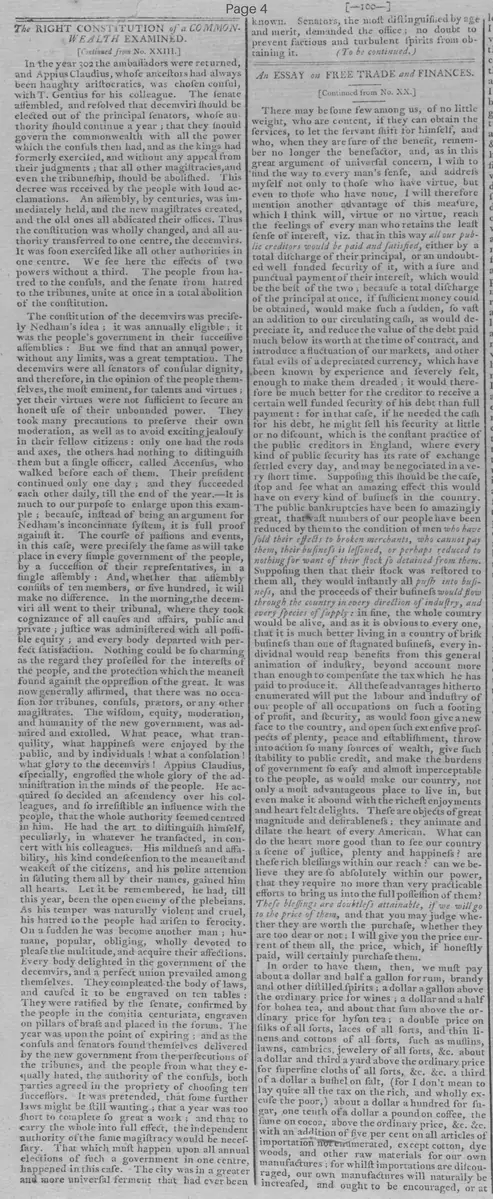
In the year 302 the ambassadors were returned, and Appius Claudius, whose ancestors had always been haughty aristocratics, was chosen consul, with T. Genucius for his colleague. The senate assembled, and resolved that decemviri should be elected out of the principal senators, whose authority should continue a year; that they should govern the commonwealth with all the power which the consuls then had, and as the kings had formerly exercised, and without any appeal from their judgments; that all other magistracies, and even the tribuneship, should be abolished. This decree was received by the people with loud acclamations. An assembly, by centuries, was immediately held, and the new magistrates created, and the old ones all abdicated their offices. Thus the constitution was wholly changed, and all authority transferred to one centre, the decemvirs.
It was soon exercised like all other authorities in one centre. We see here the effects of two powers without a third. The people from hatred to the consuls, and the senate from hatred to the tribunes, unite at once in a total abolition of the constitution.
The constitution of the decemvirs was precisely Nedham's idea; it was annually elective; it was the people's government in their successive assemblies: But we find that an annual power, without any limits, was a great temptation. The decemvirs were all senators of consular dignity, and therefore, in the opinion of the people themselves, the most eminent, for talents and virtues; yet their virtues were not sufficient to secure an honest use of their unbounded power. They took many precautions to preserve their own moderation, as well as to avoid exciting jealousy in their fellow citizens: only one had the rods and axes, the others had nothing to distinguish them but a single officer, called Accensus, who walked before each of them. Their president continued only one day; and they succeeded each other daily, till the end of the year. It is much to our purpose to enlarge upon this example; because, instead of being an argument for Nedham's inconcinnate system, it is full proof against it. The course of passions and events, in this case, were precisely the same as will take place in every simple government of the people, by a succession of their representatives, in a single assembly: And, whether that assembly consists of ten members, or five hundred, it will make no difference. In the morning, the decemviri all went to their tribunal, where they took cognizance of all causes and affairs, public and private; justice was administered with all possible equity; and every body departed with perfect satisfaction. Nothing could be so charming as the regard they professed for the interests of the people, and the protection which the meanest found against the oppression of the great. It was now generally affirmed, that there was no occasion for tribunes, consuls, praetors, or any other magistrates. The wisdom, equity, moderation, and humanity of the new government, was admired and extolled. What peace, what tranquility, what happiness were enjoyed by the public, and by individuals! what a consolation! what glory to the decemvirs! Appius Claudius, especially, engrossed the whole glory of the administration in the minds of the people. He acquired so decided an ascendency over his colleagues, and so irresistible an influence with the people, that the whole authority seemed centred in him. He had the art to distinguish himself, peculiarly, in whatever he transacted, in concert with his colleagues. His mildness and affability, his kind condescension to the meanest and weakest of the citizens, and his polite attention in saluting them all by their names, gained him all hearts. Let it be remembered, he had, till this year, been the open enemy of the plebeians. As his temper was naturally violent and cruel, his hatred to the people had arisen to ferocity. On a sudden he was become another man; humane, popular, obliging, wholly devoted to please the multitude, and acquire their affections. Every body delighted in the government of the decemvirs, and a perfect union prevailed amongst themselves. They completed the body of laws, and caused it to be engraved on ten tables: They were ratified by the senate, confirmed by the people in the comitia centuriata, engraven on pillars of brass and placed in the forum. The year was upon the point of expiring; and as the consuls and senators found themselves delivered by the new government from the persecutions of the tribunes, and the people from what they equally hated, the authority of the consuls, both parties agreed in the propriety of choosing ten successors. It was pretended, that some further laws might be still wanting; that a year was too short to complete so great a work; and that to carry the whole into full effect, the independent authority of the same magistracy would be necessary. That which must happen upon all annual elections of such a government in one centre, happened in this case. The city was in a greater and more universal ferment than had ever been known. Senators, then not distinguished by age and merit, demanded the office; no doubt to prevent factious and turbulent spirits from obtaining it.
(To be continued.)
[Continued from No. XXIII.]
In the year 302 the ambassadors were returned, and Appius Claudius, whose ancestors had always been haughty aristocratics, was chosen consul, with T. Genucius for his colleague. The senate assembled, and resolved that decemviri should be elected out of the principal senators, whose authority should continue a year; that they should govern the commonwealth with all the power which the consuls then had, and as the kings had formerly exercised, and without any appeal from their judgments; that all other magistracies, and even the tribuneship, should be abolished. This decree was received by the people with loud acclamations. An assembly, by centuries, was immediately held, and the new magistrates created, and the old ones all abdicated their offices. Thus the constitution was wholly changed, and all authority transferred to one centre, the decemvirs.
It was soon exercised like all other authorities in one centre. We see here the effects of two powers without a third. The people from hatred to the consuls, and the senate from hatred to the tribunes, unite at once in a total abolition of the constitution.
The constitution of the decemvirs was precisely Nedham's idea; it was annually elective; it was the people's government in their successive assemblies: But we find that an annual power, without any limits, was a great temptation. The decemvirs were all senators of consular dignity, and therefore, in the opinion of the people themselves, the most eminent, for talents and virtues; yet their virtues were not sufficient to secure an honest use of their unbounded power. They took many precautions to preserve their own moderation, as well as to avoid exciting jealousy in their fellow citizens: only one had the rods and axes, the others had nothing to distinguish them but a single officer, called Accensus, who walked before each of them. Their president continued only one day; and they succeeded each other daily, till the end of the year. It is much to our purpose to enlarge upon this example; because, instead of being an argument for Nedham's inconcinnate system, it is full proof against it. The course of passions and events, in this case, were precisely the same as will take place in every simple government of the people, by a succession of their representatives, in a single assembly: And, whether that assembly consists of ten members, or five hundred, it will make no difference. In the morning, the decemviri all went to their tribunal, where they took cognizance of all causes and affairs, public and private; justice was administered with all possible equity; and every body departed with perfect satisfaction. Nothing could be so charming as the regard they professed for the interests of the people, and the protection which the meanest found against the oppression of the great. It was now generally affirmed, that there was no occasion for tribunes, consuls, praetors, or any other magistrates. The wisdom, equity, moderation, and humanity of the new government, was admired and extolled. What peace, what tranquility, what happiness were enjoyed by the public, and by individuals! what a consolation! what glory to the decemvirs! Appius Claudius, especially, engrossed the whole glory of the administration in the minds of the people. He acquired so decided an ascendency over his colleagues, and so irresistible an influence with the people, that the whole authority seemed centred in him. He had the art to distinguish himself, peculiarly, in whatever he transacted, in concert with his colleagues. His mildness and affability, his kind condescension to the meanest and weakest of the citizens, and his polite attention in saluting them all by their names, gained him all hearts. Let it be remembered, he had, till this year, been the open enemy of the plebeians. As his temper was naturally violent and cruel, his hatred to the people had arisen to ferocity. On a sudden he was become another man; humane, popular, obliging, wholly devoted to please the multitude, and acquire their affections. Every body delighted in the government of the decemvirs, and a perfect union prevailed amongst themselves. They completed the body of laws, and caused it to be engraved on ten tables: They were ratified by the senate, confirmed by the people in the comitia centuriata, engraven on pillars of brass and placed in the forum. The year was upon the point of expiring; and as the consuls and senators found themselves delivered by the new government from the persecutions of the tribunes, and the people from what they equally hated, the authority of the consuls, both parties agreed in the propriety of choosing ten successors. It was pretended, that some further laws might be still wanting; that a year was too short to complete so great a work; and that to carry the whole into full effect, the independent authority of the same magistracy would be necessary. That which must happen upon all annual elections of such a government in one centre, happened in this case. The city was in a greater and more universal ferment than had ever been known. Senators, then not distinguished by age and merit, demanded the office; no doubt to prevent factious and turbulent spirits from obtaining it.
(To be continued.)
What sub-type of article is it?
Essay
What themes does it cover?
Political
Liberty Freedom
What keywords are associated?
Roman Constitution
Decemvirs
Appius Claudius
Political Power
Annual Election
Nedham's System
Literary Details
Title
The Right Constitution Of A Common Wealth Examined.
Key Lines
The Constitution Of The Decemvirs Was Precisely Nedham's Idea; It Was Annually Elective; It Was The People's Government In Their Successive Assemblies: But We Find That An Annual Power, Without Any Limits, Was A Great Temptation.
It Is Much To Our Purpose To Enlarge Upon This Example; Because, Instead Of Being An Argument For Nedham's Inconcinnate System, It Is Full Proof Against It.
Appius Claudius, Especially, Engrossed The Whole Glory Of The Administration In The Minds Of The People.