Thank you for visiting SNEWPapers!
Sign up free
Gazette Of The United States
New York, New York County, New York
What is this article about?
Detailed account of U.S. House of Representatives proceedings from May 5-8, 1789, covering debates on referring Virginia's amendments proposal, tonnage duties on foreign vessels affecting southern states, legislative bills, and presentation of a congratulatory address to President George Washington.
Merged-components note: Continuation across pages of the detailed report on congressional proceedings, including debates on tonnage and the address to President Washington.
Clippings
1 of 2
OCR Quality
Full Text
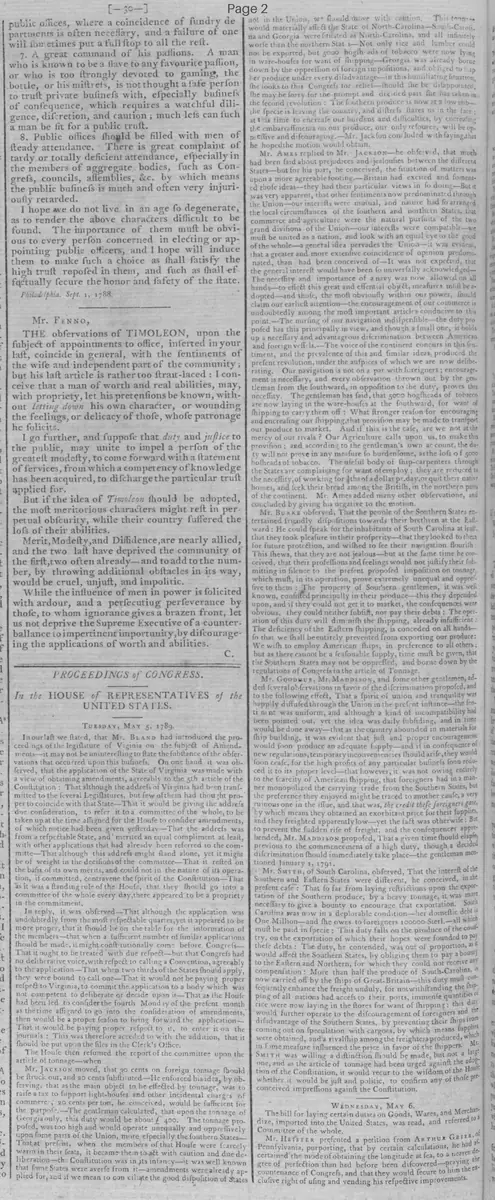
In the HOUSE of REPRESENTATIVES of the UNITED STATES.
TUESDAY, MAY 5, 1789.
In our last we stated, that Mr. Bland had introduced the proceedings of the legislature of Virginia on the subject of Amendments—it may not be uninteresting to state the substance of the observations that occurred upon this business. On one hand it was observed, that the application of the State of Virginia was made with a view of obtaining amendments, agreeably to the 5th article of the Constitution: That although the address of Virginia had been transmitted to the several Legislatures, but few of them had thought proper to coincide with that State—That it would be giving the address due consideration, to refer it to a committee of the whole, to be taken up at the time assigned for the House to consider amendments, of which notice had been given yesterday—That the address was from a respectable State, and merited an equal compliment at least, with other applications that had already been referred to the committee—That although this address might stand alone, yet it might be of weight in the decisions of the committee—That it rested on the basis of its own merits, and could not in the nature of its operation, if committed, contravene the spirit of the Constitution—That as it was a standing rule of the House, that they should go into a committee of the whole every day, there appeared to be a propriety in the commitment.
In reply, it was observed—That although the application was undoubtedly from the most respectable quarter, yet it appeared to be more proper, that it should lie on the table for the information of the members—that when a sufficient number of similar applications should be made, it might constitutionally come before Congress— That it ought to be treated with due respect—but that Congress had no deliberative voice, with respect to calling a Convention, agreeably to the application —That when two thirds of the States should apply, they were bound to call one—That it would not be paying proper respect to Virginia, to commit the application to a body which was not competent to deliberate or decide upon it—That as the House had been led to consider the fourth Monday of the present month as the time assigned to go into the consideration of amendments then would be a proper season to bring forward the application— That it would be paying proper respect to it, to enter it on the journals: This was therefore acceded to with the addition, that it should be put upon the files in the Clerk's Office.
The House then resumed the report of the committee upon the article of tonnage—when Mr. Jackson moved, that 30 cents on foreign tonnage should be struck out, and 20 cents substituted—He enforced his idea, by observing, that as the main object to be effected by tonnage, was to raise a tax to support light-houses and other incidental charges of commerce, 20 cents per ton, he conceived, would be sufficient for the purpose,—The gentleman calculated, that upon the tonnage of Georgia only, this duty would be about £400. The tonnage proposed, was too high and would operate unequally and oppressively upon some parts of the Union, more especially the southern States— That at present, when the members of that House were scarcely warm in their seats, it became them to act with caution and due deliberation—the Constitution was in its infancy—it was well known that some States were averse from it—amendments were already applied for, and if we mean to conciliate the good disposition of States not in the Union, we should move with caution. This ton would materially affect the State of North-Carolina—South-Carolina and Georgia were situated as North-Carolina, and all infinitely worse than the northern States—Not only rice and lumber could not be exported, but 5000 hogsheads of tobacco were now lying in ware-houses for want of shipping—Georgia was already borne down by the oppression of foreign impositions, and obliged to ship her produce under every disadvantage—in this humiliating situation, she looks to this Congress for relief—should she be disappointed, she may be sorry for the prompt and decided part she has taken in the second revolution: The southern produce is now at a low ebb— the specie is leaving the country, and distress stares us in the face; at this time to increase our burdens and difficulties, by increasing the embarrassments on our produce, our only resource, will be oppressive and discouraging.—Mr. Jackson concluded with saying, that he hoped the motion would obtain.
Mr. Ames replied to Mr. Jackson—he observed, that much had been said about prejudices and jealousies between the different States—but for his part, he conceived, the situation of matters was upon a more agreeable footing.—Britain had excited and fomented those ideas—they had their particular views in so doing—But it was very apparent, that other sentiments now predominated through the Union—our interests were mutual, and nature had so arranged the local circumstances of the southern and northern States, that commerce and agriculture were the natural pursuits of the two grand divisions of the Union—our interests were compatible—we must be united as a nation, and look with an equal eye to the good of the whole—a general idea pervades the Union—it was evident, that a greater and more extensive coincidence of opinion predominated, than had been conceived of—It was not expected, that the general interest would have been so universally acknowledged— The necessity and importance of a navy was now allowed on all hands—to effect this great and essential object, measures must be adopted—and those, the most obviously within our power, should claim our earliest attention— the encouragement of our commerce is undoubtedly among the most important articles conducive to this point.—The nursing of our navigation indispensable—the duty proposed has this principally in view, and though a small one, it holds up a necessary and advantageous discrimination between American and foreign vessels.—The voice of the continent concurs in this sentiment, and the prevalence of this and similar ideas, produced the present revolution, under the auspices of which we are now deliberating. Our navigation is not on a par with foreigners; encouragement is necessary, and every observation thrown out by the gentleman from the southward, in opposition to the duty, proves this necessity. The gentleman has said, that 5000 hogsheads of tobacco are now laying in the ware-houses at the southward, for want of shipping to carry them off: What stronger reason for encouraging and increasing our shipping, that provision may be made to transport our produce to market. And if this is the case, are we not at the mercy of our rivals? Our Agriculture calls upon us, to make this provision; and according to the gentleman's own account, the duty will not prove in any measure so burdensome, as the loss of 2000 hogsheads of tobacco. The useful body of ship-carpenters through the States are complaining for want of employ; they are reduced to the necessity of working for the half of a dollar per day, or quit their native homes, and seek their bread among the British, in the northern parts of the continent. Mr. Ames added many other observations, and concluded by giving his negative to the motion.
Mr. Burke observed, That the people of the Southern States entertained friendly dispositions towards their brethren at the Eastward: He could speak for the inhabitants of South Carolina at least. that they took pleasure in their prosperity—that they looked to them for future protection, and wished to see their navigation flourish This shews, that they are not jealous—but at the same time he conceived, that their professions and feelings would not justify their submitting in silence to the present proposed imposition on tonnage which must, in its operation, prove extremely unequal and oppressive to them: The property of Southern gentlemen, it was well known, consisted principally in their produce—this they depended upon, and if they could not get it to market, the consequences were obvious, they could neither subsist, nor pay their debts: The operation of this duty will diminish the shipping, already insufficient: The deficiency of the Eastern shipping, is conceded on all hands— so that we shall be entirely prevented from exporting our produce: We wish to employ American ships, in preference to all others; but as there cannot be a seasonable supply, time must be given, that the Southern States may not be oppressed, and borne down by the regulations of Congress in the article of Tonnage.
Mr. Goodhue, Mr. Madison, and some other gentlemen, added several observations in favor of the discrimination proposed, and to the following effect, That a spirit of union and tranquility was happily diffused through the Union in the present instance—the continent was uniform, and although a kind of incompatibility had been pointed out, yet the idea was daily subsiding, and in time would be done away—that as the country abounded in materials for ship building, it was evident that just and proper encouragement would soon produce an adequate supply—and if in consequence of new regulations, temporary inconveniencies should arise, they would soon cease, for the high profits of any particular business soon reduced it to its proper level—that however, it was not owing entirely to the scarcity of American shipping, that foreigners had in a manner monopolized the carrying trade from the Southern States, but the preference they enjoyed might be traced to another cause, a very ruinous one in the issue, and that was, the credit these foreigners gave, by which means they obtained an exorbitant price for their supplies, and they freighted apparently low—yet the fact was otherwise: But to prevent the sudden rise of freight, and the consequences apprehended, Mr. Madison proposed, That a given time should elapse, previous to the commencement of a high duty, though a decided discrimination should immediately take place—the gentleman mentioned January 1, 1791.
Mr. Smith, of South Carolina, observed, That the interest of the Southern and Eastern States were different, he conceived, in the present case: That so far from laying restrictions upon the exportation of the Southern produce by heavy tonnage it was more necessary to give a bounty to encourage that exportation. South Carolina was now in deplorable condition— her domestic debt is One Million—and she owes to foreigners 100000 Sterling—all which must be paid in specie: This duty falls on the produce of the country, on the exportation of which their hopes were founded to pay these debts The duty he contended was out of proportion as would affect the Southern States, by obliging them to pay a bounty to the Eastern and Northern, for which they could not receive any compensation: More than half the produce of South-Carolina, is now carried off by the ships of Great-Britain—this duty must consequently enhance the freight unduly, for notwithstanding the ships were now laying in the stores for want of shipping this duty would further operate to the discouragement of foreigners and the coming out on speculation with cargoes, by which means supplies disadvantage of the Southern States by preventing their ships from SmiTH was willing a distinction should be made, but not a large one meafure influenced the price in favor of the shippers. Mr. obtained and rivalfhip among the freighters produced which tio of the Constitution, it would recur to the widom of the Houe one and as the article of tonnage had been urged against the adop- whether it would be just and politic, to confirm any of thoe pre- conceived imprefions againft the Conftitution.
The bill for laying certain duties on Goods, Wares, and Merchandize, imported into the United States, was read, and referred to
Wednesday, May 6.
Committee of the whole.
ey lvan purga a ul
Mr. Hass reR presented a petition from Arthur Grier, of gree of perfection than had before been discovered—praying the of Congres and that they would ecure to him the ex- clusive right of using and vending his respective improvements.
and the amendments adopted by the House of the Senate respecting the manner of making certain oaths, was read.
On motion of Mr. Sherman, the bill, with amendments from the Senate
Mr. Lawrence introduced the application of the Legislature of New-York, on 5th February last, sitting a convention to confirm
The original petition placed on the Files in the Clerk's office.
from Virginia, being entered on journals, and the
Amendments which being read was
After some debate, the report of the Committee on laying cents per ton on
The House resumed the subject of Tonnage, and after some further
adopted.
The House then adjourned.
with whom treaties had been formed was
Thursday, May 7.
Mr. Smith, of South Carolina, from the Committee appointed to wait on the President and when it would be convenient for him
reported [that they] waited on the President. and that he had
Hou portThat the ha
Ho t p.
to the President on Friday, in the room adjoining the Representatives'
The House then resolved, that they would present their Address
Chamber.
with the Senate, in the mode of presenting bill, resolutions,
On motion of Mr. Bland, a Committee was appointed to confer
and addresses to the President
The House then resumed the subject of Tonnage.
A motion was made by Mr. Madison, to reduce the tonnage on
cents pr. ton, till the 1st of January, 1790, and then to be raised to
foreign ships not in alliance with the United States from 50 to 40
75 cents.
out the 50, in order to make way for Mr. Madison's motion, it
This motion produced some debate; and on the question to strike
was negatived—25 to 20.
A clause was then added to the report, which is intended to prevent any vessels from trading coastwise, except those which are
wholly owned by citizens of the United States.
The report as amended was then agreed to by the House—and a
committee was appointed to bring in a bill.
Adjourned.
FRIDAY, May 8.
Upon the report of a Committee in favor of appointing a Sergeant
at Arms, and nominations being called for, Mr. Ames and Mr.
Thacher made some observations in opposition to the measure—
contending, that the officer was super-numerary, and the post a mere
sinecure.
Mr. Gerry, from the Committee appointed to prepare a bill
prescribing the mode of collecting the Revenue, introduced a tem-
porary law, which was read, and a hundred copies ordered to be
printed for the House.
Mr. Smith, of South Carolina, at this moment came in, and inform-
ed the House, that The President was ready to receive their address.
The House immediately arose, and following the Speaker, attended
The President in the room adjoining, where the following Address
was presented by the Speaker, in the name of the House.
The ADDRESS
Of the HOUSE of REPRESENTATIVES, to GEORGE
WASHINGTON, PRESIDENT of the UNITED
STATES.
SIR,
The representatives of the people of the United
States, present their congratulations on the
event by which your fellow-citizens have attested
the pre-eminence of your merit. You have long
held the first place in their esteem—you have of-
ten received tokens of their affection—you now
possess the only proof that remained of their gra-
titude for your services, of their reverence for
your wisdom, and of their confidence in
your
virtues. You enjoy the highest, because, the
truest honor, of being the first magistrate, by the
unanimous choice of the freest people on the face of
the earth.
We well know the anxieties with which you
must have obeyed a summons, from the repose re-
served for your declining years, into public scenes,
of which you had taken your leave forever—But
the obedience was due to the occasion. It is al-
ready applauded by the universal joy, which
welcomes you to your station, and we cannot
doubt that it will be rewarded with all the satis-
faction, with which an ardent love for your fel-
low-citizens must review successful efforts to pro-
mote their happiness.
This anticipation is not justified merely by the
past experience of your signal services. it is par-
ticularly suggested by the pious impressions under
which you commence your administration, and
the enlightened maxims by which you mean to
conduct it. We feel with you the strongest obli-
gations to adore the invisible hand which has led
the American people through so many difficulties,
to cherish a conscious responsibility for the destiny
of republican liberty, and to seek the only sure
means of preserving and recommending the pre-
cious deposit in a system of legislation, founded
on the principles of an honest policy, and direct-
ed by the spirit of a diffusive patriotism.
The question arising out of the fifth article of
the constitution, will receive all the attention de-
manded by its importance, and will, we trust, be
decided under the influence of all the considerati-
ons to which you allude.
In forming the pecuniary provisions for the ex-
ecutive department, we shall not lose sight of a
wish resulting from motives which give it a pecu-
liar claim to our regard.—Your resolution in a
moment critical to the liberties of your country,
to renounce all personal emolument, was among
the many presages of your patriotic services,
which have been amply fulfilled, and your cru-
pulous adherence now to the law then imposed on
yourself, cannot fail to demonstrate the purity,
whilst it increases the lustre of a character, which
has so many titles to admiration.
Such are the sentiments which we have thought
fit to address to you : They flow from our own
hearts, and we verily believe, that among the mil-
lions we represent, there is not a virtuous citizen
whose heart will disown them.
All that remains is, that we join in your fervent
application for the blessings of Heaven on our
country; and that we add our own for the choicest
of those blessings on the most beloved of her citi-
zens.
To which THE PRESIDENT made the following
REPLY.
GENTLEMEN,
YOUR very affectionate Address, produces emo-
tions, which I know not how to express : I feel that
my past endeavors in the service of my country,
are far overpaid by its goodness ; and I fear much
that my future ones may not fulfil your kind anti-
cipation.
All that I can promise is, that they
will be invariably directed by an honest, and an
ardent zeal. Of this resource my heart assures
me.
For all beyond, I rely on the wisdom and
patriotism of those with whom I am to co-operate,
and a continuance of the blessings of Heaven on
our beloved country.
G. WASHINGTON.
After this, The President retiring, the Mem-
bers of the House returned to their seats.
A motion which was laid on the table the 4th
inst. respecting a request to the President, that he
would procure an estimate of exports and imports,
entries and clearances from the several States in the
Union, for twelve months previous to the fourth
of March last, was taken up, and after sundry a-
mendments, one of which was, appointing a Com-
mittee to attend to the business, the motion was
adopted.
After this, the appointment of a Sergeant at
Arms was taken into consideration again—and a
vote for assigning a time to come to a choice ob-
tained—Tuesday next being appointed.
The Order of the day was then called for, and
the House went into a Committee of the whole,
when the second reading of the Bill, ascertaining
the rates of Impost, was attended to.
Dr. Tucker proposed, That the duty on distil-
led spirits, Jamaica proof, should be reduced to 6
cents, pr. gallon—this brought on a debate which
lasted till the House adjourned.
What sub-type of article is it?
What keywords are associated?
What entities or persons were involved?
Where did it happen?
Domestic News Details
Primary Location
United States House Of Representatives
Event Date
May 5 8, 1789
Key Persons
Outcome
debates on tonnage duties resulted in amendments reducing rates on foreign ships and adding clauses for coastwise trade; virginia's amendments proposal entered on journals; address presented to president washington with his reply; various bills referred and motions adopted.
Event Details
The House debated referring Virginia's proposal for constitutional amendments, deciding to enter it on journals. Extensive discussion on tonnage duties, with southern representatives arguing for lower rates due to economic impacts on exports like tobacco and rice, while northern members advocated for discrimination to encourage American shipping. Motions to reduce duties were debated, with Madison proposing phased implementation. On May 8, the House presented a congratulatory address to President Washington, who replied expressing commitment to honest service. Other business included petitions, bills on imports and revenue, and appointments.