Thank you for visiting SNEWPapers!
Sign up free
The Cordova Daily Times
Cordova, Alaska
What is this article about?
Washington, Feb. 27: USDA officials urge boosting dollar value and farm markets for relief, blaming under-consumption not over-production for surpluses. Dr. F. D. Ball notes historical production peaks and predicts future imports as population grows.
Clipping
OCR Quality
Full Text
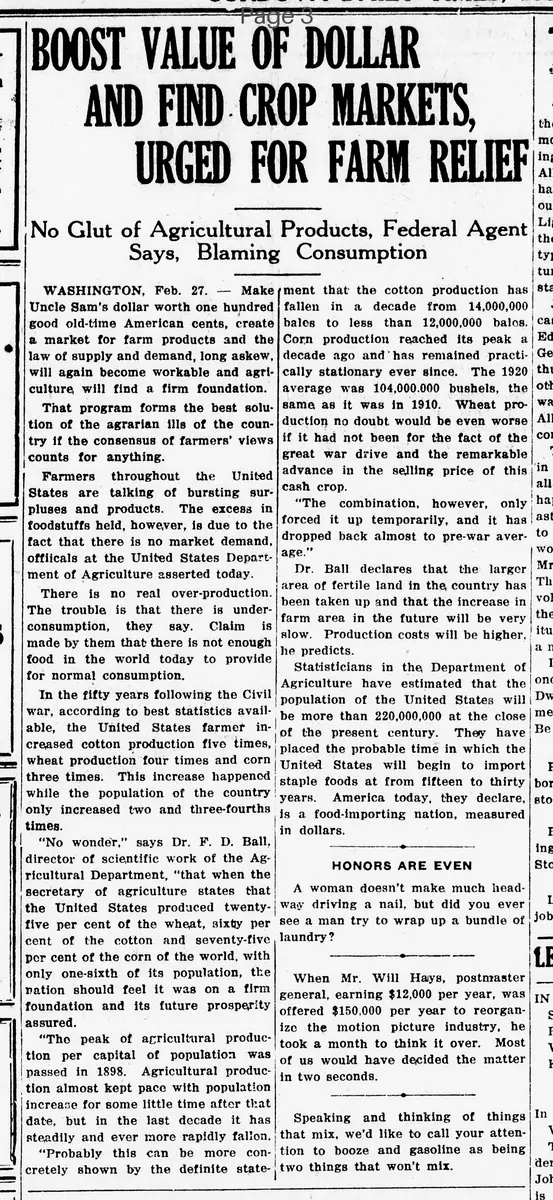
No Glut of Agricultural Products, Federal Agent Says, Blaming Consumption
WASHINGTON, Feb. 27.
Make Uncle Sam's dollar worth one hundred good old-time American cents, create a market for farm products and the law of supply and demand, long askew, will again become workable and agriculture will find a firm foundation.
That program forms the best solution of the agrarian ills of the country if the consensus of farmers' views counts for anything.
Farmers throughout the United States are talking of bursting surpluses and products.
The excess in foodstuffs held, however, is due to the fact that there is no market demand, officials at the United States Department of Agriculture asserted today.
There is no real over-production.
The trouble is that there is under-consumption, they say.
Claim is made by them that there is not enough food in the world today to provide for normal consumption.
In the fifty years following the Civil war, according to best statistics available, the United States farmer increased cotton production five times, wheat production four times and corn three times.
This increase happened while the population of the country only increased two and three-fourths times.
"No wonder," says Dr. F. D. Ball, director of scientific work of the Agricultural Department, "that when the secretary of agriculture states that the United States produced twenty five per cent of the wheat, sixty per cent of the cotton and seventy-five per cent of the corn of the world, with only one-sixth of its population, the nation should feel it was on a firm foundation and its future prosperity assured.
The peak of agricultural production per capital of population was passed in 1898.
Agricultural production almost kept pace with population increase for some little time after that date, but in the last decade it has steadily and ever more rapidly fallen.
"Probably this can be more concretely shown by the definite statement that the cotton production has fallen in a decade from 14,000,000 bales to less than 12,000,000 bales.
Corn production reached its peak a decade ago and has remained practically stationary ever since.
The 1920 average was 10,000,000 bushels, the same as it was in 1910.
Wheat production no doubt would be even worse if it had not been for the fact of the great war drive and the remarkable advance in the selling price of this cash crop.
"The combination, however, only forced it up temporarily, and it has dropped back almost to pre-war average.
Dr. Ball declares that the larger area of fertile land in the country has been taken up and that the increase in farm area in the future will be very slow.
Production costs will be higher, he predicts.
Statisticians in the Department of Agriculture have estimated that the population of the United States will be more than 220,000,000 at the close of the present century.
They have placed the probable time in which the United States will begin to import staple foods at from fifteen to thirty years.
America today, they declare, is a food-importing nation, measured in dollars.
What sub-type of article is it?
What keywords are associated?
What entities or persons were involved?
Where did it happen?
Domestic News Details
Primary Location
Washington
Event Date
Feb. 27
Key Persons
Event Details
Officials at the United States Department of Agriculture assert there is no real over-production of agricultural products but under-consumption due to lack of market demand. Dr. F. D. Ball discusses historical increases in cotton, wheat, and corn production post-Civil War, peaking per capita in 1898, and recent declines. Future predictions include higher production costs, slow farm area increase, population growth to over 220,000,000 by century's end, and the US becoming a food-importing nation in 15-30 years.