Thank you for visiting SNEWPapers!
Sign up free
Letter to Editor
February 4, 1921
Ladysmith News Budget
Ladysmith, Rusk County, Wisconsin
What is this article about?
Fred Brown writes to the Editor of News-Budget criticizing high taxes in Glen Flora, Wis., caused by excessive town officials and unnecessary divisions of towns like True, Lawrence, and Hawkins eight years prior. He praises past honest leadership by D. W. Maloney and questions wasteful purchases like tractors, advocating for fewer officers.
Clipping
OCR Quality
98%
Excellent
Full Text
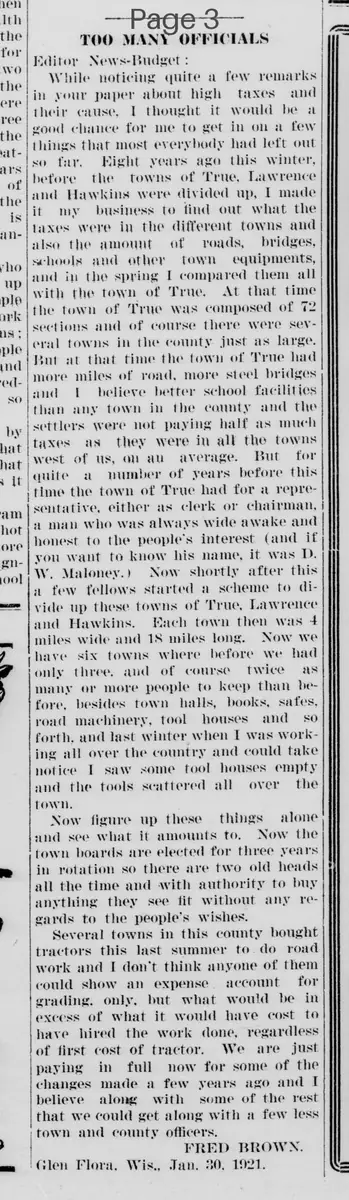
TOO MANY OFFICIALS
Editor News-Budget:
While noticing quite a few remarks in your paper about high taxes and their cause, I thought it would be a good chance for me to get in on a few things that most everybody had left out so far. Eight years ago this winter, before the towns of True, Lawrence and Hawkins were divided up, I made it my business to find out what the taxes were in the different towns and also the amount of roads, bridges, schools and other town equipments, and in the spring I compared them all with the town of True. At that time the town of True was composed of 72 sections and of course there were several towns in the county just as large.
But at that time the town of True had more miles of road, more steel bridges and I believe better school facilities than any town in the county and the settlers were not paying half as much taxes as they were in all the towns west of us, on an average. But for quite a number of years before this time the town of True had for a representative, either as clerk or chairman, a man who was always wide awake and honest to the people's interest (and if you want to know his name, it was D. W. Maloney.) Now shortly after this a few fellows started a scheme to divide up these towns of True, Lawrence and Hawkins. Each town then was 4 miles wide and 18 miles long. Now we have six towns where before we had only three, and of course twice as many or more people to keep than before, besides town halls, books, safes, road machinery, tool houses and so forth, and last winter when I was working all over the country and could take notice I saw some tool houses empty and the tools scattered all over the town.
Now figure up these things alone and see what it amounts to. Now the town boards are elected for three years in rotation so there are two old heads all the time and with authority to buy anything they see fit without any regards to the people's wishes.
Several towns in this county bought tractors this last summer to do road work and I don't think anyone of them could show an expense account for grading, only, but what would be in excess of what it would have cost to have hired the work done, regardless of first cost of tractor. We are just paying in full now for some of the changes made a few years ago and I believe along with some of the rest that we could get along with a few less town and county officers.
FRED BROWN.
Glen Flora, Wis., Jan. 30, 1921.
Editor News-Budget:
While noticing quite a few remarks in your paper about high taxes and their cause, I thought it would be a good chance for me to get in on a few things that most everybody had left out so far. Eight years ago this winter, before the towns of True, Lawrence and Hawkins were divided up, I made it my business to find out what the taxes were in the different towns and also the amount of roads, bridges, schools and other town equipments, and in the spring I compared them all with the town of True. At that time the town of True was composed of 72 sections and of course there were several towns in the county just as large.
But at that time the town of True had more miles of road, more steel bridges and I believe better school facilities than any town in the county and the settlers were not paying half as much taxes as they were in all the towns west of us, on an average. But for quite a number of years before this time the town of True had for a representative, either as clerk or chairman, a man who was always wide awake and honest to the people's interest (and if you want to know his name, it was D. W. Maloney.) Now shortly after this a few fellows started a scheme to divide up these towns of True, Lawrence and Hawkins. Each town then was 4 miles wide and 18 miles long. Now we have six towns where before we had only three, and of course twice as many or more people to keep than before, besides town halls, books, safes, road machinery, tool houses and so forth, and last winter when I was working all over the country and could take notice I saw some tool houses empty and the tools scattered all over the town.
Now figure up these things alone and see what it amounts to. Now the town boards are elected for three years in rotation so there are two old heads all the time and with authority to buy anything they see fit without any regards to the people's wishes.
Several towns in this county bought tractors this last summer to do road work and I don't think anyone of them could show an expense account for grading, only, but what would be in excess of what it would have cost to have hired the work done, regardless of first cost of tractor. We are just paying in full now for some of the changes made a few years ago and I believe along with some of the rest that we could get along with a few less town and county officers.
FRED BROWN.
Glen Flora, Wis., Jan. 30, 1921.
What sub-type of article is it?
Persuasive
Informative
Political
What themes does it cover?
Taxation
Economic Policy
Politics
What keywords are associated?
High Taxes
Town Division
Excessive Officials
Government Waste
Local Governance
Tractor Purchases
What entities or persons were involved?
Fred Brown
Editor News Budget
Letter to Editor Details
Author
Fred Brown
Recipient
Editor News Budget
Main Argument
high taxes result from unnecessary division of towns into more units, leading to excessive officials, duplicated expenses, and wasteful purchases like tractors; fewer town and county officers are needed.
Notable Details
Praises D. W. Maloney As Honest Leader
Towns Divided From 3 To 6
Criticizes Town Board Authority
Mentions Tractor Purchases Exceeding Hired Work Costs