Thank you for visiting SNEWPapers!
Sign up free
Literary
August 3, 1841
Southport Telegraph
Kenosha, Southport, Kenosha County, Wisconsin
What is this article about?
John Lloyd Stephens, in an excerpt from his new work, discusses the extent of Palenque ruins, debunking exaggerated claims of their size. He describes the dense forest cover, challenges faced by previous explorers like Del Rio and Dupaix, and obstacles during his own expedition including rainy season, lack of tools, and Indian labor shortages during planting time.
Clipping
OCR Quality
95%
Excellent
Full Text
From Mr. Stephens' New Work.
EXTENT OF THE RUINS OF PALENQUE.
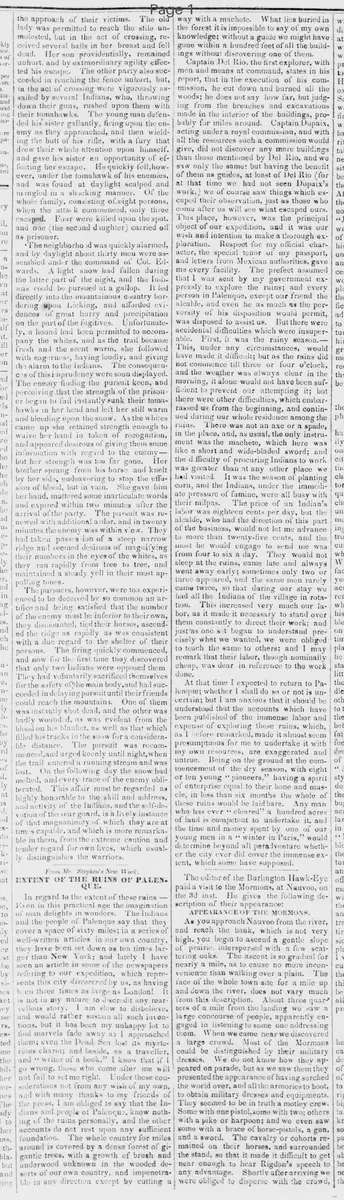
In regard to the extent of these ruins--Even in this practical age the imagination of man delights in wonders. The Indians and the people of Palenque say that they cover a space of sixty miles; in a series of well-written articles in our own country, they have been set down as ten times larger than New York; and lately I have seen an article in some of the newspapers referring to our expedition, which represents this city discovered by us, as having been three times as large as London! It is not in my nature to discredit any marvellous story. I am slow to disbelieve, and would rather sustain all such inventions, but it has been my unhappy lot to find marvels fade away as I approached them; even the Dead Sea lost its mysterious character; and besides, as a traveller and "writer of a book," I know that if I go wrong, those who come after me will not fail to set me right. Under these considerations not from any wish of my own, and with many thanks to my friends of the press, I am obliged to say that the Indians and people of Palenque, know nothing of the ruins personally, and the other accounts do not rest upon any sufficient foundation. The whole country for miles around is covered by a dense forest of gigantic trees, with a growth of brush and underwood unknown in the wooded deserts of our own country, and impenetrable in any direction except by cutting a way with a machete. What lies buried in the forest it is impossible to say of my own knowledge; without a guide we might have gone within a hundred feet of all the buildings without discovering one of them.
Captain Del Rio, the first explorer, with men and means at command, states in his report, that in the execution of his commission, he cut down and burned all the woods; he does not say how far, but judging from the breaches and excavations made in the interior of the buildings, probably for miles around. Captain Dupaix, acting under a royal commission, and with all the resources such a commission would give, did not discover any more buildings than those mentioned by Del Rio, and we saw only the same: but having the benefit of them as guides, at least of Del Rio (for at that time we had not seen Dupaix's work,) we of course saw things which escaped their observation, just as those who come after us will see what escaped ours.
This place, however, was the principal object of our expedition, and it was our wish and intention to make a thorough exploration. Respect for my official character, the special tenor of my passport, and letters from Mexican authorities, gave me every facility. The prefect assumed that I was sent by my government expressly to explore the ruins; and every person in Palenque, except our friend the alcalde, and even he as much as the perversity of his disposition would permit, was disposed to assist us. But there were accidental difficulties which were insuperable. First, it was the rainy season. This, under any circumstances, would have made it difficult; but as the rains did not commence till three or four o'clock, and the weather was always clear in the morning, it alone would not have been sufficient to prevent our attempting it; but there were other difficulties, which embarrassed us from the beginning, and continued during our whole residence among the ruins. There was not an axe or a spade, in the place, and, as usual, the only instrument was the machete, which here was like a short and wide-bladed sword; and the difficulty of procuring Indians to work was greater than at any other place we had visited. It was the season of planting corn, and the Indians, under the immediate pressure of famine, were all busy with their milpas. The price of an Indian's labor was eighteen cents per day, but the alcalde, who had the direction of this part of the business, would not let me advance to more than twenty-five cents, and the most he would engage to send me was from four to six a day. They would not sleep at the ruins, came late and always went away early; sometimes only two or three appeared, and the same men rarely came twice, so that during our stay we had all the Indians of the village in rotation. This increased very much our labor, as it made it necessary to stand over them constantly to direct their work; and just as one set began to understand precisely what we wanted, we were obliged to teach the same to others; and I may remark that their labor, though nominally cheap, was dear in reference to the work done.
At that time I expected to return to Palenque; whether I shall do so or not is uncertain; but I am anxious that it should be understood that the accounts which have been published of the immense labor and expense of exploring these ruins, which, as I before remarked, made it almost seem presumptuous for me to undertake it with my own resources, are exaggerated and untrue. Being on the ground at the commencement of the dry season, with eight or ten young "pioneers," having a spirit of enterprise equal to their bone and muscle, in less than six months the whole of these ruins would be laid bare. Any man who has ever "cleared" a hundred acres of land is competent to undertake it, and the time and money spent by one of our young men in a "winter in Paris," would determine beyond all peradventure whether the city ever did cover the immense extent, which some have supposed.
EXTENT OF THE RUINS OF PALENQUE.
In regard to the extent of these ruins--Even in this practical age the imagination of man delights in wonders. The Indians and the people of Palenque say that they cover a space of sixty miles; in a series of well-written articles in our own country, they have been set down as ten times larger than New York; and lately I have seen an article in some of the newspapers referring to our expedition, which represents this city discovered by us, as having been three times as large as London! It is not in my nature to discredit any marvellous story. I am slow to disbelieve, and would rather sustain all such inventions, but it has been my unhappy lot to find marvels fade away as I approached them; even the Dead Sea lost its mysterious character; and besides, as a traveller and "writer of a book," I know that if I go wrong, those who come after me will not fail to set me right. Under these considerations not from any wish of my own, and with many thanks to my friends of the press, I am obliged to say that the Indians and people of Palenque, know nothing of the ruins personally, and the other accounts do not rest upon any sufficient foundation. The whole country for miles around is covered by a dense forest of gigantic trees, with a growth of brush and underwood unknown in the wooded deserts of our own country, and impenetrable in any direction except by cutting a way with a machete. What lies buried in the forest it is impossible to say of my own knowledge; without a guide we might have gone within a hundred feet of all the buildings without discovering one of them.
Captain Del Rio, the first explorer, with men and means at command, states in his report, that in the execution of his commission, he cut down and burned all the woods; he does not say how far, but judging from the breaches and excavations made in the interior of the buildings, probably for miles around. Captain Dupaix, acting under a royal commission, and with all the resources such a commission would give, did not discover any more buildings than those mentioned by Del Rio, and we saw only the same: but having the benefit of them as guides, at least of Del Rio (for at that time we had not seen Dupaix's work,) we of course saw things which escaped their observation, just as those who come after us will see what escaped ours.
This place, however, was the principal object of our expedition, and it was our wish and intention to make a thorough exploration. Respect for my official character, the special tenor of my passport, and letters from Mexican authorities, gave me every facility. The prefect assumed that I was sent by my government expressly to explore the ruins; and every person in Palenque, except our friend the alcalde, and even he as much as the perversity of his disposition would permit, was disposed to assist us. But there were accidental difficulties which were insuperable. First, it was the rainy season. This, under any circumstances, would have made it difficult; but as the rains did not commence till three or four o'clock, and the weather was always clear in the morning, it alone would not have been sufficient to prevent our attempting it; but there were other difficulties, which embarrassed us from the beginning, and continued during our whole residence among the ruins. There was not an axe or a spade, in the place, and, as usual, the only instrument was the machete, which here was like a short and wide-bladed sword; and the difficulty of procuring Indians to work was greater than at any other place we had visited. It was the season of planting corn, and the Indians, under the immediate pressure of famine, were all busy with their milpas. The price of an Indian's labor was eighteen cents per day, but the alcalde, who had the direction of this part of the business, would not let me advance to more than twenty-five cents, and the most he would engage to send me was from four to six a day. They would not sleep at the ruins, came late and always went away early; sometimes only two or three appeared, and the same men rarely came twice, so that during our stay we had all the Indians of the village in rotation. This increased very much our labor, as it made it necessary to stand over them constantly to direct their work; and just as one set began to understand precisely what we wanted, we were obliged to teach the same to others; and I may remark that their labor, though nominally cheap, was dear in reference to the work done.
At that time I expected to return to Palenque; whether I shall do so or not is uncertain; but I am anxious that it should be understood that the accounts which have been published of the immense labor and expense of exploring these ruins, which, as I before remarked, made it almost seem presumptuous for me to undertake it with my own resources, are exaggerated and untrue. Being on the ground at the commencement of the dry season, with eight or ten young "pioneers," having a spirit of enterprise equal to their bone and muscle, in less than six months the whole of these ruins would be laid bare. Any man who has ever "cleared" a hundred acres of land is competent to undertake it, and the time and money spent by one of our young men in a "winter in Paris," would determine beyond all peradventure whether the city ever did cover the immense extent, which some have supposed.
What sub-type of article is it?
Essay
Journey Narrative
What keywords are associated?
Palenque Ruins
Stephens Expedition
Del Rio
Dupaix
Dense Forest
Indian Labor
Machete
Rainy Season
Archaeological Exploration
What entities or persons were involved?
From Mr. Stephens' New Work.
Literary Details
Title
Extent Of The Ruins Of Palenque.
Author
From Mr. Stephens' New Work.
Subject
Extent And Exploration Of Palenque Ruins
Form / Style
Prose Travel Narrative Debunking Exaggerations
Key Lines
The Indians And The People Of Palenque Say That They Cover A Space Of Sixty Miles; In A Series Of Well Written Articles In Our Own Country, They Have Been Set Down As Ten Times Larger Than New York; And Lately I Have Seen An Article In Some Of The Newspapers Referring To Our Expedition, Which Represents This City Discovered By Us, As Having Been Three Times As Large As London!
The Whole Country For Miles Around Is Covered By A Dense Forest Of Gigantic Trees, With A Growth Of Brush And Underwood Unknown In The Wooded Deserts Of Our Own Country, And Impenetrable In Any Direction Except By Cutting A Way With A Machete.
Being On The Ground At The Commencement Of The Dry Season, With Eight Or Ten Young "Pioneers," Having A Spirit Of Enterprise Equal To Their Bone And Muscle, In Less Than Six Months The Whole Of These Ruins Would Be Laid Bare.