Thank you for visiting SNEWPapers!
Sign up free
Literary
August 11, 1888
Wichita Eagle
Wichita, Sedgwick County, Kansas
What is this article about?
An essay praising dogs as loyal companions who thrive on proximity to their owners, highlighting their intelligence, the joy of raising them from puppies, and the endearing flaws that deepen affection.
Clipping
OCR Quality
98%
Excellent
Full Text
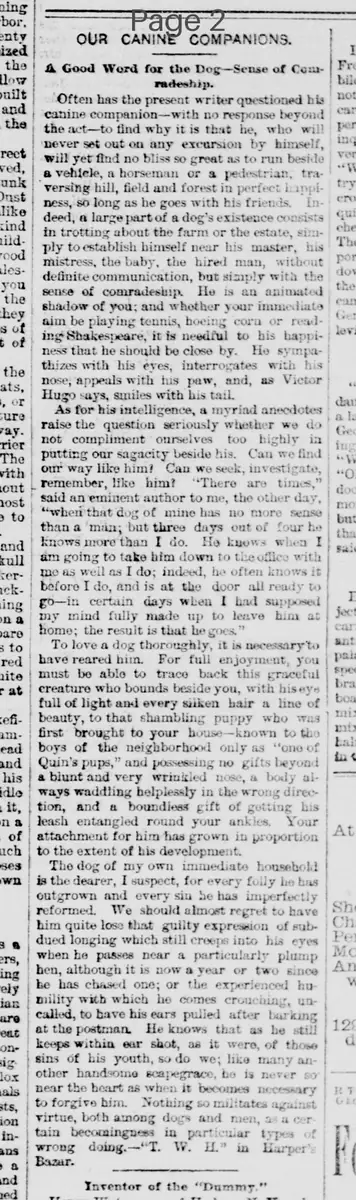
OUR CANINE COMPANIONS.
A Good Word for the Dog—Sense of Comradeship.
Often has the present writer questioned his canine companion—with no response beyond the act—to find why it is that he, who will never set out on any excursion by himself, will yet find no bliss so great as to run beside a vehicle, a horseman or a pedestrian, traversing hill, field and forest in perfect happiness, so long as he goes with his friends. Indeed, a large part of a dog's existence consists in trotting about the farm or the estate, simply to establish himself near his master, his mistress, the baby, the hired man, without definite communication, but simply with the sense of comradeship. He is an animated shadow of you; and whether your immediate aim be playing tennis, hoeing corn or reading Shakespeare, it is needful to his happiness that he should be close by. He sympathizes with his eyes, interrogates with his nose, appeals with his paw, and, as Victor Hugo says, smiles with his tail.
As for his intelligence, a myriad anecdotes raise the question seriously whether we do not compliment ourselves too highly in putting our sagacity beside his. Can we find our way like him? Can we seek, investigate, remember, like him? "There are times," said an eminent author to me, the other day, "when that dog of mine has no more sense than a man; but three days out of four he knows more than I do. He knows when I am going to take him down to the office with me as well as I do; indeed, he often knows it before I do, and is at the door all ready to go—in certain days when I had supposed my mind fully made up to leave him at home; the result is that he goes."
To love a dog thoroughly, it is necessary to have reared him. For full enjoyment, you must be able to trace back this graceful creature who bounds beside you, with his eyes full of light and every silken hair a line of beauty, to that shambling puppy who was first brought to your house—known to the boys of the neighborhood only as "one of Quin's pups," and possessing no gifts beyond a blunt and very wrinkled nose, a body always waddling helplessly in the wrong direction, and a boundless gift of getting his leash entangled round your ankles. Your attachment for him has grown in proportion to the extent of his development.
The dog of my own immediate household is the dearer, I suspect, for every folly he has outgrown and every sin he has imperfectly reformed. We should almost regret to have him quite lose that guilty expression of subdued longing which still creeps into his eyes when he passes near a particularly plump hen, although it is now a year or two since he has chased one; or the experienced humility with which he comes crouching, uncalled, to have his ears pulled after barking at the postman He knows that as he still keeps within ear shot, as it were, of those sins of his youth, so do we; like many another handsome scapegrace, he is never so near the heart as when it becomes necessary to forgive him. Nothing so militates against virtue, both among dogs and men, as a certain becomingness in particular types of wrong doing.—"T. W. H." in Harper's Bazar.
A Good Word for the Dog—Sense of Comradeship.
Often has the present writer questioned his canine companion—with no response beyond the act—to find why it is that he, who will never set out on any excursion by himself, will yet find no bliss so great as to run beside a vehicle, a horseman or a pedestrian, traversing hill, field and forest in perfect happiness, so long as he goes with his friends. Indeed, a large part of a dog's existence consists in trotting about the farm or the estate, simply to establish himself near his master, his mistress, the baby, the hired man, without definite communication, but simply with the sense of comradeship. He is an animated shadow of you; and whether your immediate aim be playing tennis, hoeing corn or reading Shakespeare, it is needful to his happiness that he should be close by. He sympathizes with his eyes, interrogates with his nose, appeals with his paw, and, as Victor Hugo says, smiles with his tail.
As for his intelligence, a myriad anecdotes raise the question seriously whether we do not compliment ourselves too highly in putting our sagacity beside his. Can we find our way like him? Can we seek, investigate, remember, like him? "There are times," said an eminent author to me, the other day, "when that dog of mine has no more sense than a man; but three days out of four he knows more than I do. He knows when I am going to take him down to the office with me as well as I do; indeed, he often knows it before I do, and is at the door all ready to go—in certain days when I had supposed my mind fully made up to leave him at home; the result is that he goes."
To love a dog thoroughly, it is necessary to have reared him. For full enjoyment, you must be able to trace back this graceful creature who bounds beside you, with his eyes full of light and every silken hair a line of beauty, to that shambling puppy who was first brought to your house—known to the boys of the neighborhood only as "one of Quin's pups," and possessing no gifts beyond a blunt and very wrinkled nose, a body always waddling helplessly in the wrong direction, and a boundless gift of getting his leash entangled round your ankles. Your attachment for him has grown in proportion to the extent of his development.
The dog of my own immediate household is the dearer, I suspect, for every folly he has outgrown and every sin he has imperfectly reformed. We should almost regret to have him quite lose that guilty expression of subdued longing which still creeps into his eyes when he passes near a particularly plump hen, although it is now a year or two since he has chased one; or the experienced humility with which he comes crouching, uncalled, to have his ears pulled after barking at the postman He knows that as he still keeps within ear shot, as it were, of those sins of his youth, so do we; like many another handsome scapegrace, he is never so near the heart as when it becomes necessary to forgive him. Nothing so militates against virtue, both among dogs and men, as a certain becomingness in particular types of wrong doing.—"T. W. H." in Harper's Bazar.
What sub-type of article is it?
Essay
What themes does it cover?
Friendship
What keywords are associated?
Dogs
Companionship
Intelligence
Loyalty
Forgiveness
What entities or persons were involved?
T. W. H. In Harper's Bazar
Literary Details
Title
Our Canine Companions.
Author
T. W. H. In Harper's Bazar
Subject
A Good Word For The Dog—Sense Of Comradeship
Key Lines
He Sympathizes With His Eyes, Interrogates With His Nose, Appeals With His Paw, And, As Victor Hugo Says, Smiles With His Tail.
There Are Times," Said An Eminent Author To Me, The Other Day, "When That Dog Of Mine Has No More Sense Than A Man; But Three Days Out Of Four He Knows More Than I Do.