Thank you for visiting SNEWPapers!
Sign up free
The Daily Advertiser
New York, New York County, New York
What is this article about?
On August 13, 1788, the Continental Congress resolved to implement the ratified U.S. Constitution by setting dates for appointing electors (first Wednesday in January 1789), electors voting for president (first Wednesday in February 1789), and commencing proceedings (first Wednesday in March 1789) in New York City as the temporary seat. An ordinance was proposed and voted on, with a tied vote on second reading.
Merged-components note: Merged vote tables into the extract from the congressional journal on implementing the constitution, as they are part of the proceedings described in the text.
Clipping
OCR Quality
Full Text
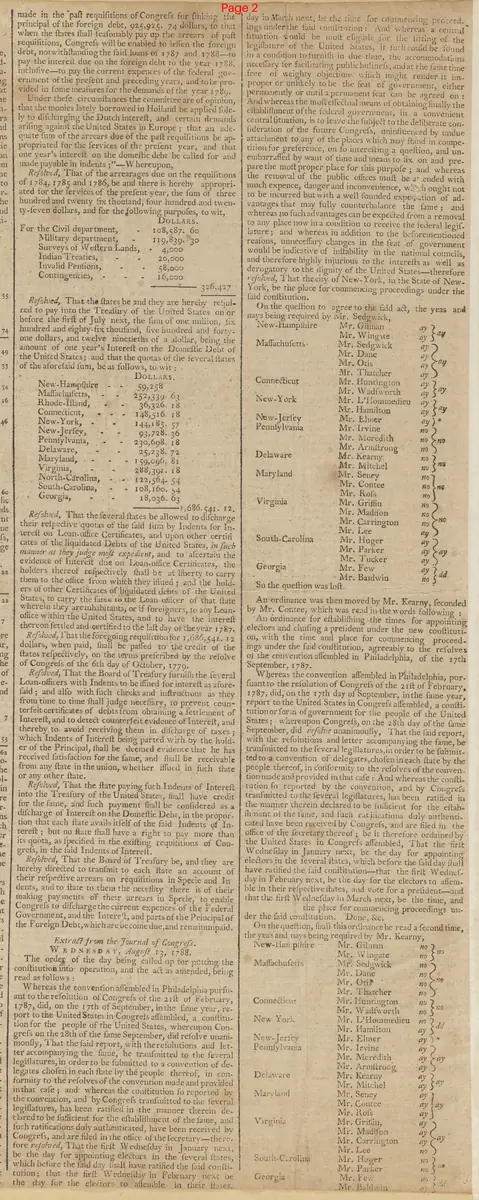
WEDNESDAY, August 13, 1788.
The order of the day being called up for putting the constitution into operation, and the act as amended, being read as follows:
Whereas the convention assembled in Philadelphia pursuant to the resolution of Congress of the 21st of February, 1787, did, on the 17th of September, in the same year, report to the United States in Congress assembled, a constitution for the people of the United States, whereupon Congress on the 28th of the same September, did resolve unanimously, That the said report, with the resolutions and letter accompanying the same, be transmitted to the several legislatures, in order to be submitted to a convention of delegates chosen in each state by the people thereof, in conformity to the resolves of the convention made and provided in that case; and whereas the constitution so reported by the convention, and by Congress transmitted to the several legislatures, has been ratified in the manner therein declared to be sufficient for the establishment of the same, and such ratifications duly authenticated, have been received by Congress, and are filed in the office of the secretary thereof; therefore resolved, That the first Wednesday in January next, be the day for appointing electors in the several states, which before the said day shall have ratified the said constitution; that the first Wednesday in February next be the day for the electors to assemble in their states, day in March next, be the time for commencing proceedings under the said constitution: And whereas a central situation would be most eligible for the sitting of the legislature of the United States, if such could be found in a condition to furnish in due time, the accommodations necessary for facilitating public business, and at the same time free of weighty objections which might render it improper or unlikely to be the seat of government, either permanently or until a permanent seat can be agreed on: And whereas the most effectual means of obtaining finally the establishment of the federal government, in a convenient central situation, is to leave the subject to the deliberate consideration of the future Congress, uninfluenced by undue attachment to any of the places which may stand in competition for preference, on so interesting a question, and unembarrassed by want of time and means to fix on and prepare the most proper place for this purpose; and whereas the removal of the public offices must be attended with much expense, danger and inconvenience, which ought not to be incurred but with a well founded expectation of advantages that may fully counterbalance the same; and whereas no such advantages can be expected from a removal to any place now in a condition to receive the federal legislature; and whereas in addition to the beforementioned reasons, unnecessary changes in the seat of government would be indicative of instability in the national councils, and therefore highly injurious to the interests as well as derogatory to the dignity of the United States—therefore resolved, That the city of New-York, in the State of New-York, be the place for commencing proceedings under the said constitution.
On the question to agree to the said act, the yeas and nays having been required by Mr. Sadowsky—
An ordinance was then moved by Mr. Kearny, seconded by Mr. Contee, which was read in the words following:
An ordinance for establishing the times for appointing electors and choosing a president under the new constitution, with the time and place for commencing proceedings under the said constitution, agreeably to the resolves of the convention assembled in Philadelphia, of the 17th September, 1787.
Whereas the convention assembled in Philadelphia, pursuant to the resolution of Congress of the 21st of February, 1787, did, on the 17th day of September, in the same year, report to the United States in Congress assembled, a constitution or form of government for the people of the United States; whereupon Congress, on the 28th day of the same September, did resolve unanimously, That the said report, with the resolutions and letter accompanying the same, be transmitted to the several legislatures, in order to be submitted to a convention of delegates, chosen in each state by the people thereof, in conformity to the resolves of the convention made and provided in that case: And whereas the constitution so reported by the convention, and by Congress transmitted to the several legislatures, has been ratified in the manner therein declared to be sufficient for the establishment of the same, and such ratifications duly authenticated have been received by Congress, and are filed in the office of the secretary thereof; be it therefore ordained by the United States in Congress assembled, That the first Wednesday in January next, be the day for appointing electors in the several states, which before the said day shall have ratified the said constitution—that the first Wednesday in February next, be the day for the electors to assemble in their respective states, and vote for a president—and that the first Wednesday in March next, be the time, and the place for commencing proceedings under the said constitution. Done, &c.
On the question, shall this ordinance be read a second time,
| New-Hampshire | Mr. Gilman | ay | 3 |
| Massachusetts | Mr. Wingate | ay | 3 |
| Mr. Sedgwick | ay | 3 | |
| Mr. Dane | ay | 3 | |
| Mr. Otis | ay | 3 | |
| Mr. Thatcher | ay | 3 | |
| Connecticut | Mr. Huntington | ay | 3 |
| Mr. Wadsworth | ay | 3 | |
| New-York | Mr. L'Hommedieu | ay | 3 |
| Mr. Hamilton | ay | 3 | |
| New-Jersey | Mr. Elmer | ay | 3 |
| Pennsylvania | Mr. Irvine | no | 3 |
| Mr. Meredith | no | 3 | |
| Mr. Armstrong | no | 3 | |
| Delaware | Mr. Kearny | no | 3 |
| Mr. Mitchel | no | 3 | |
| Maryland | Mr. Seney | no | 3 |
| Mr. Contee | no | 3 | |
| Mr. Ross | no | 3 | |
| Virginia | Mr. Griffin | no | 3 |
| Mr. Madison | no | 3 | |
| Mr. Carrington | no | 3 | |
| South-Carolina | Mr. Lee | ay | 3 |
| Mr. Huger | ay | 3 | |
| Mr. Parker | ay | 3 | |
| Georgia | Mr. Tucker | ay | 3 |
| Mr. Few | ay | 3 | |
| Mr. Baldwin | no | 3 | |
| So the question was left |
| New-Hampshire | Mr. Gilman | no | 3 |
| Mr. Wingate | no | 3 | |
| Massachusetts | Mr. Sedgwick | no | 3 |
| Mr. Dane | no | 3 | |
| Mr. Otis | no | 3 | |
| Mr. Thatcher | no | 3 | |
| Connecticut | Mr. Huntington | no | 3 |
| Mr. Wadsworth | no | 3 | |
| New York | Mr. L'Hommedieu | no | 3 |
| Mr. Hamilton | ay | 3 | |
| New-Jersey | Mr. Elmer | ay | 3 |
| Pennsylvania | Mr. Irvine | ay | 3 |
| Mr. Meredith | ay | 3 | |
| Mr. Armstrong | ay | 3 | |
| Delaware | Mr. Kearny | ay | 3 |
| Mr. Mitchel | ay | 3 | |
| Maryland | Mr. Seney | ay | 3 |
| Mr. Contee | ay | 3 | |
| Mr. Ross | ay | 3 | |
| Virginia | Mr. Griffin | ay | 3 |
| Mr. Madison | ay | 3 | |
| Mr. Carrington | ay | 3 | |
| Mr. Lee | no | 3 | |
| South Carolina | Mr. Huger | no | 3 |
| Mr. Parker | no | 3 | |
| Georgia | Mr. Few | no | 3 |
| Mr. Baldwin | ay | 3 |
What sub-type of article is it?
What keywords are associated?
What entities or persons were involved?
Where did it happen?
Domestic News Details
Primary Location
New York
Event Date
August 13, 1788
Key Persons
Outcome
resolution passed to commence constitution proceedings in new york on first wednesday in march 1789; ordinance for dates of electors and president vote proposed, vote on second reading tied.
Event Details
Congress read and agreed to an amended act setting dates for appointing electors, voting for president, and commencing proceedings under the ratified Constitution, designating New York as the temporary seat. Mr. Kearny moved an ordinance restating these dates, seconded by Mr. Contee; vote on second reading resulted in a tie.