Thank you for visiting SNEWPapers!
Sign up free
Alexandria Daily Gazette, Commercial & Political
Alexandria, Virginia
What is this article about?
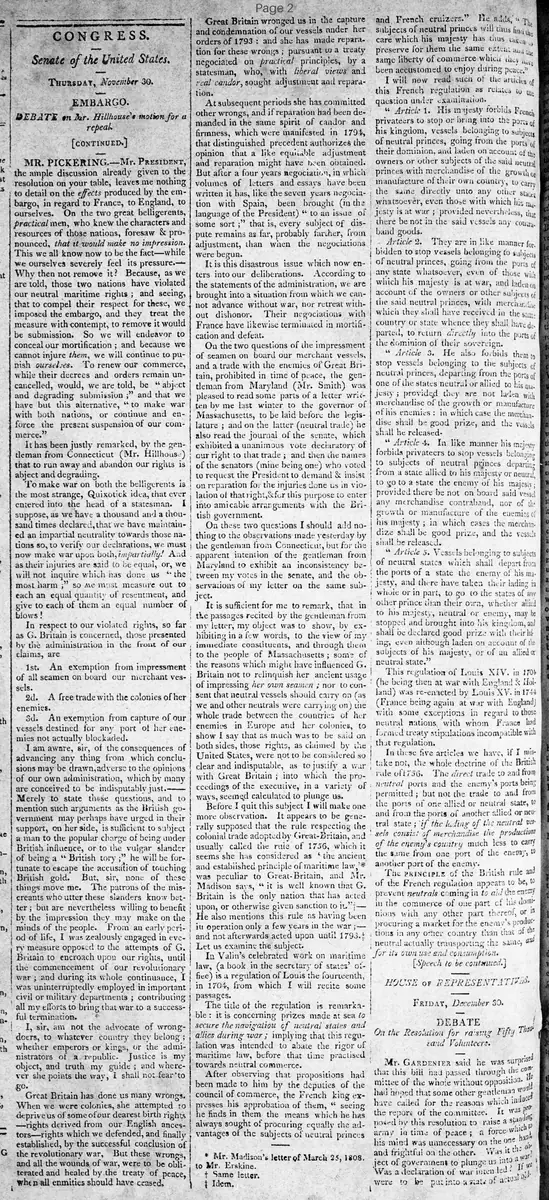
In a US Senate debate on November 30, Senator Pickering argues for repealing the embargo, noting its ineffectiveness against Britain and France while harming American commerce, critiques war proposals, and defends US claims on impressment and neutral trade rights, citing historical precedents.
Clipping
OCR Quality
Full Text
Senate of the United States.
THURSDAY, November 30.
EMBARGO.
DEBATE on Mr. Hillhouse's motion for a repeal
[CONTINUED.]
MR. PICKERING. -Mr. President,
the ample discussion already given to the
resolution on your table, leaves me nothing
to detail on the effects produced by the em-
bargo, in regard to France, to England, to
ourselves. On the two great belligerents,
practical men, who knew the characters and
resources of those nations, foresaw & pro-
nounced, that it would make no impression.
This we all know now to be the fact--while
we ourselves severely feel its pressure.
Why then not remove it? Because, as we
are told, those two nations have violated
our neutral maritime rights ; and seeing,
that to compel their respect for these, we
imposed the embargo, and they treat the
measure with contempt, to remove it would
be submission. So we will endeavor to
conceal our mortification ; and because we
cannot injure them, we will continue to pu-
nish ourselves. To renew our commerce,
while their decrees and orders remain un-
cancelled, would, we are told, be "abject
and degrading submission ;" and that we
have but this alternative, "to make war
with both nations, or continue and en-
force the present suspension of our com-
merce."
It has been justly remarked, by the gen-
tleman from Connecticut (Mr. Hillhouse)
that to run away and abandon our rights is
abject and degrading.
To make war on both the belligerents is
the most strange, Quixotick idea, that ever
entered into the head of a statesman. I
suppose, as we have a thousand and a thou-
sand times declared, that we have maintain-
ed an impartial neutrality towards those na-
tions so, to verify our declarations, we must
now make war upon both, impartially! And
as their injuries are said to be equal, or, we
will not inquire which has done us "the
most harm ;" so we must measure out to
each an equal quantity of resentment, and
give to each of them an equal number of
blows!
In respect to our violated rights, so far
as G. Britain is concerned, those presented
by the administration in the front of our
claims, are
1st. An exemption from impressment
of all seamen on board our merchant ves-
sels.
2d. A free trade with the colonies of her
enemies.
3d. An exemption from capture of our
vessels destined for any port of her ene-
mies not actually blockaded.
I am aware, sir, of the consequences of
advancing any thing from which conclu-
sions may be drawn, adverse to the opinions
of our own administration, which by many
are conceived to be indisputably just.
Merely to state these questions, and to
mention such arguments as the British go-
vernment may perhaps have urged in their
support, on her side, is sufficient to subject
a man to the popular charge of being under
British influence, or to the vulgar slander
of being a "British tory ;" he will be for-
tunate to escape the accusation of touching
British gold. But, sir, none of these
things move me. The patrons of the mis-
creants who utter these slanders know bet-
ter; but are nevertheless willing to benefit
by the impression they may make on the
minds of the people. From an early peri-
od of life, I was zealously engaged in eve-
ry measure opposed to the attempts of G.
Britain to encroach upon our rights, until
the commencement of our revolutionary
war ; and during its whole continuance, I
was uninterruptedly employed in important
civil or military departments ; contributing
all my efforts to bring that war to a success-
ful termination.
I, sir, am not the advocate of wrong-
doers, to whatever country they belong ;
whether emperors or kings, or the admi-
ministrators of a republic. Justice is my
object, and truth my guide ; and where-
ver she points the way, I shall not fear to
go.
Great Britain has done us many wrongs.
When we were colonies, she attempted to
deprive us of some of our dearest birth rights
--rights derived from our English ances-
tors--rights which we defended, and finally
established, by the successful conclusion of
the revolutionary war. But these wrongs,
and all the wounds of war, were to be obli-
terated and healed by the treaty of peace,
when all enmities should have ceased.
Great Britain wronged us in the capture
and condemnation of our vessels under her
orders of 1793 : and she has made repara-
tion for these wrongs ; pursuant to a treaty
negotiation on practical principles, by a
statesman, who, with liberal views and
real candor, sought adjustment and repara-
tion.
At subsequent periods she has committed
other wrongs, and if reparation had been de-
manded in the same spirit of candor and
firmness, which were manifested in 1794,
that distinguished precedent authorizes the
opinion that a like equitable adjustment
and reparation might have been obtained.
But after a four years negotiation, in which
volumes of letters and essays have been
written it has, like the seven years negotia-
tion with Spain, been brought (in the
language of the President) "to an issue of
some sort ;" that is, every subject of dis-
pute remains as far, probably farther, from
adjustment, than when the negotiations
were begun.
It is this disastrous issue which now en-
enters into our deliberations. According to
the statements of the administration, we are
brought into a situation from which we can-
not advance without war, nor retreat with-
out dishonor. Their negotiations with
France have likewise terminated in mortif-
ication and defeat.
On the two questions of the impressment
of
seamen on board our merchant vessels,
and a trade with the enemies of Great Bri-
tain, prohibited in time of peace, the gen-
tleman from Maryland (Mr. Smith) was
pleased to read some parts of a letter writ-
ten by me last winter to the governor of
Massachusetts, to be laid before the legis-
lature ; and on the latter (neutral trade) he
also read the journal of the senate, which
exhibited a unanimous vote declaratory of
our right to that trade ; and then the names
of the senators (nine being one) who voted
to request the President to demand & insist
on reparation for the injuries done us in vio-
lations of that right, & for this purpose to enter
into amicable arrangements with the Bri-
tish government.
On these two questions I should add no-
thing to the observations made yesterday by
the gentleman from Connecticut, but for the
apparent intention of the gentleman from
Maryland to exhibit an inconsistency be-
tween my votes in the senate, and the ob-
servations of my letter on the same sub-
ject.
It is sufficient for me to remark that in
the passages recited by the gentleman from
my letter, my object was to show, by ex-
hibiting in a few words, to the view of my
immediate constituents, and through them
to the people of Massachusetts : some of
the reasons which might have influenced G.
Britain not to relinquish her ancient usage
of impressing her own seamen ; nor to con-
sent that neutral vessels should carry on (as
we and other neutrals were carrying on) the
whole trade between the countries of her
enemies in Europe and her colonies, to
show I say that as much was to be said on
both sides, those rights, as claimed by the
United States, were not to be considered so
clear and indisputable, as to justify a war
with Great Britain ; into which the pro-
ceedings of the executive, in a variety of
ways, seemed calculated to plunge us.
Before I quit this subject I will make one
more observation. It appears to be gene-
rally supposed that the rule respecting the
colonial trade adopted by Great-Britain, and
usually called the rule of 1756, which it
seems she has considered as the ancient
and established principle of maritime law. *
was peculiar to Great-Britain, and Mr.
Madison says, "it is well known that G.
Britain is the only nation that has acted
upon, or otherwise given sanction to it."†--
He also mentions this rule as having been
in operation only a few years in the war ;--
and not afterwards acted upon until 1793.#
Let us examine the subject.
In Valin's celebrated work on maritime
law, (a book in the secretary of state's of-
fice) is a regulation of Louis the fourteenth,
in 1704, from which I will recite some
passages.
The title of the regulation is remarka-
ble : it is concerning prizes made at sea to
secure the navigation of neutral states and
allies during war; implying that this regu-
lation was intended to abate the rigor of
maritime law, before that time practised
towards neutral commerce.
After observing that propositions had
been made to him by the deputies of the
council of commerce, the French king ex-
presses his approbation of them, "seeing
he finds in them the means which he has
always sought of procuring equally the ad-
vantages of the subjects of neutral princes
and French cruizers." He adds, "The
subjects of neutral princes will thus find the
care which his majesty has thus taken
preserve for them the same extent and the
same liberty of commerce which they have
been accustomed to enjoy during peace."
I will now read such of the articles of
this French regulation as relates to the
question under examination.
"Article 1. His majesty forbids French
privateers to stop or bring into the ports of
his kingdom, vessels belonging to subjects
of neutral princes, going from the ports of
their dominion, and laden on account of the
owners or other subjects of the said neutral
princes with merchandise of the growth or
manufacture of their own country, to carry
the same directly unto any other state
whatsoever, even those with which his ma-
jesty is at war ; provided nevertheless, that
there be not in the said vessels any contra-
band goods.
"Article 2. They are in like manner for-
bidden to stop vessels belonging to subjects
of neutral princes, going from the ports of
any state whatsoever, even of those with
which his majesty is at war, and laden on
account of the owners or other subjects of
the said neutral princes, with merchandise
which they shall have received in the same
country or state whence they shall have de-
parted, to return directly into the ports of
the dominion of their sovereign.
"Article 3. He also forbids them to
stop vessels belonging to the subjects of
neutral princes, departing from the ports of
one of the states neutral or allied to his ma-
jesty; provided they are not laden with
merchandise of the growth or manufacture
of his enemies : in which case the merchan-
dise shall be good prize, and the vessels
shall be released.
"Article 4. In like manner his majesty
forbids privateers to stop vessels belonging
to subjects of neutral princes departing
from a state allied to his majesty or neutral
to go to a state the enemy of his majesty
provided there be not on board said vessel
any merchandise contraband, nor of the
growth or manufacture of the enemies of
his majesty : in which cases the merchan-
dize shall be good prize, and the vessels
shall be released.
"Article 5. Vessels belonging to subjects
of neutral states which shall depart from
the ports of a state the enemy of his ma-
jesty, and there have taken their lading in
whole or in part, to go to the states of any
other prince than their own, whether allied
to his majesty, neutral or enemy, may be
stopped and brought into his kingdom, and
shall be declared good prize with their la-
ding, even although laden on account of the
subjects of his majesty, or of an allied or
neutral state."
This regulation of Louis XIV. in 1704
(he being then at war with England & Hol-
land) was re-enacted by Louis XV. in 1744
(France being again at war with England)
with some exceptions in regard to those
neutral nations with whom France had
formed treaty stipulations incompatible with
that regulation.
In these five articles we have, if I mis-
take not, the whole doctrine of the British
rule of 1756. The direct trade to and from
neutral ports and the enemy's ports being
permitted ; but not the trade to and from
the ports of one allied or neutral state, to
and from the ports of another allied or neu-
tral state ; if the lading of the neutral ves-
sels consists of merchandise the productions
of the enemy's country much less to carry
the same from one port of the enemy, to
another port of the enemy.
The PRINCIPLE of the British rule and
of the French regulation appears to be, to
prevent neutrals coming in to aid the enemy
in the commerce of one part of his do-
minions with any other part thereof, or in
procuring a market for the enemy's produc-
tions in any other country than that of the
neutral actually transporting the same,
and
for its own use and consumption.
[Speech to be continued.]
What sub-type of article is it?
What keywords are associated?
What entities or persons were involved?
Where did it happen?
Domestic News Details
Primary Location
United States Senate
Event Date
Thursday, November 30
Key Persons
Event Details
Mr. Pickering speaks in the Senate debate on Mr. Hillhouse's motion to repeal the embargo, arguing that it fails to affect Britain and France but harms the US, criticizes the idea of war with both nations, discusses US maritime rights violations by Britain including impressment, colonial trade, and captures, defends his past positions, references historical treaties and French regulations from 1704 supporting similar principles to Britain's rule of 1756.