Thank you for visiting SNEWPapers!
Sign up free
The Detroit Tribune
Detroit, Wayne County, Michigan
What is this article about?
Excerpt from J.S. Vaughan's radio remarks on August 17, 1954, accusing the union of planning a strike at Square D regardless of negotiations, presenting excessive demands, and prioritizing leaders' interests over employees' job security.
Merged-components note: Continuation of the same story on the Square D strike, with sequential reading order and coherent topic on union demands and company response.
Clipping
OCR Quality
Full Text
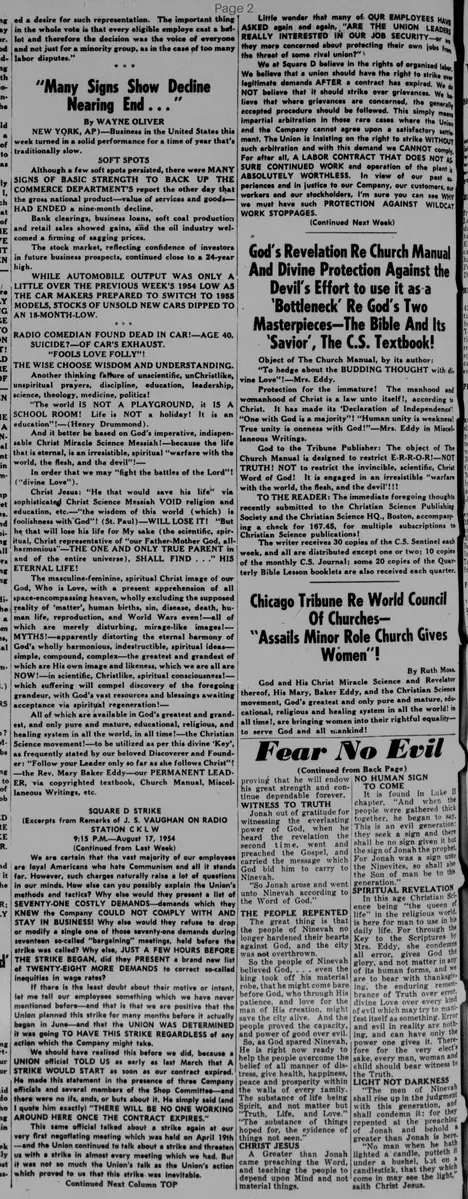
(Excerpts from Remarks of J. S. VAUGHAN ON RADIO STATION C K L W 9:15 P.M.-August 17, 1954
(Continued from Last Week)
We are certain that the vast majority of our employees are loyal Americans who hate Communism and all it stands for. However, such charges naturally raise a lot of questions in our minds. How else can you possibly explain the Union's methods and tactics? Why else would they present a list of SEVENTY-ONE COSTLY DEMANDS demands which they KNEW the Company COULD NOT COMPLY WITH AND STAY IN BUSINESS! Why else would they refuse to drop or modify a single one of those seventy-one demands during seventeen so-called "bargaining" meetings, held before the strike Was called? Why else, JUST A FEW HOURS BEFORE THE STRIKE BEGAN, did they PRESENT a brand new list of TWENTY-EIGHT MORE DEMANDS to cOrreCt sO-Called inequities in wage rates?
If there is the least doubt about their motive or intent, let me tell our employees something which we have never mentioned before and that is that we are positive that the Union planned this strike for many months before it actually began in June—and that the UNION WAS DETERMINED it WAS going TO HAVE THIS STRIKE REGARDLESS of any action which the Company might take.
We should have realized this before we did, because a UNION official TOLD US as early as last March that A STRIKE WOULD START as soon as our contract expired.
He made this statement in the presence of three Company officials and several members of the Shop Committee and there were no ifs, ands, or buts about it. He simply said (and I quote him eXactly) "THERE WILL BE NO ONE WORKING AROUND HERE ONCE THE CONTRACT EXPIRES."
This same official talked about a strike again at our very first negotlating meeting which was held on April 19th —and the Union continued to talk about a strike and threaten us with a strike in almost every meeting which we had. But it was not so much the Union's talk as the Union's action which proved to us that this strike. was inevitable.
Conti: (O:
Little wonder that many of OUR EMPLOYEES HAVE ASKED again and again, "ARE THE UNION LEADERS REALLY INTERESTED IN OUR JOB SECURITY-or are they more concerned about protecting their own jobs from the threat of some rival union?"
We at Square D believe in the rights of organized labor,
We believe that a union should have the right to strike over legitimate demands AFTER a contract has expired.
We do NOT believe that it should strike over grievances.
We believe that where grievances are concerned, the generally accepted procedure should be followed.
This simply means impartial arbitration in those rare cases where the Union and the Company cannot agree upon a satisfactory settlement. The Union is insisting on the right to strike WiTHOUT such arbitration and with this demand we CANNOT comply.
For after all, A LaBOR COnTRACT ThaT DOES NOT AS. SURE CONTINUED WORK and operation of the plant is ABSOLUTELY WORTHLESS.
In view of our past periences and in justice to our Company, our customers, our workers and our stockholders, I'm sure you can see WHY we must have SUch PROTECTION AGAINST WILDCAT WORK STOPPAGES.
(Continued Next Week)
What sub-type of article is it?
What themes does it cover?
What keywords are associated?
What entities or persons were involved?
Where did it happen?
Story Details
Key Persons
Location
Square D Company
Event Date
1954 06 (Strike); 1954 08 17 (Remarks)
Story Details
J.S. Vaughan accuses the union of premeditating a strike at Square D in June 1954, presenting impossible demands during negotiations from March to April, and refusing arbitration, prioritizing leaders' interests over employees' job security.