Thank you for visiting SNEWPapers!
Sign up free
Editorial
December 23, 1789
Gazette Of The United States
New York, New York County, New York
What is this article about?
An editorial critiquing charity schools for their partiality, high costs, and inability to educate all poor children, advocating instead for free public schools as successfully implemented in Connecticut, contrasting with London's extensive but insufficient institutions.
Clipping
OCR Quality
98%
Excellent
Full Text
For the GAZETTE of the UNITED STATES.
ON CHARITY SCHOOLS.
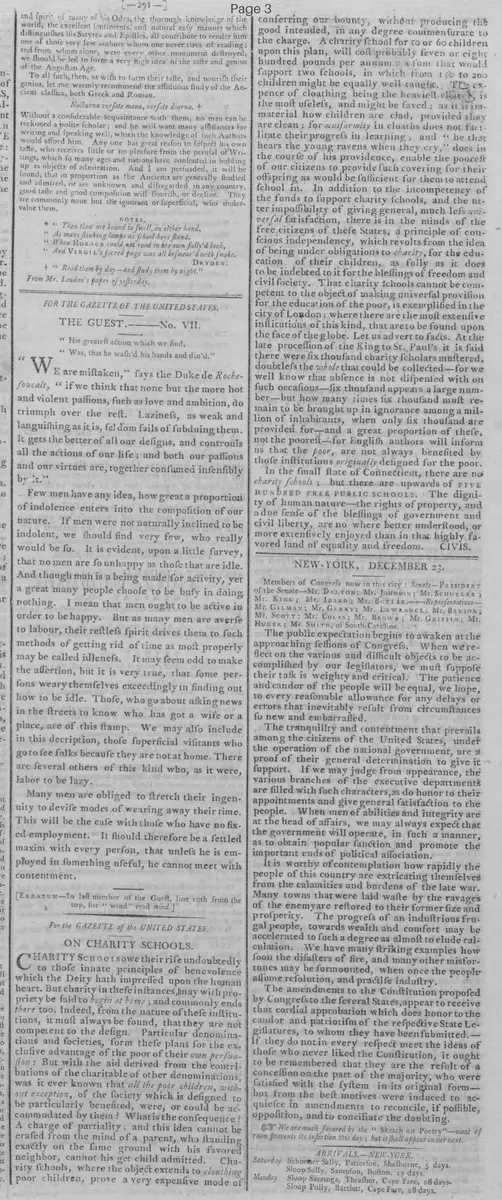
CHARITY SCHOOLS owe their rise undoubtedly to those innate principles of benevolence which the Deity hath impressed upon the human heart. But charity in these instances, may with propriety be said to begin at home; and commonly ends there too. Indeed, from the nature of these institutions, it must always be found, that they are not competent to the design. Particular denominations and societies, form these plans for the exclusive advantage of the poor of their own persuasion: But with the aid derived from the contributions of the charitable of other denominations, was it ever known that all the poor children, without exception, of the society which is designed to be particularly benefited, were, or could be accommodated by them? What is the consequence? A charge of partiality; and this idea cannot be erased from the mind of a parent, who standing exactly on the same ground with his favored neighbor, cannot get his child admitted. Charity schools, where the object extends to cloathing poor children, prove a very expensive mode of conferring our bounty, without producing the good intended, in any degree commensurate to the charge. A charity school for 50 or 60 children upon this plan, will cost probably seven or eight hundred pounds per annum: a sum that would support two schools, in which from 150 to 200 children might be equally well taught. The expence of cloathing being the heaviest charge, is the most useless, and might be saved; as it is immaterial how children are clad, provided they are clean; for uniformity in cloaths does not facilitate their progress in learning; and "he that hears the young ravens when they cry," does in the course of his providence, enable the poorest of our citizens to provide such covering for their offspring as would be sufficient for them to attend school in. In addition to the incompetency of the funds to support charity schools, and the utter impossibility of giving general, much less universal satisfaction, there is in the minds of the free citizens of these States, a principle of conscious independency, which revolts from the idea of being under obligations to charity, for the education of their children, as fully as it does to be indebted to it for the blessings of freedom and civil society. That charity schools cannot be competent to the object of making universal provision for the education of the poor, is exemplified in the city of London; where there are the most extensive institutions of this kind, that are to be found upon the face of the globe. Let us advert to facts. At the late procession of the King to St. Paul's it is said there were six thousand charity scholars mustered, doubtless the whole that could be collected—for we well know that absence is not dispensed with on such occasions—six thousand appears a large number—but how many times six thousand must remain to be brought up in ignorance among a million of inhabitants, when only six thousand are provided for—and a great proportion of these, not the poorest—for English authors will inform us that the poor, are not always benefited by those institutions originally designed for the poor. In the small state of Connecticut, there are no charity schools; but there are upwards of FIVE HUNDRED FREE PUBLIC SCHOOLS. The dignity of human nature—the rights of property, and a due sense of the blessings of government and civil liberty, are no where better understood, or more extensively enjoyed than in that highly favored land of equality and freedom.
CIVIS.
ON CHARITY SCHOOLS.
CHARITY SCHOOLS owe their rise undoubtedly to those innate principles of benevolence which the Deity hath impressed upon the human heart. But charity in these instances, may with propriety be said to begin at home; and commonly ends there too. Indeed, from the nature of these institutions, it must always be found, that they are not competent to the design. Particular denominations and societies, form these plans for the exclusive advantage of the poor of their own persuasion: But with the aid derived from the contributions of the charitable of other denominations, was it ever known that all the poor children, without exception, of the society which is designed to be particularly benefited, were, or could be accommodated by them? What is the consequence? A charge of partiality; and this idea cannot be erased from the mind of a parent, who standing exactly on the same ground with his favored neighbor, cannot get his child admitted. Charity schools, where the object extends to cloathing poor children, prove a very expensive mode of conferring our bounty, without producing the good intended, in any degree commensurate to the charge. A charity school for 50 or 60 children upon this plan, will cost probably seven or eight hundred pounds per annum: a sum that would support two schools, in which from 150 to 200 children might be equally well taught. The expence of cloathing being the heaviest charge, is the most useless, and might be saved; as it is immaterial how children are clad, provided they are clean; for uniformity in cloaths does not facilitate their progress in learning; and "he that hears the young ravens when they cry," does in the course of his providence, enable the poorest of our citizens to provide such covering for their offspring as would be sufficient for them to attend school in. In addition to the incompetency of the funds to support charity schools, and the utter impossibility of giving general, much less universal satisfaction, there is in the minds of the free citizens of these States, a principle of conscious independency, which revolts from the idea of being under obligations to charity, for the education of their children, as fully as it does to be indebted to it for the blessings of freedom and civil society. That charity schools cannot be competent to the object of making universal provision for the education of the poor, is exemplified in the city of London; where there are the most extensive institutions of this kind, that are to be found upon the face of the globe. Let us advert to facts. At the late procession of the King to St. Paul's it is said there were six thousand charity scholars mustered, doubtless the whole that could be collected—for we well know that absence is not dispensed with on such occasions—six thousand appears a large number—but how many times six thousand must remain to be brought up in ignorance among a million of inhabitants, when only six thousand are provided for—and a great proportion of these, not the poorest—for English authors will inform us that the poor, are not always benefited by those institutions originally designed for the poor. In the small state of Connecticut, there are no charity schools; but there are upwards of FIVE HUNDRED FREE PUBLIC SCHOOLS. The dignity of human nature—the rights of property, and a due sense of the blessings of government and civil liberty, are no where better understood, or more extensively enjoyed than in that highly favored land of equality and freedom.
CIVIS.
What sub-type of article is it?
Education
Social Reform
What keywords are associated?
Charity Schools
Public Education
Poor Children
Connecticut Schools
London Institutions
Educational Reform
What entities or persons were involved?
Connecticut
London
King
Editorial Details
Primary Topic
Critique Of Charity Schools Advocating Public Education
Stance / Tone
Critical Of Charity Schools, Supportive Of Free Public Schools
Key Figures
Connecticut
London
King
Key Arguments
Charity Schools Are Partial And Exclude Many Poor Children
High Costs Of Charity Schools, Especially Clothing, Are Inefficient
Public Funds Could Support More Children Without Charity Obligations
London's Charity Schools Fail To Educate All Poor Despite Scale
Connecticut's Free Public Schools Provide Universal Education