Thank you for visiting SNEWPapers!
Sign up free
Virginia Argus
Richmond, Virginia
What is this article about?
Narrator describes huge bones of an extinct mammoth-like animal unearthed from a marl-pit on Mr. Mater's farm in Ulster County, 14 miles from the village. Provides detailed measurements of skull, jaws, limbs, ribs, and tusks, speculating on the creature's immense size and predatory capabilities.
Merged-components note: These three sequential components form a single continuous article on the discovery and description of mammoth bones, with text flowing directly from one to the next without interruption.
Clipping
OCR Quality
Full Text
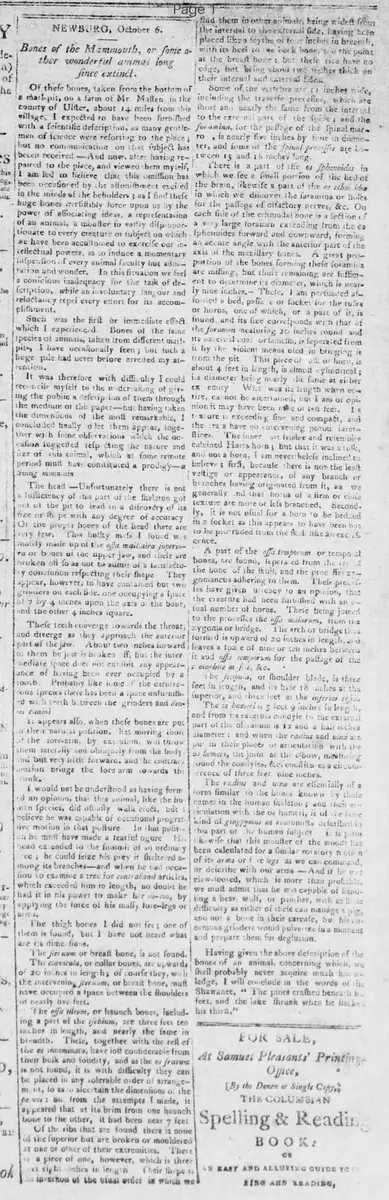
Of these bones, taken from the bottom of a marl-pit, on a farm of Mr. Mater in the county of Ulster, about 14 miles from this village, I expected to have been furnished with a scientific description, as many gentlemen of science were resorting to the place; but no communication on that subject has been received --And poor, after having repaired to the place, and viewed them myself, I am led to believe that this omission has been occasioned by the astonishment excited in the minds of the beholders; as I find these huge bones irresistibly force upon us by the power of associating ideas, a representation of an animal, a monster so vastly disproportionate to every creature or subject on which we have been accustomed to exercise our intellectual powers, as to induce a momentary suspension of every animal faculty but admiration and wonder. In this situation we feel a conscious inadequacy for the task of description, while an involuntary languor and reluctancy repel every effort for its accomplishment.
Such was the first or immediate effect which I experienced. Bones of the same species of animal, taken from different marl-pits I have occasionally seen: but such a huge pile had never before arrested my attention.
It was therefore with difficulty I could reconcile myself to the idea of giving the public a description of them through the medium of this paper--but having taken the dimensions of the most remarkable, I concluded finally to let them appear, together with some observations which the occasion suggested respecting the nature and size of this animal, which at some remote period must have constituted a prodigy-a living mountain.
The head --Unfortunately there is not a sufficiency of this part of the skeleton got out of the pit to lead to a discovery of its size or the shape with any degree of accuracy. Of the proper bones of the head there are very few. This bulky mass I found was mostly made up of the os maxillaris superor or bones of the upper jaw, and these are broken off so as not to admit of a satisfactory conclusion respecting their shape. They appear, however, to have contained but two grinders on each side, one occupying a space of 7 by 4 inches upon the axis of the bone, and the other 4 inches square.
These teeth converge towards the throat, and diverge as they approach the anterior part of the jaw. About two inches forward of them the jaw is broken, but the intermediate space does not exhibit any appearance of having been ever occupied by a tooth.
Probably like some of the carnivorous species there has been a space unfurnished with teeth between the grinders and dentes canini.
a
it appears also, when these bones are put in their natural position, that moving those of the fore-arm, by extension, will throw them laterally and obliquely from the body and but very little forward, and the contrary motion bringing the fore arm towards the trunk.
would not be understood as having formed an opinion that the animal, like the hyenan species, did usually walk erect, but I believe he was capable of occasional progressive motion in that posture. In that position he must have made a terrible figure. His head extended to the summit of an ordinary tree; he could seize his prey if sheltered among its branches-and when he had occasion to examine a tree for contraband articles, which exceeded him in length, no doubt he had it in his power to make her kneel, by applying the force of his mighty fore-legs or arms.
The thigh bones I did not see; one of them is found, but I have not heard what are its dimensions.
The sternum or breast bone, is not found.
The clavicula, or collar bones, are upwards of 20 inches in length; of course they, with the interveving sternum, or breast bone, must have occupied a space between the shoulders of nearly five feet.
The ossa ilium, or haunch bones, including a part of the os sacrum, are three feet ten inches in length, and nearly the same in breadth. These, together with the rest of the ossa innominata, have lost considerable from their bulk and solidity, and as the os sacrum is not found, it is with difficulty they can be placed in any tolerable order of arrangement, so as to ascertain the dimensions of the pelvis: But from the attempts I made, it appeared that at its brim from one haunch bone to the other, it had been near 7 feet.
Of the ribs that are found there is none of the superior but are broken or mouldered at one or other of their extremities. There is a piece of one, however, which is three feet eight inches in length.
Their shape is in favor of the usual order in which we find them in other animals, being wider from the internal to the external side, having been placed like a scythe of four inches in breadth, with its heel to the back bone, and the point at the breast bone: but these ribs have no edge, but being about two inches thick on their internal and external edges.
Some of the vertebrae are 21 inches wide, including the transverse processes, which are short and nearly the same from the internal to the external part of the spine: and the foramina, for the passage of the spinal marrow, is nearly five inches by four in diameter, and some of the spinal processes are between 15 and 18 inches long.
There is a part of the os sphenoides in which we see a small portion of the bed of the brain, likewise a part of the os ethmoides in which we discover the foramina or holes for the passage of olfactory nerves, &c. On each side of the cribriform bone is a section of a very large foramen extending from the os sphenoides forward and downward, forming an acute angle with the anterior part of the axis of the maxillary bones. A great proportion of the bones forming these foramina are missing, but those remaining are sufficient to determine its diameter, which is nearly nine inches.- These, I am persuaded, afford a bed passage or socket for the tusk or horn, one of which, or a part of it, is found, and its size corresponds with that of the foramina measuring 20 inches round and its external coat or enamel is separated from it by the violent means used in bringing it from the pit. This piece of tusk or horn, is about 4 feet in length, is almost cylindrical; its diameter being nearly the same at either extremity. What was its length when entire, can not be ascertained, but I am of opinion it may have been nine or ten feet. Its texture is exceeding fine and compact, and the rays have no intervening porous interstices. The outer part friable and resembles calcined Harts horn: but that it was a tusk, and not a horn, I am nevertheless inclined to believe: first, because there is not the least vestige or appearance, of any branch or branches having originated from it, as we generally find those horns of a firm or close texture are more or less branched. Secondly, it is not usual for a horn to be bedded in a socket as this appears to have been but to be protruded from the skull as an excrescence.
A part of the ossa temporum or temporal bones, are found. It appeared from the temporal bone of the skull, and the processus zygomaticus adhering to them. These processes have given currency to an opinion, that the creature had been furnished with an unusual number of horns. These being joined to the processes the ossa malarum, from the zygoma or bridge. The arch or bridge thus formed is upward of 20 inches in length, and leaves a space of nine or ten inches between it and ossa temporum for the passage of the globus oculi, &c.
The scapula, or shoulder blade, is three feet in length, and the blade 18 inches at the superior, and three feet at the inferior side.
The os humeri is 3 feet 6 inches in length, and from its external condyle to the external part of the os panis is 11 and a half inches diameter: and when the radius and ulna are put in their places of articulation with the os humeri, the joint at the elbow, measuring round the condyles, &c. constitutes a circumference of three feet nine inches.
The radius and ulna are essentially of a form similar to the bones known by those names in the human skeleton; and their articulation with the os humeri, is of the same kind of ginglymus as Avalon describes in his part of the human subject. I am likewise of opinion that this monster of the wood has been calculated for a similar rotatory motion of its arms or fore legs as we can command, or describe with our arms-and it he was claw-footed, which is more than probable, we must admit that he was capable of handling a bear, wolf, or panther, with as little difficulty as either of these can manage a pig, and not a bone in their carcase, but his clorous grinders would pulverize in a moment and prepare them for deglutition.
Having given the above description of the bones of an animal, concerning which, we shall probably never acquire much knowledge, I will conclude in the words of a Shawanee, "The pines crashed beneath his feet, and the lake shrunk when he slacked his thirst."
What sub-type of article is it?
What themes does it cover?
What keywords are associated?
What entities or persons were involved?
Where did it happen?
Story Details
Key Persons
Location
County Of Ulster, About 14 Miles From This Village
Story Details
Narrator visits site of huge bones from extinct animal in marl-pit, measures parts like jaws with two grinders each, tusks up to 10 feet, limbs suggesting ability to walk erect occasionally and handle prey, ribs and vertebrae indicating massive size.