Thank you for visiting SNEWPapers!
Sign up free
Daily National Intelligencer
Washington, District Of Columbia
What is this article about?
Report on U.S. Senate and House of Representatives proceedings in Washington on April 2-3, 1816, covering the Bank Bill's advancement in the Senate, House discussions on petitions, resolutions for committees and compensations, debates on franking privileges and tariff duties, and passage of several appropriation bills.
Merged-components note: These sequential components form a continuous narrative report on congressional proceedings in the House of Representatives, including debates on the bank bill, post-office amendments, and tariff duties, split across columns on page 3.
Clipping
OCR Quality
Full Text
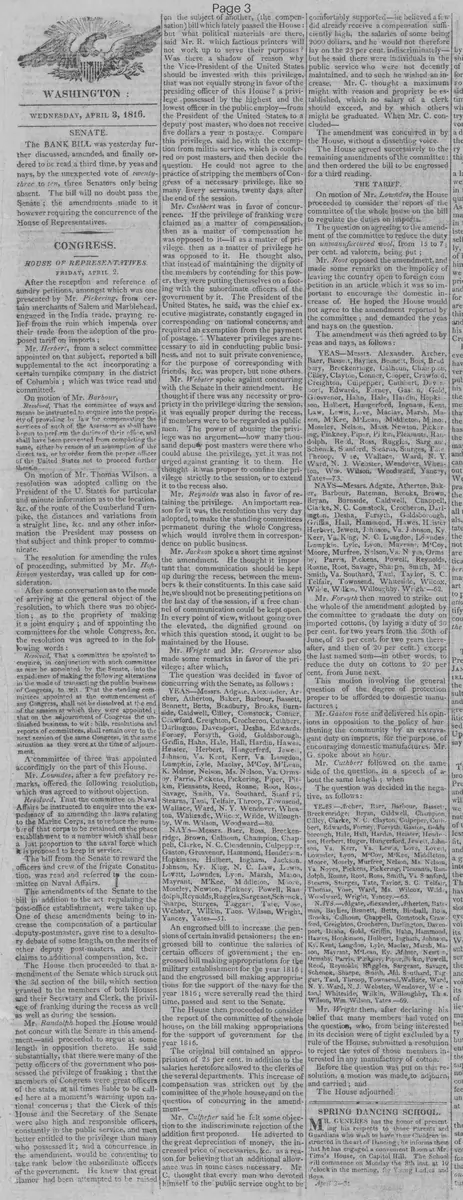
WEDNESDAY, APRIL 3, 1816.
SENATE.
The BANK BILL was yesterday further discussed, amended, and finally ordered to be read a third time, by yeas and nays, by the unexpected vote of twenty-three to ten, three Senators only being absent. The bill will no doubt pass the Senate; the amendments made to it however requiring the concurrence of the House of Representatives.
CONGRESS.
HOUSE OF REPRESENTATIVES.
FRIDAY, APRIL 2.
After the reception and reference of sundry petitions, amongst which was one presented by Mr. Pickering, from certain merchants of Salem and Marblehead, engaged in the India trade, praying relief from the ruin which impends over their trade from the adoption of the proposed tariff on imports;
Mr. Herbert, from a select committee appointed on that subject, reported a bill supplemental to the act incorporating a certain turnpike company in the district of Columbia; which was twice read and committed.
On motion of Mr. Barbour
Resolved, That the committee of ways and means be instructed to enquire into the propriety of providing by law for compensating the services of such of the Assessors as shall have begun to perform the duties of their office, and shall have been prevented from completing the same, either by reason of an assumption of the direct tax, or by order from the proper officer of the United States not to proceed further therein.
On motion of Mr. Thomas Wilson, a resolution was adopted calling on the President of the U. States for particular and minute information as to the location, &c. of the route of the Cumberland Turnpike, the distances and variations from a straight line, &c. and any other information the President may possess on that subject and think proper to communicate.
The resolution for amending the rules of proceeding, submitted by Mr. Hopkinson yesterday, was called up for consideration.
After some conversation as to the mode of arriving at the general object of the resolution, to which there was no objection; as to the propriety of making it a joint enquiry; and of appointing the committees for the whole Congress, &c. the resolution was agreed to in the following words:
Resolved, That a committee be appointed to enquire, in conjunction with such committee as may be appointed by the Senate, into the expediency of making the following alterations in the mode of transacting the public business of Congress, to wit. That the standing committees appointed at the commencement of any Congress, shall not be dissolved at the end of the session at which they were appointed; that on the adjournment of Congress the unfinished business, to wit: bills, resolutions and reports of committees, shall remain over to the next session of the same Congress, in the same situation as they were at the time of adjournment.
A committee of three was appointed accordingly on the part of this House.
Mr. Lowndes, after a few prefatory remarks, offered the following resolution, which was agreed to without objection.
Resolved, That the committee on Naval Affairs be instructed to enquire into the expediency of so amending the laws relating to the Marine Corps, as to reduce the number of that corps to be retained on the peace establishment to a number which shall bear a just proportion to the naval force which it is proposed to keep in service.
The bill from the Senate to reward the officers and crew of the frigate Constitution, was read and referred to the committee on Naval Affairs.
The amendments of the Senate to the bill in addition to the act regulating the post-office establishment, were taken up.
One of these amendments being to increase the compensation of a particular deputy-postmaster, gave rise to a desultory debate of some length, on the merits of other deputy post-masters, and their claims to additional compensation, &c.
The House then proceeded to that amendment of the Senate which struck out the 3d section of the bill, which section granted to the members of both Houses and their Secretary and Clerk, the privilege of franking during the recess as well as during the session.
Mr. Randolph hoped the House would not concur with the Senate in this amendment-and proceeded to argue at some length in opposition thereto. He said substantially, that there were many of the petty officers of the government who possessed the privilege of franking; that the members of Congress were great officers of the state, at all times liable to be called here at a moment's warning upon national concerns; that the Clerk of this House and the Secretary of the Senate were also high and responsible officers, constantly in the public service, and men better entitled to the privilege than many who possessed it; and a concurrence in the amendment, would be consenting to take rank below the subordinate officers of the government. He knew that great clamor had been attempted to be raised
on the subject of another, (the compensation) bill which lately passed the House: but what political materials are there, said Mr. R. which factious printers will not work up to serve their purposes? Was there a shadow of reason why the Vice-President of the United States should be invested with this privilege that was not equally strong in favor of the presiding officer of this House? a privilege possessed by the highest and the lowest officer in the public employ-from the President of the United States, to a deputy post master, who does not receive five dollars a year in postage. Compare this privilege, said he, with the exemption from militia service, which is conferred on post masters, and then decide the question. He could not agree to the practice of stripping the members of Congress of a necessary privilege, like so many livery servants, twenty days after the end of the session.
Mr. Cuthbert was in favor of concurrence. If the privilege of franking were claimed as a matter of compensation, then as a matter of compensation he was opposed to it--if as a matter of privilege, then as a matter of privilege he was opposed to it. He thought also, that instead of maintaining the dignity of the members by contending for this power, they were putting themselves on a footing with the subordinate officers of the government by it. The President of the United States, he said, was the chief executive magistrate, constantly engaged in corresponding on national concerns, and required an exemption from the payment of postage. - Whatever privileges are necessary to aid in conducting public business, and not to suit private convenience, for the purpose of corresponding with friends, &c. was proper, but none others.
Mr. Webster spoke against concurring with the Senate in their amendment. He thought if there was any necessity or propriety in the privilege during the session, it was equally proper during the recess if members were to be regarded as public men. The power of abusing the privilege was no argument--how many thousand deputy post masters were there who could abuse the privilege, yet it was not urged against granting it to them. He thought it was proper to confine the privilege strictly to the session, or to extend it to the recess also.
Mr. Reynolds was also in favor of retaining the privilege. An important reason for it was, the resolution this very day adopted, to make the standing committees permanent during the whole Congress, which would involve them in correspondence on public business
Mr. Jackson spoke a short time against the amendment. He thought it important that communication should be kept up during the recess, between the members & their constituents. In this case said he, we should not be presenting petitions on the last day of the session, if a free channel of communication could be kept open. In every point of view, without going over the elevated, the dignified ground on which this question stood, it ought to be maintained by the House.
Mr. Wright and Mr. Grosvenor also made some remarks in favor of the privilege; after which,
The question was decided in favor of concurring with the Senate, as follows:
YEAS--Messrs. Adgate, Alexander, Archer, Atherton, Baker, Barbour, Bassett, Bennett, Betts, Bradbury, Brooks, Burnside, Caldwell, Cilley, Comstock, Conner, Crawford, Creighton, Crocheron, Cuthbert, Darlington, Davenport, Desha, Edwards, Forney, Forsyth, Gold, Goldsborough, Griffin, Hahn, Hale, Hall, Hardin, Hawes, Heister, Herbert, Hungerford, Jewett, Johnson, Va. Kent, Kerr, Va. Langdon, Lumpkin, Lyle, Maclay, M'Coy, M'Lean, K. Milnor, Nelson, Ms. Nelson, Va. Ormsby, Parris, Pickens, Pickering, Piper, Pitkin, Pleasants, Reed, Roane, Root, Ross, Savage, Smith, Va. Southard, Stanford, Stearns, Taulbee, Telfair, Throop, Townsend, Wallace, Ward, N. Y. Wendover, Wheaton, Whiteside, Wilcox, Wilde, Willoughby, Wm. Wilson, Woodward--80.
NAYs--Messrs. Baer, Boss, Breckenridge, Brown, Calhoun, Champion, Chapell, Clarke, N. C. Clendennin, Culpepper, Gaston, Grosvenor, Hammond, Henderson, Hopkinson, Hulbert, Ingham, Jackson, Johnson, Ky. King, N. C. Law, Lewis, Lovett, Lowndes, Lyon, Marsh, Mason, Mayrant, M'Kee, Middleton, Moore, Moseley, Newton, Pinkney, Powell, Randolph, Reynolds, Ruggles, Sargeant, Schenck, Sharpe, Sturges, Taggart, Tate, Vose, Webster, Wilkin, Thos. Wilson, Wright, Yancey, Yates--51.
An engrossed bill to increase the pensions of certain invalid pensioners; the engrossed bill to continue the salaries of certain officers of government; the engrossed bill making appropriations for the military establishment for the year 1816; and the engrossed bill making appropriations for the support of the navy for the year 1816; were severally read the third time, passed and sent to the Senate.
The House then proceeded to consider the report of the committee of the whole house, on the bill making appropriations for the support of government for the year 1816.
The original bill contained an appropriation of 25 per cent. in addition to the salaries heretofore allowed to the clerks of the several departments. This increase of compensation was stricken out by the committee of the whole house, and on the question of concurring in the amendment--
Mr. Culpepper said he felt some objection to the indiscriminate rejection of the addition first proposed. He adverted to the great depreciation of money, the increased price of necessaries, &c. as a reason for believing that an additional allowance was in some cases necessary. Mr. C. thought that every man who devoted himself to the public service ought to be comfortably supported—he believed a few did already receive a compensation sufficiently high, the salaries of some being 2000 dollars, and he would not therefore lay on the 25 per cent. indiscriminately- but he said there were individuals in the public service who were not decently maintained, and to such he wished an increase.
Mr. C. thought a maximum might with reason and propriety be established, which no salary of a clerk should exceed, and by which others might be graduated. When Mr. C. concluded--
The amendment was concurred in by the House, without a dissenting voice.
The House agreed successively to the remaining amendments of the committee: and then ordered the bill to be engrossed for a third reading.
THE TARIFF
On motion of Mr. Lowndes, the House proceeded to consider the report of the committee of the whole house on the bill to regulate the duties on imports.
The question on agreeing to the amendment of the committee to reduce the duty on unmanufactured wool, from 15 to 7 per cent. ad valorem, being put;
Mr. Root opposed the amendment, and made some remarks on the impolicy of leaving the country open to foreign competition in an article which it was so important to encourage the domestic increase of. He hoped the House would not agree to the amendment reported by the committee; and demanded the yeas and nays on the question.
The amendment was then agreed to by yeas and nays, as follows:
YEAS--Messrs. Alexander, Archer, Baer, Bassett, Baylies, Bennett, Boss, Bradbury, Breckenridge, Calhoun, Champion, Cilley, Clayton, Conner, Cooper, Crawford, Creighton, Culpepper, Cuthbert, Davenport, Edwards, Forney, Gaston, Gold, Grosvenor, Hahn, Hale, Hardin, Hopkinson, Hulbert, Hungerford, Ingham, Kent, Law, Lewis, Love, Maclay, Marsh, Mason, M'Kee, M'Lean, Middleton, Milnor, Moseley, Nelson, Mass. Newton, Pickering, Pinkney, Piper, Pitkin, Pleasants, Randolph, Reed, Ross, Ruggles, Sargeant, Schenck, Stanford, Stearns, Sturges, Tate, Throop, Vose, Wallace, Ward, N. Y. Ward, N. J. Webster, Wendover, Wheaton, Wm. Wilson, Woodward, Yancey, Yates--73.
NAYS--Messrs. Adgate, Atherton, Baker, Barbour, Bateman, Brooks, Brown, Bryan, Burnside, Caldwell, Chapell, Clarke, N. C. Comstock, Crocheron, Darlington, Desha, Forsyth, Goldsborough, Griffin, Hall, Hammond, Hawes, Heister, Herbert, Jewett, Johnson, Va. Johnson, Ky. Kerr, Va. King, N. C. Langdon, Lowndes, Lumpkin, Lyle, Lyon, Mayrant, M'Coy, Moore, Murfree, Nelson, Va. Noyes, Ormsby, Parris, Pickens, Powell, Reynolds, Roane, Root, Savage, Sharpe, Smith, Md. Smith, Va. Southard, Taul, Taylor, S. C. Telfair, Townsend, Whiteside, Wilcox, Wilde, Wilkin, Willoughby, Wright--62.
Mr. Forsyth then moved to strike out the whole of the amendment adopted by the committee to graduate the duty on imported cottons, (by laying a duty of 30 per cent. for two years from the 30th of June, of 25 per cent. for two years thereafter, and then of 20 per cent.) except the last named sum--in other words, to reduce the duty on cottons to 20 per cent. from June next.
This motion involving the general question of the degree of protection proper to be afforded to domestic manufactures;
Mr. Gaston rose and delivered his opinions in opposition to the policy of burdening the community by an extravagant duty on imports, for the purpose of encouraging domestic manufactures. Mr. G. spoke about an hour.
Mr. Cuthbert followed on the same side of the question, in a speech of about the same length; when
The question was decided in the negative, as follows:
YEAS--Archer, Baer, Barbour, Bassett, Breckenridge, Bryan, Caldwell, Champion, Cilley, Clarke, N. C. Clayton, Culpepper, Cuthbert, Edwards, Forney, Forsyth, Gaston, Goldsborough, Hale, Hall, Hardin, Heister, Henderson, Herbert, Huger, Hungerford, Jewett, Johnson, Va. Kerr, Va. Lewis, Love, Lovett, Lowndes, Lyon, M'Coy, M'Kee, Middleton, Moore, Moseley, Murfree, Nelson, Ms. Nelson, Va. Noyes, Pickens, Pickering, Pleasants, Randolph, Roane, Root, Ross, Smith, Va. Stanford, Stearns, Sturges, Tate, Taylor, S. C. Telfair, Thomas, Vose, Ward, Ms. Wilcox, Wilde, Woodward, Wright, Yancey.--65
NAYs.--Adgate, Alexander, Atherton, Bateman, Baylies, Bennett, Betts, Birdsall, Boss, Brooks, Calhoun, Chappell, Comstock, Crawford, Creighton, Crocheron, Darlington, Davenport, Desha, Gold, Griffin, Hahn, Hammond, Hawes, Hopkinson, Hulbert, Ingham, Johnson, Ky. Kent, Langdon, Lyle, Maclay, Marsh, Mason, Mayrant, M'Lean, Ky. Milnor, Newton, Ormsby, Parris, Pinkney, Piper, Pitkin, Powell, Reed, Reynolds, Ruggles, Sargeant, Savage, Schenck, Sharpe, Smith, Md. Southard, Taggart, Taul, Throop, Townsend, Wallace, Ward, N. Y. Ward, N.J. Webster, Wendover, Wheaton, Whiteside, Wilkin, Willoughby, Thos. Wilson, Wm. Wilson, Yates--69.
Mr. Wright then, after declaring his belief that many members had voted on the question, who, from being interested in its decision were of right excluded by a rule of the House, submitted a resolution to reject the votes of those members interested in any manufactory of cotton.
Before the question was put on this resolution, a motion was made to adjourn, and carried; and
The House adjourned
What sub-type of article is it?
What keywords are associated?
What entities or persons were involved?
Where did it happen?
Domestic News Details
Primary Location
Washington
Event Date
April 3, 1816
Key Persons
Outcome
bank bill advanced in senate by 23-10 vote; house passed resolutions on assessor compensation, cumberland turnpike info, congressional rules amendments, marine corps reduction; concurred with senate on franking privilege amendment by 80-51; passed bills on pensions, salaries, military and navy appropriations; rejected 25% clerk salary increase; agreed to reduce wool duty to 7%; rejected immediate cotton duty reduction to 20%, maintaining graduated duties; house adjourned.
Event Details
The Senate discussed, amended, and ordered third reading of the Bank Bill. In the House, petitions were received including one on tariff relief; a turnpike bill reported; resolutions adopted for assessor compensation inquiry, presidential info on Cumberland Turnpike, joint committee on congressional procedures, and Marine Corps amendment; Senate bill on frigate Constitution referred; debated and concurred on Senate amendments to post-office bill, including franking privilege during recess; passed several appropriation and pension bills; struck clerk salary increase; debated and voted on tariff duties for wool and cotton.