Thank you for visiting SNEWPapers!
Sign up free
Story
November 30, 1831
The Massachusetts Spy
Worcester, Worcester County, Massachusetts
What is this article about?
Detailed account of cylinder glass production in an American manufactory, from mixing ingredients like sand and ashes, melting in clay pots, blowing into cylinders, cutting, flattening, and annealing into panes. Notes 700-1000 boxes monthly, annual output, and price reduction excluding foreign glass.
Clipping
OCR Quality
95%
Excellent
Full Text
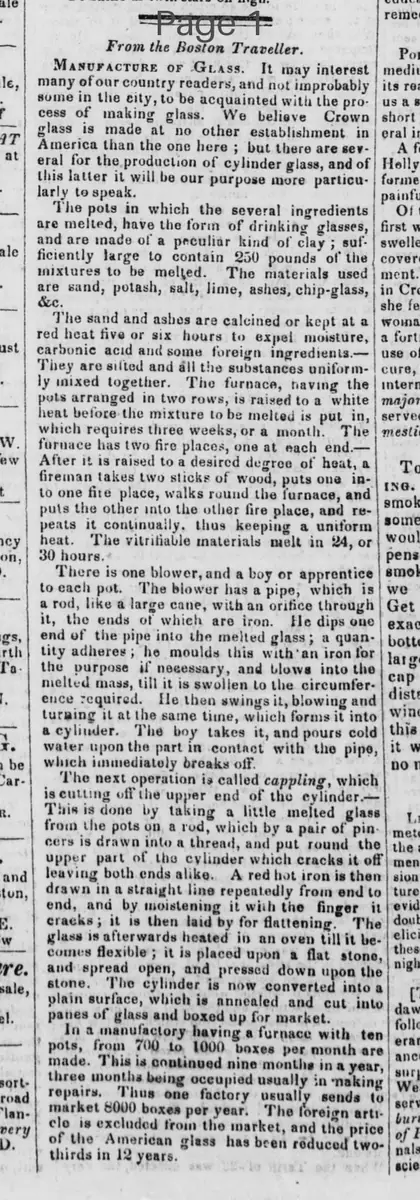
From the Boston Traveller,
MANUFACTURE OF GLASS. It may interest
many of our country readers, and not improbably
some in the city, to be acquainted with the process
of making glass. We believe Crown
glass is made at no other establishment in
America than the one here; but there are several
for the production of cylinder glass, and of
this latter it will be our purpose more particularly
to speak.
The pots in which the several ingredients
are melted, have the form of drinking glasses,
and are made of a peculiar kind of clay; sufficiently
large to contain 250 pounds of the
mixtures to be melted. The materials used
are sand, potash, salt, lime, ashes, chip-glass,
&c.
The sand and ashes are calcined or kept at a
red heat five or six hours to expel moisture,
carbonic acid and some foreign ingredients.-
They are sifted and all the substances uniformly
mixed together. The furnace, having the
pots arranged in two rows, is raised to a white
heat before the mixture to be melted is put in,
which requires three weeks, or a month. The
furnace has two fire places, one at each end.-
After it is raised to a desired degree of heat, a
fireman takes two sticks of wood, puts one into
one fire place, walks round the furnace, and
puts the other into the other fire place, and repeats
it continually, thus keeping a uniform
heat. The vitrifiable materials melt in 24, or
30 hours.
There is one blower, and a boy or apprentice
to each pot. The blower has a pipe, which is
a rod, like a large cane, with an orifice through
it, the ends of which are iron. He dips one
end of the pipe into the melted glass; a quantity
adheres; he moulds this with an iron for
the purpose if necessary, and blows into the
melted mass, till it is swollen to the circumference
required. He then swings it, blowing and
turning it at the same time, which forms it into
a cylinder. The boy takes it, and pours cold
water upon the part in contact with the pipe,
which immediately breaks off.
The next operation is called cappling, which
is cutting off the upper end of the cylinder.-
This is done by taking a little melted glass
from the pots on a rod, which by a pair of pincers
is drawn into a thread, and put round the
upper part of the cylinder which cracks it off
leaving both ends alike. A red hot iron is then
drawn in a straight line repeatedly from end to
end, and by moistening it with the finger it
cracks; it is then laid by for flattening. The
glass is afterwards heated in an oven till it becomes
flexible; it is placed upon a flat stone,
and spread open, and pressed down upon the
stone. The cylinder is now converted into a
plain surface, which is annealed and cut into
panes of glass and boxed up for market.
In a manufactory having a furnace with ten
pots, from 700 to 1000 boxes per month are
made. This is continued nine months in a year,
three months being occupied usually in making
repairs. Thus one factory usually sends to
market 9000 boxes per year. The foreign article
is excluded from the market, and the price
of the American glass has been reduced two-thirds
in 12 years.
MANUFACTURE OF GLASS. It may interest
many of our country readers, and not improbably
some in the city, to be acquainted with the process
of making glass. We believe Crown
glass is made at no other establishment in
America than the one here; but there are several
for the production of cylinder glass, and of
this latter it will be our purpose more particularly
to speak.
The pots in which the several ingredients
are melted, have the form of drinking glasses,
and are made of a peculiar kind of clay; sufficiently
large to contain 250 pounds of the
mixtures to be melted. The materials used
are sand, potash, salt, lime, ashes, chip-glass,
&c.
The sand and ashes are calcined or kept at a
red heat five or six hours to expel moisture,
carbonic acid and some foreign ingredients.-
They are sifted and all the substances uniformly
mixed together. The furnace, having the
pots arranged in two rows, is raised to a white
heat before the mixture to be melted is put in,
which requires three weeks, or a month. The
furnace has two fire places, one at each end.-
After it is raised to a desired degree of heat, a
fireman takes two sticks of wood, puts one into
one fire place, walks round the furnace, and
puts the other into the other fire place, and repeats
it continually, thus keeping a uniform
heat. The vitrifiable materials melt in 24, or
30 hours.
There is one blower, and a boy or apprentice
to each pot. The blower has a pipe, which is
a rod, like a large cane, with an orifice through
it, the ends of which are iron. He dips one
end of the pipe into the melted glass; a quantity
adheres; he moulds this with an iron for
the purpose if necessary, and blows into the
melted mass, till it is swollen to the circumference
required. He then swings it, blowing and
turning it at the same time, which forms it into
a cylinder. The boy takes it, and pours cold
water upon the part in contact with the pipe,
which immediately breaks off.
The next operation is called cappling, which
is cutting off the upper end of the cylinder.-
This is done by taking a little melted glass
from the pots on a rod, which by a pair of pincers
is drawn into a thread, and put round the
upper part of the cylinder which cracks it off
leaving both ends alike. A red hot iron is then
drawn in a straight line repeatedly from end to
end, and by moistening it with the finger it
cracks; it is then laid by for flattening. The
glass is afterwards heated in an oven till it becomes
flexible; it is placed upon a flat stone,
and spread open, and pressed down upon the
stone. The cylinder is now converted into a
plain surface, which is annealed and cut into
panes of glass and boxed up for market.
In a manufactory having a furnace with ten
pots, from 700 to 1000 boxes per month are
made. This is continued nine months in a year,
three months being occupied usually in making
repairs. Thus one factory usually sends to
market 9000 boxes per year. The foreign article
is excluded from the market, and the price
of the American glass has been reduced two-thirds
in 12 years.
What sub-type of article is it?
Curiosity
What themes does it cover?
Triumph
What keywords are associated?
Glass Manufacture
Cylinder Glass
American Factory
Blowing Process
Industrial Production
Where did it happen?
America
Story Details
Location
America
Story Details
Process of making cylinder glass: ingredients mixed and melted in clay pots over weeks; blown into cylinders by workers, cut, flattened on stones, annealed, and cut into panes. Factory produces 700-1000 boxes monthly for 9 months yearly, reducing prices and excluding imports.