Thank you for visiting SNEWPapers!
Sign up free
Editorial
April 27, 1836
Morning Star
Limerick, York County, Maine
What is this article about?
Editorial in Dover newspaper responds to John G. Adams' criticism in 'Star in the East' of 'Morning Star' publishing letters signed 'E.', defending them as personal soul histories against Universalism, exhorting Adams to reconsider his doctrine's dangers, and preferring experiential testimony over formal debate.
Clipping
OCR Quality
95%
Excellent
Full Text
DOVER:
WEDNESDAY, APRIL 27.
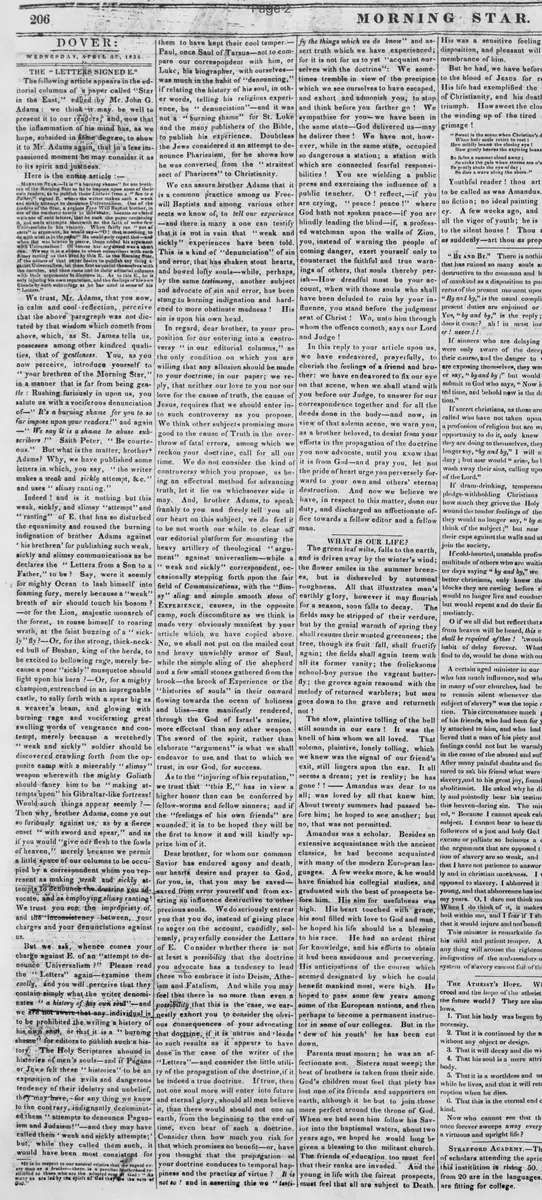
THE "LETTERS SIGNED E."
The following article appears in the editorial columns of a paper called "Star in the East," edited by Mr. John G. Adams: we think it may be well to present it to our readers; and, now that the inflammation of his mind has, as we hope, subsided in some degree, to show it to Mr. Adams again, that in a less impassioned moment he may consider it as to its spirit and justness.
Here is the entire article:-
Morning Star.-It is "a burning shame" for our brethren of the Morning Star so far to impose upon some of their own readers, as to publish those letters from a "Son to a Father," signed E. wherein the writer makes such a weak and sickly attempt to denounce Universalism. One of the readers of the Star, a zealous Free Will Baptist brother, in one of the northern towns in this state, became so elated with one of said letters, that he took the paper containing it, and made attempts therewith on the faith of some few Universalists in his vicinity. When fairly run "out of sorts" in argument, he would say-"O! that is nothing to do with what is in the paper!" He could only repeat that-and when that was beaten in pieces, there ended his argument with Universalism! Of course his argument was a short one. We say it is a shame to abuse subscribers with such flimsy ranting as that used by this E. in the Morning Star. If the editors of that paper desire to publish any thing against Universalism, let them first acquaint themselves with the doctrine, and then come out in their editorial columns with their arguments to disprove it. As to this E., he is only injuring his own reputation, and the feelings of his own friends by such subterfuge as he has used in some of his "Letters."
We trust, Mr. Adams, that you now, in calm and cool reflection, perceive that the above paragraph was not dictated by that wisdom which cometh from above, which, as St. James tells us, possesses among other kindred qualities, that of gentleness. You, as you now perceive, introduce yourself to "your brethren of the Morning Star," in a manner that is far from being gentle: Rushing furiously in upon us, you salute us with a vociferous denunciation of- "It's a burning shame for you to so far impose upon your readers!" and again- "We say it is a shame to abuse subscribers!" . Saith Peter. "Be courteous." But what is the matter, brother Adams? Why, we have published some letters in which, you say, "the writer makes a weak and sickly attempt, &c." and uses "flimsy ranting."
Indeed! and is it nothing but this weak, sickly, and flimsy "attempt" and "ranting" of E. that has so disturbed the equanimity and roused the burning indignation of brother Adams against "his brethren" for publishing such weak, sickly and flimsy communications as he declares the "Letters from a Son to a Father," to be? Say, were it seemly for mighty Ocean to lash himself into foaming fury, merely because a "weak" breath of air should touch his bosom? -or for the Lion, majestic monarch of the forest, to rouse himself to roaring wrath, at the faint buzzing of a "sickly" fly?--Or, for the strong, thick-necked bull of Bashan, king of the herds, to be excited to bellowing rage, merely because a poor "sickly" musquito should light upon his horn? -Or, for a mighty champion, entrenched in an impregnable castle, to sally forth with a spear big as a weaver's beam, and glowing with burning rage and vociferating great swelling words of vengeance and contempt, merely because a wretchedly "weak and sickly" soldier should be discovered crawling forth from the opposite camp with a miserably "flimsy" weapon wherewith the mighty Goliath should fancy him to be "making attempts upon" his Gibraltar-like fortress!
Would such things appear seemly?- Then why, brother Adams, come ye out so furiously against us, as by a fierce onset "with sword and spear," and as if you would "give our flesh to the fowls of heaven," merely because we permit a little space of our columns to be occupied by a correspondent whom you represent as making weak and sickly attempts to denounce the doctrine you advocate, and as employing flimsy ranting!
We trust you see the impropriety of, and the inconsistency between, your charges and your denunciations against us.
But we ask, whence comes your charge against E. of an "attempt to denounce Universalism?" Please read the Letters again-examine them coolly, and you will perceive that they contain simply what the writer denominates "a history of his own soul"-and we are not aware that any individual is to be prohibited the writing a history of his own soul, or that it is a "burning shame" for editors to publish such a history: The Holy Scriptures abound in histories of men's souls-and if Pagans or Jews felt these "histories" to be an exposition of the evils and dangerous tendency of their idolatry and unbelief, they may have-for any thing we know to the contrary, indignantly denominated them "attempts to denounce Paganism and Judaism!"-and they may have called them "weak and sickly attempts;" but, while they called them such, it would have been most consistent for them to have kept their cool temper.-
Paul, once Saul of Tarsus-not to compare our correspondent with him, or Luke, his biographer, with ourselves- was much in the habit of "denouncing," if relating the history of his soul, in other words, telling his religious experience, be "denunciation" and it was not a "burning shame" for St. Luke and the many publishers of the Bible, to publish his experience. Doubtless the Jews considered it an attempt to denounce Pharisaism, or he shows how he was converted from the "straitest sect of Pharisees" to Christianity.
We can assure brother Adams that it is a common practice among us Free-will Baptists and among various other sects we know of, to tell our experience -and there is many a one can testify that it is not in vain that "weak and sickly" experiences have been told.
This is a kind of "denunciation" of sin and error, that has shaken stout hearts, and bowed lofty souls-while, perhaps, by the same testimony, another subject and advocate of sin and error, has been stung to burning indignation and hardened to more obstinate madness! His sin is upon his own head.
In regard, dear brother, to your proposition for our entering into a controversy "in our editorial columns," as the only condition on which you are willing that any allusion should be made to your doctrine, in our paper; we reply, that neither our love to you nor our love for the cause of truth, the cause of Jesus, requires that we should enter into such controversy as you propose.
We think other subjects promising more good to the cause of Truth in the overthrow of fatal errors, among which we reckon your doctrine, call for all our time. We do not consider the kind of controversy which you propose, as being an effectual method for advancing truth, let it lie on whichsoever side it may. And, brother Adams, to speak frankly to you and freely tell you all our heart on this subject, we do feel it to be not worth our while to clear off our editorial platform for mounting the heavy artillery of theological "argument" against universalism-while a "weak and sickly" correspondent, occasionally stepping forth upon the arena of Communications, with the "flimsy" sling and simple smooth stone of Experience, causes, in the opposite camp, such discomfiture as we think is made very obviously manifest by your article which we have copied above.
No, we shall not put on the mailed coat and heavy unwieldy armor of Saul, while the simple sling of the shepherd and a few small stones gathered from the brook-the brook of Experience or the "histories of souls" in their onward flowing towards the ocean of holiness and bliss are manifestly rendered, through the God of Israel's armies, more effectual than any other weapon.
The sword of the spirit, rather than elaborate "argument" is what we shall endeavor to use and that to which we trust, in our God, our success.
As to the "injuring of his reputation," we trust that "this E," has in view a higher honor than can be conferred by fellow-worms and fellow sinners; and if the "feelings of his own friends" are wounded, it is to be hoped they will be the first to know it and will kindly apprise him of it.
Dear brother, for whom our common Savior has endured agony and death, our hearts desire and prayer to God, for you, is, that you may be saved- saved from error yourself and from exerting an influence destructive to other precious souls. We do seriously entreat you that you do, instead of giving place to anger on the account, candidly, solemnly, prayerfully consider the Letters of E. Consider whether there is not at least a possibility that the doctrine you advocate has a tendency to lead those who embrace it into Deism, Atheism and Fatalism. And while you may feel that there is no more than even a possibility, that this is the case, we earnestly exhort you to consider the obvious consequences of your advocating that doctrine, if it is untrue and leads to such results as it appears to have done in the case of the writer of the "Letters"-and consider the little utility of the propagation of the doctrine, if it be indeed a true doctrine. If true, then not one soul more will enter into future and eternal glory, should all men believe it, than there would should not one on earth, from the beginning to the end of time, even hear of such a doctrine.
Consider then how much you risk for that which promises no benefit--or, have you thought that the propagation of your doctrine conduces to temporal happiness and the practice of virtue? It is not so! and in asserting this we "testify the things which we do know" and assert truth which we have experienced; for it is not for us to yet "acquaint ourselves with the doctrine": We sometimes tremble in view of the precipice which we see ourselves to have escaped, and exhort and admonish you, to stop and think before you farther go! We sympathise for you we have been in the same state-God delivered us-may he deliver thee! We have not, however, while in the same state, occupied so dangerous a station; a station with which are connected fearful responsibilities! You are wielding a public press and exercising the influence of a public teacher. O! reflect,-if you are crying, "peace! peace!" where God hath not spoken peace-if you are blindly leading the blind-if, a professed watchman upon the walls of Zion, you, instead of warning the people of coming danger, exert yourself only to counteract the faithful and true warnings of others, that souls thereby perish--How dreadful must be your account, when with those souls who shall have been deluded to ruin by your influence, you stand before the judgment seat of Christ! Wo, unto him through whom the offence cometh, says our Lord and Judge!
In this reply to your article upon us, we have endeavored, prayerfully, to cherish the feelings of a friend and brother: we have endeavored to fix our eye on that scene, when we shall stand with you before our Judge, to answer for our correspondence together and for all the deeds done in the body-and now, in view of that solemn scene, we warn you, as a brother beloved, to desist from your efforts in the propagation of the doctrine you now advocate, until you know that it is from God-and pray you, let not the pride of heart urge you perversely forward to your own and others' eternal destruction. And now we believe we have, in respect to this matter, done our duty, and discharged an affectionate office towards a fellow editor and a fellow man.
WEDNESDAY, APRIL 27.
THE "LETTERS SIGNED E."
The following article appears in the editorial columns of a paper called "Star in the East," edited by Mr. John G. Adams: we think it may be well to present it to our readers; and, now that the inflammation of his mind has, as we hope, subsided in some degree, to show it to Mr. Adams again, that in a less impassioned moment he may consider it as to its spirit and justness.
Here is the entire article:-
Morning Star.-It is "a burning shame" for our brethren of the Morning Star so far to impose upon some of their own readers, as to publish those letters from a "Son to a Father," signed E. wherein the writer makes such a weak and sickly attempt to denounce Universalism. One of the readers of the Star, a zealous Free Will Baptist brother, in one of the northern towns in this state, became so elated with one of said letters, that he took the paper containing it, and made attempts therewith on the faith of some few Universalists in his vicinity. When fairly run "out of sorts" in argument, he would say-"O! that is nothing to do with what is in the paper!" He could only repeat that-and when that was beaten in pieces, there ended his argument with Universalism! Of course his argument was a short one. We say it is a shame to abuse subscribers with such flimsy ranting as that used by this E. in the Morning Star. If the editors of that paper desire to publish any thing against Universalism, let them first acquaint themselves with the doctrine, and then come out in their editorial columns with their arguments to disprove it. As to this E., he is only injuring his own reputation, and the feelings of his own friends by such subterfuge as he has used in some of his "Letters."
We trust, Mr. Adams, that you now, in calm and cool reflection, perceive that the above paragraph was not dictated by that wisdom which cometh from above, which, as St. James tells us, possesses among other kindred qualities, that of gentleness. You, as you now perceive, introduce yourself to "your brethren of the Morning Star," in a manner that is far from being gentle: Rushing furiously in upon us, you salute us with a vociferous denunciation of- "It's a burning shame for you to so far impose upon your readers!" and again- "We say it is a shame to abuse subscribers!" . Saith Peter. "Be courteous." But what is the matter, brother Adams? Why, we have published some letters in which, you say, "the writer makes a weak and sickly attempt, &c." and uses "flimsy ranting."
Indeed! and is it nothing but this weak, sickly, and flimsy "attempt" and "ranting" of E. that has so disturbed the equanimity and roused the burning indignation of brother Adams against "his brethren" for publishing such weak, sickly and flimsy communications as he declares the "Letters from a Son to a Father," to be? Say, were it seemly for mighty Ocean to lash himself into foaming fury, merely because a "weak" breath of air should touch his bosom? -or for the Lion, majestic monarch of the forest, to rouse himself to roaring wrath, at the faint buzzing of a "sickly" fly?--Or, for the strong, thick-necked bull of Bashan, king of the herds, to be excited to bellowing rage, merely because a poor "sickly" musquito should light upon his horn? -Or, for a mighty champion, entrenched in an impregnable castle, to sally forth with a spear big as a weaver's beam, and glowing with burning rage and vociferating great swelling words of vengeance and contempt, merely because a wretchedly "weak and sickly" soldier should be discovered crawling forth from the opposite camp with a miserably "flimsy" weapon wherewith the mighty Goliath should fancy him to be "making attempts upon" his Gibraltar-like fortress!
Would such things appear seemly?- Then why, brother Adams, come ye out so furiously against us, as by a fierce onset "with sword and spear," and as if you would "give our flesh to the fowls of heaven," merely because we permit a little space of our columns to be occupied by a correspondent whom you represent as making weak and sickly attempts to denounce the doctrine you advocate, and as employing flimsy ranting!
We trust you see the impropriety of, and the inconsistency between, your charges and your denunciations against us.
But we ask, whence comes your charge against E. of an "attempt to denounce Universalism?" Please read the Letters again-examine them coolly, and you will perceive that they contain simply what the writer denominates "a history of his own soul"-and we are not aware that any individual is to be prohibited the writing a history of his own soul, or that it is a "burning shame" for editors to publish such a history: The Holy Scriptures abound in histories of men's souls-and if Pagans or Jews felt these "histories" to be an exposition of the evils and dangerous tendency of their idolatry and unbelief, they may have-for any thing we know to the contrary, indignantly denominated them "attempts to denounce Paganism and Judaism!"-and they may have called them "weak and sickly attempts;" but, while they called them such, it would have been most consistent for them to have kept their cool temper.-
Paul, once Saul of Tarsus-not to compare our correspondent with him, or Luke, his biographer, with ourselves- was much in the habit of "denouncing," if relating the history of his soul, in other words, telling his religious experience, be "denunciation" and it was not a "burning shame" for St. Luke and the many publishers of the Bible, to publish his experience. Doubtless the Jews considered it an attempt to denounce Pharisaism, or he shows how he was converted from the "straitest sect of Pharisees" to Christianity.
We can assure brother Adams that it is a common practice among us Free-will Baptists and among various other sects we know of, to tell our experience -and there is many a one can testify that it is not in vain that "weak and sickly" experiences have been told.
This is a kind of "denunciation" of sin and error, that has shaken stout hearts, and bowed lofty souls-while, perhaps, by the same testimony, another subject and advocate of sin and error, has been stung to burning indignation and hardened to more obstinate madness! His sin is upon his own head.
In regard, dear brother, to your proposition for our entering into a controversy "in our editorial columns," as the only condition on which you are willing that any allusion should be made to your doctrine, in our paper; we reply, that neither our love to you nor our love for the cause of truth, the cause of Jesus, requires that we should enter into such controversy as you propose.
We think other subjects promising more good to the cause of Truth in the overthrow of fatal errors, among which we reckon your doctrine, call for all our time. We do not consider the kind of controversy which you propose, as being an effectual method for advancing truth, let it lie on whichsoever side it may. And, brother Adams, to speak frankly to you and freely tell you all our heart on this subject, we do feel it to be not worth our while to clear off our editorial platform for mounting the heavy artillery of theological "argument" against universalism-while a "weak and sickly" correspondent, occasionally stepping forth upon the arena of Communications, with the "flimsy" sling and simple smooth stone of Experience, causes, in the opposite camp, such discomfiture as we think is made very obviously manifest by your article which we have copied above.
No, we shall not put on the mailed coat and heavy unwieldy armor of Saul, while the simple sling of the shepherd and a few small stones gathered from the brook-the brook of Experience or the "histories of souls" in their onward flowing towards the ocean of holiness and bliss are manifestly rendered, through the God of Israel's armies, more effectual than any other weapon.
The sword of the spirit, rather than elaborate "argument" is what we shall endeavor to use and that to which we trust, in our God, our success.
As to the "injuring of his reputation," we trust that "this E," has in view a higher honor than can be conferred by fellow-worms and fellow sinners; and if the "feelings of his own friends" are wounded, it is to be hoped they will be the first to know it and will kindly apprise him of it.
Dear brother, for whom our common Savior has endured agony and death, our hearts desire and prayer to God, for you, is, that you may be saved- saved from error yourself and from exerting an influence destructive to other precious souls. We do seriously entreat you that you do, instead of giving place to anger on the account, candidly, solemnly, prayerfully consider the Letters of E. Consider whether there is not at least a possibility that the doctrine you advocate has a tendency to lead those who embrace it into Deism, Atheism and Fatalism. And while you may feel that there is no more than even a possibility, that this is the case, we earnestly exhort you to consider the obvious consequences of your advocating that doctrine, if it is untrue and leads to such results as it appears to have done in the case of the writer of the "Letters"-and consider the little utility of the propagation of the doctrine, if it be indeed a true doctrine. If true, then not one soul more will enter into future and eternal glory, should all men believe it, than there would should not one on earth, from the beginning to the end of time, even hear of such a doctrine.
Consider then how much you risk for that which promises no benefit--or, have you thought that the propagation of your doctrine conduces to temporal happiness and the practice of virtue? It is not so! and in asserting this we "testify the things which we do know" and assert truth which we have experienced; for it is not for us to yet "acquaint ourselves with the doctrine": We sometimes tremble in view of the precipice which we see ourselves to have escaped, and exhort and admonish you, to stop and think before you farther go! We sympathise for you we have been in the same state-God delivered us-may he deliver thee! We have not, however, while in the same state, occupied so dangerous a station; a station with which are connected fearful responsibilities! You are wielding a public press and exercising the influence of a public teacher. O! reflect,-if you are crying, "peace! peace!" where God hath not spoken peace-if you are blindly leading the blind-if, a professed watchman upon the walls of Zion, you, instead of warning the people of coming danger, exert yourself only to counteract the faithful and true warnings of others, that souls thereby perish--How dreadful must be your account, when with those souls who shall have been deluded to ruin by your influence, you stand before the judgment seat of Christ! Wo, unto him through whom the offence cometh, says our Lord and Judge!
In this reply to your article upon us, we have endeavored, prayerfully, to cherish the feelings of a friend and brother: we have endeavored to fix our eye on that scene, when we shall stand with you before our Judge, to answer for our correspondence together and for all the deeds done in the body-and now, in view of that solemn scene, we warn you, as a brother beloved, to desist from your efforts in the propagation of the doctrine you now advocate, until you know that it is from God-and pray you, let not the pride of heart urge you perversely forward to your own and others' eternal destruction. And now we believe we have, in respect to this matter, done our duty, and discharged an affectionate office towards a fellow editor and a fellow man.
What sub-type of article is it?
Moral Or Religious
What keywords are associated?
Universalism
Free Will Baptists
Religious Experience
Soul History
Theological Debate
Morning Star
Star In The East
Letters Signed E
What entities or persons were involved?
John G. Adams
Star In The East
Morning Star
E.
Free Will Baptists
Universalists
Editorial Details
Primary Topic
Defense Of Anti Universalist Letters And Critique Of Universalism
Stance / Tone
Defensive Exhortation Against Universalism
Key Figures
John G. Adams
Star In The East
Morning Star
E.
Free Will Baptists
Universalists
Key Arguments
Letters Signed E. Are Personal Soul Histories, Not Weak Denunciations
Adams' Response Lacks Gentleness And Wisdom
Publishing Religious Experiences Is Biblical And Common Practice
Universalism Risks Leading To Deism, Atheism, And Fatalism
Experiential Testimony More Effective Than Formal Theological Argument
Exhortation To Adams To Reconsider His Doctrine's Dangers And Responsibilities As Editor