Thank you for visiting SNEWPapers!
Sign up free
Letter to Editor
February 23, 1816
Daily National Intelligencer
Washington, District Of Columbia
What is this article about?
A letter defending domestic manufacturing in the US, citing employment and value figures from a commerce report. Argues it boosts consumption, benefits agriculture, increases commerce, and supports moderate protecting duties to avoid smuggling. Signed CIVIS.
Clipping
OCR Quality
98%
Excellent
Full Text
TO THE EDITORS.
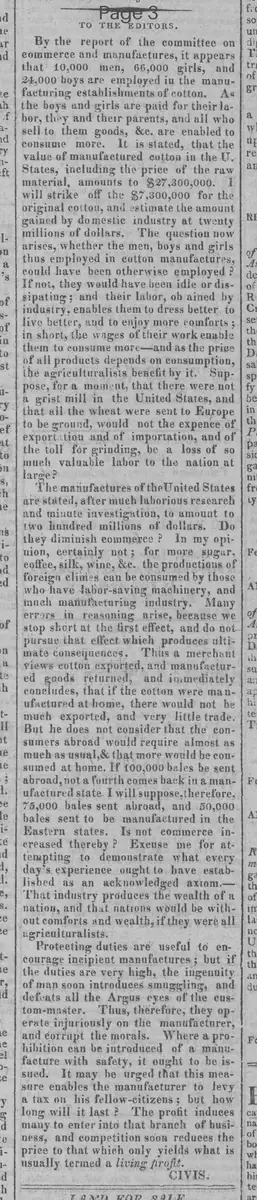
By the report of the committee on commerce and manufactures, it appears that 10,000 men, 66,000 girls, and 24,000 boys are employed in the manufacturing establishments of cotton. As the boys and girls are paid for their labor, they and their parents, and all who sell to them goods, &c. are enabled to consume more. It is stated, that the value of manufactured cotton in the U. States, including the price of the raw material, amounts to $27,300,000. I will strike off the $7,300,000 for the original cotton, and estimate the amount gained by domestic industry at twenty millions of dollars. The question now arises, whether the men, boys and girls thus employed in cotton manufactures, could have been otherwise employed? If not, they would have been idle or dissipating; and their labor, obtained by industry, enables them to dress better, to live better, and to enjoy more comforts; in short, the wages of their work enable them to consume more—and as the price of all products depends on consumption, the agriculturalists benefit by it. Suppose, for a moment, that there were not a grist mill in the United States, and that all the wheat were sent to Europe to be ground, would not the expence of exportation and of importation, and of the toll for grinding, be a loss of so much valuable labor to the nation at large?
The manufactures of the United States are stated, after much laborious research and minute investigation, to amount to two hundred millions of dollars. Do they diminish commerce? In my opinion, certainly not; for more sugar, coffee, silk, wine, &c. the productions of foreign climes can be consumed by those who have labor-saving machinery, and much manufacturing industry. Many errors in reasoning arise, because we stop short at the first effect, and do not pursue that effect which produces ultimate consequences. Thus a merchant views cotton exported, and manufactured goods returned, and immediately concludes, that if the cotton were manufactured at home, there would not be much exported, and very little trade. But he does not consider that the consumers abroad would require almost as much as usual, & that more would be consumed at home. If 100,000 bales be sent abroad, not a fourth comes back in a manufactured state. I will suppose, therefore, 75,000 bales sent abroad, and 25,000 bales sent to be manufactured in the Eastern states. Is not commerce increased thereby? Excuse me for attempting to demonstrate what every day's experience ought to have established as an acknowledged axiom.—That industry produces the wealth of a nation, and that nations would be without comforts and wealth, if they were all agriculturalists.
Protecting duties are useful to encourage incipient manufactures: but if the duties are very high, the ingenuity of man soon introduces smuggling, and defeats all the Argus eyes of the custom-master. Thus, therefore, they operate injuriously on the manufacturer, and corrupt the morals. Where a prohibition can be introduced of a manufacture with safety, it ought to be issued. It may be urged that this measure enables the manufacturer to levy a tax on his fellow-citizens; but how long will it last? The profit induces many to enter into that branch of business, and competition soon reduces the price to that which only yields what is usually termed a living profit.
CIVIS.
By the report of the committee on commerce and manufactures, it appears that 10,000 men, 66,000 girls, and 24,000 boys are employed in the manufacturing establishments of cotton. As the boys and girls are paid for their labor, they and their parents, and all who sell to them goods, &c. are enabled to consume more. It is stated, that the value of manufactured cotton in the U. States, including the price of the raw material, amounts to $27,300,000. I will strike off the $7,300,000 for the original cotton, and estimate the amount gained by domestic industry at twenty millions of dollars. The question now arises, whether the men, boys and girls thus employed in cotton manufactures, could have been otherwise employed? If not, they would have been idle or dissipating; and their labor, obtained by industry, enables them to dress better, to live better, and to enjoy more comforts; in short, the wages of their work enable them to consume more—and as the price of all products depends on consumption, the agriculturalists benefit by it. Suppose, for a moment, that there were not a grist mill in the United States, and that all the wheat were sent to Europe to be ground, would not the expence of exportation and of importation, and of the toll for grinding, be a loss of so much valuable labor to the nation at large?
The manufactures of the United States are stated, after much laborious research and minute investigation, to amount to two hundred millions of dollars. Do they diminish commerce? In my opinion, certainly not; for more sugar, coffee, silk, wine, &c. the productions of foreign climes can be consumed by those who have labor-saving machinery, and much manufacturing industry. Many errors in reasoning arise, because we stop short at the first effect, and do not pursue that effect which produces ultimate consequences. Thus a merchant views cotton exported, and manufactured goods returned, and immediately concludes, that if the cotton were manufactured at home, there would not be much exported, and very little trade. But he does not consider that the consumers abroad would require almost as much as usual, & that more would be consumed at home. If 100,000 bales be sent abroad, not a fourth comes back in a manufactured state. I will suppose, therefore, 75,000 bales sent abroad, and 25,000 bales sent to be manufactured in the Eastern states. Is not commerce increased thereby? Excuse me for attempting to demonstrate what every day's experience ought to have established as an acknowledged axiom.—That industry produces the wealth of a nation, and that nations would be without comforts and wealth, if they were all agriculturalists.
Protecting duties are useful to encourage incipient manufactures: but if the duties are very high, the ingenuity of man soon introduces smuggling, and defeats all the Argus eyes of the custom-master. Thus, therefore, they operate injuriously on the manufacturer, and corrupt the morals. Where a prohibition can be introduced of a manufacture with safety, it ought to be issued. It may be urged that this measure enables the manufacturer to levy a tax on his fellow-citizens; but how long will it last? The profit induces many to enter into that branch of business, and competition soon reduces the price to that which only yields what is usually termed a living profit.
CIVIS.
What sub-type of article is it?
Persuasive
Informative
Political
What themes does it cover?
Economic Policy
Commerce Trade
Agriculture
What keywords are associated?
Domestic Manufacturing
Cotton Industry
Protecting Duties
Commerce Benefits
Agricultural Gains
Smuggling Risks
National Wealth
What entities or persons were involved?
Civis.
To The Editors.
Letter to Editor Details
Author
Civis.
Recipient
To The Editors.
Main Argument
domestic manufacturing employs workers who otherwise might be idle, increases consumption benefiting agriculture and commerce, and does not diminish trade; protecting duties should encourage new industries moderately to avoid smuggling and moral corruption.
Notable Details
Cites Report: 10,000 Men, 66,000 Girls, 24,000 Boys Employed In Cotton Manufacturing
Value Of Manufactured Cotton: $27,300,000 Total, $20,000,000 From Domestic Industry
Analogy To Grist Mills For Value Of Domestic Processing
Us Manufactures Total $200,000,000
Example: 100,000 Bales Cotton Exported, Only 1/4 Returns Manufactured