Thank you for visiting SNEWPapers!
Sign up free
The Southern Press
Washington, District Of Columbia
What is this article about?
U.S. Senate session on December 20, 1851, featuring petitions on Indian affairs and breakwaters, debates on congressional binding costs, non-intervention resolutions, requests for Irish exiles and Abd-el-Kader releases, printing of journals, bounty land amendments, and a heated exchange between Senators Foote and Rhett on compromise, secession, and historical figures.
Clipping
OCR Quality
Full Text
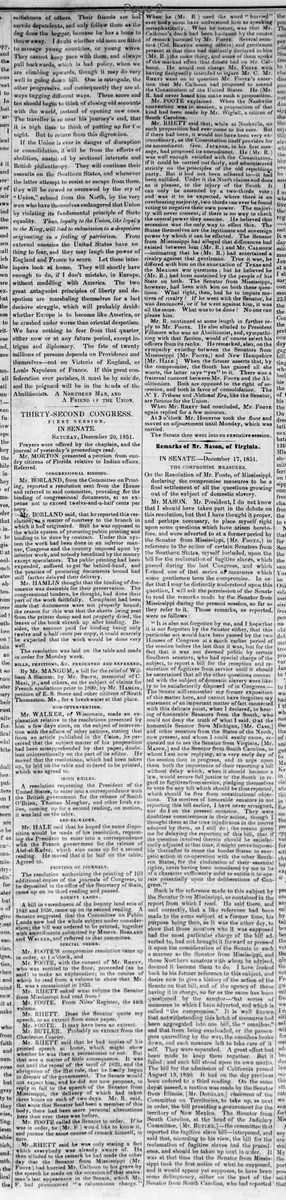
FIRST SESSION.
IN SENATE
Saturday, December 20, 1851.
Prayers were offered by the chaplain, and the journal of yesterday's proceedings read.
Mr. Morton presented a petition from sundry citizens of Florida relative to Indian affairs. Referred.
CONGRESSIONAL BINDING.
Mr. Borland, from the Committee on Printing, reported a resolution sent from the House and referred to said committee, providing for the binding of congressional documents, at an expense not to exceed twelve-and-a-half cents per copy.
Mr. Borland said, that he reported this resolution, as a matter of courtesy to the branch in which it had originated. Still he was opposed to the whole system of procuring public printing and binding to be done by contract. Under this system the work had been done in an inferior manner, Congress and the country imposed upon by inferior work, and nobody benefitted by the money except speculators. The public printing had been expended, suffered to get far behind-hand, and the practice of procuring documents bound had still farther delayed their delivery.
Mr. Hamlin thought that the binding of documents was desirable for their preservation. The congressional binders, he thought, had done their part of the work faithfully. Complaint had been made that documents were not properly bound; the reason for this was that the sheets being sent from the printer damp and not properly dried, the leaves of the book shrank up after binding. Besides, the amount paid for binding being only twelve and a-half cents per copy, it could scarcely be expected that the work would be done very well.
The resolution was laid on the table and made in order for Monday week.
BILLS, PETITIONS, &C. PRESENTED AND REFERRED,
By Mr. Mangum, a bill for the relief of William A. Slacum; by Mr. Smith, memorial of C. Mason, jr., and others, on the subject of claims for French spoliations prior to 1800; by Mr. Hamlin, petition of E. S. Stone and other citizens of South Thomaston, Me., for a breakwater at that place.
NON-INTERVENTION.
Mr. Walker, of Wisconsin, made an explanation relative to the resolutions presented by him a few days since, on the subject of intervention with the affairs of other nations, stating that from an article published in the Union, he perceived that the subject matter of his proposition had been misapprehended by that paper, doubtless unintentionally on the part of its editor. He moved that the resolutions, which had been taken up, be laid on the table and ordered to be printed, which was agreed to.
IRISH EXILES.
A resolution requesting the President of the United States, to enter into a correspondence with the British government for the release of Smith O'Brien, Thomas Meagher, and other Irish exiles, coming up for a second reading, on motion, it was laid on the table.
ABD-EL-KADER.
Mr. Hale said that he hoped the same disposition would be made of his resolution, requesting the President to enter into a correspondence with the French government for the release of Abd-el-Kader, which also came up for a second reading. He moved that it be laid on the table. Agreed to.
PRINTING OF JOURNALS.
The resolution authorizing the printing of 100 additional copies of the journals of Congress, to be deposited in the office of the Secretary of State, came up on its third reading and passed.
BOUNTY LANDS.
A bill in amendment of the bounty land acts of 1848 and 1850, came up on its second reading. A Senator suggested that the Committee on Public Lands now had the whole subject under consideration; the bill was ordered to be printed, together with amendments submitted by Messrs. Borland and Walker, and referred to that committee.
SPECIAL ORDER
Mr. Foote's compromise resolution came up in order, at 1 o'clock, and Mr. Foote, with the consent of Mr. Rhett who was entitled to the floor, proceeded (as he said) to make an explanation; in the course of which he read from a volume to show that Mr. R. was a secessionist in 1833.
Mr. Rhett asked what volume the Senator from Mississippi had read from?
Mr. Foote. From Niles' Register, the 44th volume.
Mr. Rhett. Does the Senator quote my speech, or an extract from some paper.
Mr. Foote. It may have been an extract.
Mr. Butler. Probably an extract from the Charleston Courier.
Mr. Rhett said that he had copies of his printed speech at home, which might show whether he was then a secessionist or not. But that was a matter of little consequence. It was not until the repeal of the tariff of 1833, and the abrogation of the 21st rule, that he finally began to despair of the government. The Senate would not expect him, and he did not now propose, to reply in full to the speech of the Senator from Mississippi, the delivery of which had taken three hours on each of two days. Mr. R. said, that since that Senator had been a member of this body, there had been more personal altercations here than ever there was before.
Mr. Foote called the Senator to order. If he was in order, he (Mr. F.) would like to know it, and pursue the same course of remark himself, in turn.
Mr. Rhett said he was only stating a fact which everybody was already aware of. He then alluded to the remark he had made the other day that the Senator from Mississippi (Mr. Foote) had hurried Mr. Calhoun to his grave by the speech he made on the occasion of that statesman's last appearance in the Senate, which Mr. F. had pronounced "a calumnious charge."
When he (Mr. R) used the word "hurried" everybody must have understood him as speaking metaphorically, What he meant, was that Mr. Calhoun's death had been hastened by the course of remark pursued by Mr. Foote. Several senators (Col. Benton among others) and gentlemen present at that time had distinctly declared to him (Mr. R.) the same thing, and some of them spoke of the marked effect that debate had on Mr. Calhoun. He would not charge Mr. Foote with having designedly intended to injure Mr. C. Mr. Rhett went on to question Mr. Foote's assertion that Mr. Calhoun had proposed to amend the Constitution of the United States. He (Mr. R.) had never heard him make such a proposition.
Mr. Foote explained. When the Nashville convention was in session, a proposition of that kind had been made by Mr. Wigfall, a citizen of South Carolina.
Mr. Rhett said that, while at Nashville, no such proposition had ever come to his ears. But if there had been, it would not have been very extraordinary, as the Constitution itself provides for its amendment. Gen. Jackson, in his first message, had proposed its amendment. He (Mr. R.) was well enough satisfied with the Constitution, if it could be carried out fairly, and administered strictly on the principles of the old republican party. But it had not been adhered to—it had been nullified. Under it the North claims and does as it pleases, to the injury of the South It can only be amended by a two-thirds vote; and was it to be expected, where there is an overbearing majority, two thirds can ever be found voting to negative their own power. The majority will never consent, if there is no way to check the central power they assume. He believed that secession was the only way to effect this. The States themselves are the legitimate and sovereign power by which it can be effected. The Senator from Mississippi had alleged that differences had existed between him (Mr. R.) and Mr. Calhoun—intimating that he (Mr. R.) had entertained a rivalry against that gentleman. True it was, he differed with him on the annexation of Texas and the Mexican war questions; but he believed he (Mr. R.) had been sustained by the people of his State on both. The Senator from Mississippi, however, had been with him on both these questions. What right, then, had he to impute motives of rivalry? If he went with the Senator, he was denounced, or if he went against him, it was all the same. What was to be done? No one can please him.
Mr. R. continued at some length in further reply to Mr. Foote. He also alluded to President Fillmore who was an Abolitionist, and, sympathizing with that faction, would of course select his officers from its ranks. He remarked, also, on the sympathy existing between the Senators from Mississippi [Mr. Foote,] and New Hampshire [Mr. Hale.] When the former asserts that, by the compromise, the South has gained all she wants, the latter says "yes" to it. There was a fraternal concord between Mr. Foote and the Abolitionists. Both are opposed to the right of secession, and both in favor of consolidation. The N. Y. Tribune and National Era, like the Senator, are furious for the Union.
When Mr. Rhett had concluded, Mr. Foote again replied for a few minutes.
At 3 o'clock Mr. Houston took the floor and moved an adjournment until Monday, which was carried.
The Senate then went into an executive session.
What sub-type of article is it?
What keywords are associated?
What entities or persons were involved?
Domestic News Details
Event Date
Saturday, December 20, 1851
Key Persons
Outcome
various resolutions laid on table; bills referred to committees; printing authorized; session adjourned to monday; debate on compromise and secession continued without resolution.
Event Details
The Senate convened with prayers and journal reading. Petitions presented on Indian affairs, French spoliations, and breakwater. Discussion on congressional binding resolution opposed due to contract system issues, defended for preservation; laid on table. Explanations on non-intervention resolutions; laid on table and printed. Resolutions for Irish exiles and Abd-el-Kader releases laid on table. Printing of additional journals passed. Bounty land bill referred to committee. Special order: Debate between Mr. Foote and Mr. Rhett on compromise, secession, historical speeches, and political alignments, with interruptions; adjourned at 3 o'clock.