Thank you for visiting SNEWPapers!
Sign up free
The Rhode Island Republican
Newport, Newport County, Rhode Island
What is this article about?
Sarah Bella Dunlop's 1821 letter from Franklin, Mississippi, details regional plant varieties like corns used for food and feed, Millet, Coffee-nut tree as coffee substitute, Honey-Locust gum, and fruits like plums and grapes, suggesting agricultural and manufacturing benefits.
Clipping
OCR Quality
Full Text
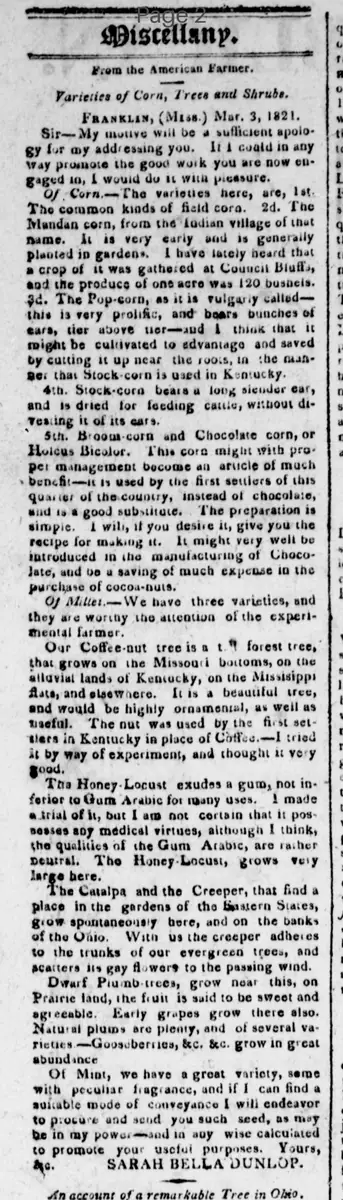
From the American Farmer.
Varieties of Corn, Trees and Shrubs.
Franklin, (Miss.) Mar. 3, 1821.
Sir--My motive will be a sufficient apology for my addressing you. If I could in any way promote the good work you are now engaged in, I would do it with pleasure.
Of Corn.--The varieties here, are, 1st. The common kinds of field corn. 2d. The Mandan corn, from the Indian village of that name. It is very early and is generally planted in gardens. I have lately heard that a crop of it was gathered at Council Bluffs, and the produce of one acre was 120 bushels. 3d. The Pop-corn, as it is vulgarly called--this is very prolific, and bears bunches of ears, tier above tier--and I think that it might be cultivated to advantage and saved by cutting it up near the roots, in the manner that Stock-corn is used in Kentucky. 4th. Stock-corn bears a long slender ear, and is dried for feeding cattle, without divesting it of its ears. 5th. Broom-corn and Chocolate corn, or Holcus Bicolor. This corn might with proper management become an article of much benefit--it was used by the first settlers of this quarter of the country, instead of chocolate, and is a good substitute. The preparation is simple. I will, if you desire it, give you the recipe for making it. It might very well be introduced in the manufacturing of Chocolate, and be a saving of much expense in the purchase of cocoa-nuts.
Of Millet.--We have three varieties, and they are worthy the attention of the experimental farmer.
Our Coffee-nut tree is a large forest tree, that grows on the Missouri bottoms, on the alluvial lands of Kentucky, on the Mississippi flats, and elsewhere. It is a beautiful tree, and would be highly ornamental, as well as useful. The nut was used by the first settlers in Kentucky in place of Coffee.--I tried it by way of experiment, and thought it very good.
The Honey-Locust exudes a gum, not inferior to Gum Arabic for many uses. I made a trial of it, but I am not certain that it possesses any medical virtues, although I think the qualities of the Gum Arabic, are rather neutral. The Honey-Locust, grows very large here.
The Catalpa and the Creeper, that find a place in the gardens of the Eastern States, grow spontaneously here, and on the banks of the Ohio. Witness the creeper adheres to the trunks of our evergreen trees, and scatters its gay flowers to the passing wind.
Dwarf Plum-trees, grow near this, on Prairie land, the fruit is said to be sweet and agreeable. Early grapes grow there also. Natural plums are plenty, and of several varieties--Gooseberries, &c, &c. grow in great abundance.
Of Mint, we have a great variety, some with peculiar fragrance, and if I can find a suitable mode of conveyance I will endeavor to procure and send you such seed, as may be in my power and in any wise calculated to promote your useful purposes. Yours, &c.
SARAH BELLA DUNLOP.
What sub-type of article is it?
What themes does it cover?
What keywords are associated?
What entities or persons were involved?
Where did it happen?
Story Details
Key Persons
Location
Franklin, (Miss.); Missouri Bottoms; Kentucky; Mississippi Flats; Ohio; Prairie Land
Event Date
Mar. 3, 1821
Story Details
Letter describing varieties of corn including common field corn, Mandan corn, Pop-corn, Stock-corn, Broom-corn and Chocolate corn used as chocolate substitute; varieties of Millet; Coffee-nut tree used as coffee substitute; Honey-Locust gum comparable to Gum Arabic; Catalpa and Creeper; Dwarf Plum-trees, Early grapes, Natural plums, Gooseberries; varieties of Mint.