Thank you for visiting SNEWPapers!
Sign up free
The Wheeling Daily Intelligencer
Wheeling, Ohio County, West Virginia
What is this article about?
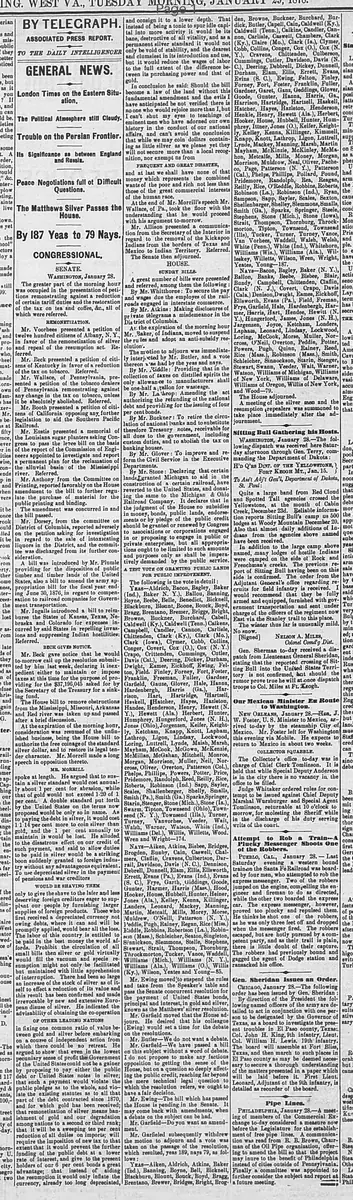
Congressional proceedings on January 28 in Washington, focusing on Senate debates over silver remonetization, tariff petitions, and Indian affairs, with speeches by Morrill opposing the measure. House passes Matthews Silver resolution 187-79 and various bills on taxes, railroads, and civil service.
Clipping
OCR Quality
Full Text
Associated Press Report.
To the Daily Intelligencer.
General News.
London Times on the Eastern Situation.
The Political Atmosphere still Cloudy.
Trouble on the Persian Frontier.
Its Significance as between England and Russia.
Peace Negotiations full of Difficult Questions.
The Matthews Silver Passes the House.
By 187 Yeas to 79 Nays.
Congressional.
Senate.
Washington, January 28.
The greater part of the morning hour was occupied in the presentation of petitions remonstrating against a reduction of certain tariff duties and the restoration of the tax on tea and coffee, etc., all of which were referred.
Remonetization.
Mr. Voorhees presented a petition of twelve hundred citizens of Albany, N. Y., in favor of the remonetization of silver and repeal of the resumption act. Referred.
Mr. Beck presented a petition of citizens of Kentucky in favor of a reduction of the tax on tobacco. Referred.
Mr. Wallace, of Pennsylvania, presented a petition of the tobacco dealers of Pennsylvania remonstrating against any change in the tax on tobacco, unless it be absolutely abolished. Referred.
Mr. Booth presented a petition of citizens of California opposing any further legislation to aid the Southern Pacific Railroad.
Mr. Eustis presented a memorial of the Louisiana sugar planters asking Congress to pass the levee bill on the basis of the report of the Commission of Engineers appointed to investigate and report a permanent plan for the reclamation of the alluvial basin of the Mississippi river. Referred.
Mr. Anthony from the Committee on Printing, reported favorably on the House amendment to the bill to further regulate the purchase of material for the public printing and binding. The amendment was concurred in and the bill passed.
Mr. Dorsey, from the committee on District of Columbia, reported adversely on the petition asking for investigation in regard to the sale of intoxicating liquors in the District, and the committee was discharged from its further consideration.
A bill was introduced by Mr. Plumbly providing for the disposition of public timber and timber lands of the United States, also a bill to amend the army appropriation bill for the fiscal year ending June 30, 1876, in regard to compensation to railroad companies for Government transportation.
Mr. Ingalls introduced a bill to reimburse the States of Kansas, Texas, Nebraska and Colorado for expenses incurred by said States in repelling invasions and suppressing Indian hostilities. Referred.
Beck Gives Notice.
Mr. Beck gave notice that he would to-morrow call up the resolution submitted by him last week, declaring it inexpedient either to maintain or impose taxes at this time for the purpose of providing for the $37,196,045 asked for by the Secretary of the Treasury for a sinking fund.
The House bill to remove obstructions from the Mississippi, Missouri, Arkansas and Red river was taken up and passed after a brief discussion.
At the expiration of the morning hour, consideration was resumed of the unfinished business, being the House bill to authorize the free coinage of the standard silver dollar, and to restore its legal tender character. Mr. Morrell made a long speech in opposition thereto.
Mr. Morrill spoke at length. He argued that to sustain a silver standard would cost annually about 1 per cent for abrasion, while that of gold would not exceed 1-20 of 1 per cent. A double standard put forth by the United States on the terms now proposed would be only so in name. As to paying the debt in silver, it would cost 1 1/4 per cent more to coin silver than gold, and the 1 per cent annually to maintain it would be lost. He alluded to the disastrous effect on our credit of such payment, and said to allow duties to be paid in silver would be a striking boon suddenly granted to foreign industry without any advantageous equivalent. To use depreciated silver in the payment of pensions and war creditors WOULD BE SHAVING THEM only to give the shave to the later and less deserving foreign creditors eager to supplant our people by furnishing larger supplies of foreign products. Those who first received a depreciated currency not owing debts, where it can and will be promptly applied, would bear all the loss. The labor of this country is entitled to be paid in the best money the world affords. Prohibit the circulation of all small bills then silver or gold virtually would fill the vacuum and specie resumption might not only be facilitated but maintained with little apprehension of interruption. There had been so large an increase of the stock of silver as of itself to effect a reduction of its value and this result has been confirmed and made irrevocable by new and extensive European disuse of silver. He indicated the advisability of obtaining the co-operation OF OTHER LEADING NATIONS in fixing one common ratio of value between gold and silver before embarking on a course of independent action from which there could be no retreat. He argued to show that even in the lowest pecuniary sense of profit the Government of the United States could not be a gainer by proposing to pay either the public debt or United States notes in silver; that such a payment would violate the public pledges as to the whole, and violate the existing statutes as to all that part of the debt contracted since 1870, and for which gold has been received; that remonetization of silver means banishment of gold and our degradation among nations to a second or third rank; that it will be a sweeping ten per cent reduction of all duties on imports; will require the imposition of new tax to that extent that it would prevent the further funding of the public debt at a lower rate of interest, and give to the present holders of our 6 per cent bonds a great advantage; that instead of aiding the resumption it would only inflate the currency, already too long depreciated, and consign it to a lower depth. That instead of being a tonic to spur idle capital into more activity it would be its bane, destructive of all vitality, and as a permanent silver standard it would not only be void of stability, and the dearest and clumsiest in its introduction and use but it would reduce the wages of labor to the full extent of the difference between its purchasing power and that of gold.
In conclusion he said: Should the bill become a law of the land without this fundamental amendment and the evils I have anticipated be not verified there is no one who would rejoice more than I, but I can't shut my eyes to teachings of eminent men who have adorned our own history in the conduct of our national affairs, and can't avoid the conclusion that while we may coin dollars containing as little silver as we please yet they will not secure more than a local recognition, nor exempt us from FREQUENT AND GREAT DISASTER, and at last we shall have none of that money which represents the combined wants of the poor and rich not less than those of the great commercial interests of the human race.
At the end of Mr. Morrill's speech Mr. Wallace, of Pa., took the floor with the understanding that he would proceed with his argument to-morrow.
Mr. Allison presented a communication from the Secretary of the Interior in regard to the removal of the Kickapoo Indians from the borders of Texas and Mexico to Indian Territory. Referred.
The Senate then adjourned.
House.
Sundry Bills.
A great number of bills were presented and referred, among them the following:
By Mr. Whitthorne: To secure the pay and wages due the employes of the railroads engaged in interstate commerce.
By Mr. Atkins: Making disclosures of private telegrams a misdemeanor in the District of Columbia.
By Mr. Biddle: Providing that in the collection of taxes on distilled spirits the only allowance to manufacturers shall be one-half a gallon for wastage.
By Mr. Lathrop: Amending the act authorizing the refunding of the national debt and providing for the issuing of four per cent bonds.
By Mr. Buckner: To retire the circulation of national banks and to substitute therefor Treasury notes, receivable for all dues to the government, including custom duties, and to abolish the tax on banking houses.
By Mr. Glover: To improve and reform the Civil Service in the Executive Departments.
By Mr. Stone: Declaring that certain lands granted Michigan to aid in the construction of a certain railroad, have reverted to the United States, and donating the same to the Michigan & Ohio Railroad Company. It declares that in the judgment of the House no subsidies in money, bonds, public lands, endorsements or by pledge of the public credit should be granted or renewed by Congress to associations or corporations engaged in or proposing to engage in public or private enterprises, but all appropriations ought to be limited to such amounts and purposes only as shall be imperatively demanded by the public service.
A Test Vote on Granting Public Lands for Public Improvement.
The following is the vote in detail:
Yeas—Aldrich, Bacon, Bagley, Baker (Ind.), Baker (N. Y.), Ballou, Banning, Boyne, Beebe, Bell, Benedict, Bicknell, Blackburn, Blount, Boone, Bouck, Boyd, Bragg, Brentano, Brewer, Briggs, Bright, Browne, Buckner, Burchard, Cabell, Caldwell (Ky.), Caldwell (Tenn.), Calkins, Campbell, Candler, Cannon, Carlisle, Chittenden, Clark (Ky.), Clark (Mo.), Clark (Iowa), Clymer, Cobb, Collins, Conger, Covert, Cox (O.), Cox (N. Y.), Crapo, Crittenden, Cummings, Cutler, Davis (Cal.), Deering, Dickey, Durham, Dwight, Eames, Eickhoff, Ewing, Felton, Field, Finley, Forney, Fort, Foster, Franklin, Freeman, Fuller, Gardner, Garfield, Gauz, Glover, Hale, Hanna, Hardenbergh, Harris (Ga.), Harrison, Hart, Hartridge, Hartzell, Haskell, Hatcher, Hayes, Hazleton, Hendee, Henderson, Henry, Hewett (N. Y.), Hewett (Ala.), Herbert, Hunter, Humphrey, Hungerford, Jones (N. H.), Jones (Ohio), Jorgensen, Keifer, Keightly, Ketcham, Knapp, Knott, Lapham, Lathrop, Ligon, Lindsay, Lockwood, Loring, Luttrell, Lynde, Maish, Marsh, Mayham, McCook, McGowan, McKenzie, McMillan, McMahon, Mitchell, Monroe, Morgan, Morrison, Muller, Neal, Norcross, Oliver, Overton, Patterson (Col.), Phelps, Phillips, Powers, Potter, Price, Pridemore, Randolph, Reed, Reilly, Rice, Roberts, Robinson (Ind.), Sapp, Sayler, Scales, Shallenberger, Shelly, Smalls, Smith (Pa.), Smith (Ga.), Sparks, Springer, Starin, Stenger, Stone (Mich.), Stone (La.), Swarm, Tipton, Townsend (Ohio), Townsend (N. Y.), Townsend (Ills.), Turner, Turney, Van Vorhees, Veeder, Wait, Walsh, Warner, Watson, White (Ind.), Williams (Del.), Willis, Willetts, Wood, Wren and Wright—174.
Nays—Aiken, Atkins, Bisbee, Bridges, Brogden, Bundy, Cain, Caswell, Chalmers, Claflin, Cravens, Culberson, Darrall, Davidson, Davis (N. C.), Denison, Devereux, Dunnell, Elam, Ellis, Ellsworth, Errett, Evans (Pa.), Evans (Ind.), Evans (S. C.), Frye, Garth, Giddings, Goode, Gunter, Harmer, Harris (Mass.), Hood, Hooker, House, Hubbell, Hunter, Heiner, Jones (Ala.), Kelley, Kenna, Killinger, Landers, Leonard, Mackey, Manning, Martin, Metcalf, Mills, Morey, Morse, Muldrow, O'Neill, Patterson (N. Y.), Peddie, Pugh, Rainey, Regan, Rice (Miss.), Riddle, Robbins, Robertson (La.), Robinson (Mass.), Schleicher, Seaton, Singleton, Sinnickson, Slemmons, Stelle, Stephens, Stewart, Strait, Thompson, Thornburg, Throckmorton, Tucker, Vance, Waddell, Williams (Mich.), Williams (N. Y.), Williams (Ala.), Williams (O.), Willis (Ky.), Wilson, Yeates and Young—85.
Mr. Ewing moved to suspend the rules and take from the Speaker's table and pass the Senate concurrent resolution for the payment of United States bonds, principal and interest, in gold and silver, known as the Matthews' silver resolution.
Mr. Garfield moved that the House adjourn. He desired that his colleague (Ewing) would set a time for the debate on the resolutions.
Mr. Butler—We do not want a debate.
Mr. Garfield—We have passed a bill on this subject without a word of debate. I do not propose to make any factious opposition to getting the sense of the House, but on a question so deeply affecting the public credit, reaching far beyond the mere technical legal question to which the resolution refers, we ought to have a fair decision.
Mr. Ewing—The bill which has passed the House is pending in the Senate. It may come back with amendments, when a debate on the subject can be had.
Mr. Garfield—Do you want an amendment?
Mr. Garfield subsequently withdrew the motion to adjourn and a vote was taken on the passage of the resolution which resulted, yeas 189, nays 79, as follows:
Yeas—Aiken, Aldrich, Atkins, Baker (Ind.), Banning, Boyne, Bell, Bicknell, Blackburn, Blount, Bouck, Boyd, Bragg, Brentano, Brewer, Bridges, Bright, Brogden, Browne, Buckner, Burchard, Burdick, Butler, Cabell, Cain, Caldwell (Ky.), Caldwell (Tenn.), Calkins, Candler, Cannon, Carlisle, Caswell, Chambers, Clark (Ky.), Clark (Mo.), Clark (Ia.), Clymer, Cobb, Collins, Conger, Cox (O.), Cox (N. Y.), Cravens, Chittenden, Culberson, Cummings, Cutler, Davidson, Davis (N. C.), Deering, Devereux, Dickey, Dunnell, Durham, Elam, Ellis, Errett, Evans, Evins (S. C.), Ewing, Felton, Finley, Forney, Fort, Foster, Franklin, Fuller, Gardner, Gart, Gauz, Giddings, Glover, Goode, Gunter, Hanna, Harris (Ga.), Harrison, Hartridge, Hartzell, Haskell, Hatcher, Hayes, Hazleton, Henderson, Henkle, Henry, Hewett (Ala.), Herbert, Hooker, House, Hubbell, Hunter, Humphrey, Ittner, Jones (O.), Keifer, Keightly, Kelley, Kenna, Killinger, Kimmell, Knapp, Knott, Lathrop, Ligon, Luttrell, Lynde, Mackey, Manning, Marsh, Martin, Mayham, McKenzie, McKinley, McMahon, Metcalfe, Mills, Money, Morgan, Morrison, Muldrow, Neal, Oliver, Pacheco, Page, Patterson (N. Y.), Patterson (Cal.), Phelps, Phillips, Pollard, Pound, Pridemore, Randolph, Rea, Reagan, Reilly, Rice, O'Riddle, Robbins, Roberts, Robinson (La.), Robinson (Ind.), Ryan, Sampson, Sapp, Sayler, Scales, Sexton, Shallenberger, Shelley, Slemmons, Smalls, Smith (Ga.), Sparks, Springer, Steele, Stephens, Stone (Mich.), Stone (Iowa), Strait, Thompson, Thornburg, Throckmorton, Tipton, Townsend, Townsend (Ills.), Tucker, Turner, Turney, Vance, Van Vorhees, Waddell, Walsh, Welsh, White (Penn.), White (Ind.), Whitehorn, Williams (Wis.), Williams (Ala.), Wilkesky, Willetts, Wilson, Wren, Wright, Yeates, Young—187.
Nays—Bacon, Bagley, Baker (N. Y.), Ballou, Banks, Beebe, Bisbee, Blair, Bundy, Campbell, Chittenden, Claflin, Clark (N. J.), Covert, Crapo, Davis (Cal.), Denison, Dwight, Eames, Eickhoff, Ellsworth, Evans (Pa.), Field, Freeman, Frye, Garfield, Hale, Hardenbergh, Harmer, Harris, Hart, Hendee, Hewitt (N. Y.), Hungerford, James, Jones (N. H.), Jorgensen, Joyce, Ketcham, Landers, Lapham, Leonard, Lindsay, Lockwood, Loring, McCook, Morse, Muller, Norcross, O'Neil, Overton, Peddie, Potter, Powers, Pugh, Quinn, Rainey, Reed, Rice (Mass.), Robinson (Mass.), Smith, Schleicher, Sinnickson, Starin, Stenger, Stewart, Swann, Veeder, Wait, Warner, Watson, Williams of Michigan, Williams of New York, Williams of Delaware, Williams of Oregon, Willis of New York, and Wood—79.
The House adjourned.
A meeting of the silver men and the resumption repealers was summoned to take place immediately after the adjournment.
What sub-type of article is it?
What keywords are associated?
What entities or persons were involved?
Where did it happen?
Story Details
Key Persons
Location
Washington
Event Date
January 28
Story Details
Senate debates silver remonetization bill with Morrill's lengthy opposition speech arguing against it due to economic costs and international implications; various petitions on tariffs, taxes, railroads, and levees presented and referred. House introduces bills on wages, telegrams, spirits taxes, debt refunding, banking, civil service, and land grants; passes Matthews Silver resolution 187-79 after brief debate.