Thank you for visiting SNEWPapers!
Sign up free
The Daily Intelligencer
Seattle, King County, Washington
What is this article about?
Correspondent visits Versailles on last Sunday, describes palace grandeur, gardens, fountains like Bassin de Neptune and Latona; historical context of Louis XIV's construction employing 36,000 laborers; occupation by Germans Oct. 5, 1870 to March 6, 1871 with Bismarck at windows opposite inscription 'A toutes les gloires de la France!'; Marie Antoinette's favorite spots and necklace adventure with Cardinal Rohan; fountains illuminated at night; Germans unable to play fountains during proclamation Jan. 18, 1871
Clipping
OCR Quality
Full Text
This is Event 1 of 2. The full text below covers all events in this component.
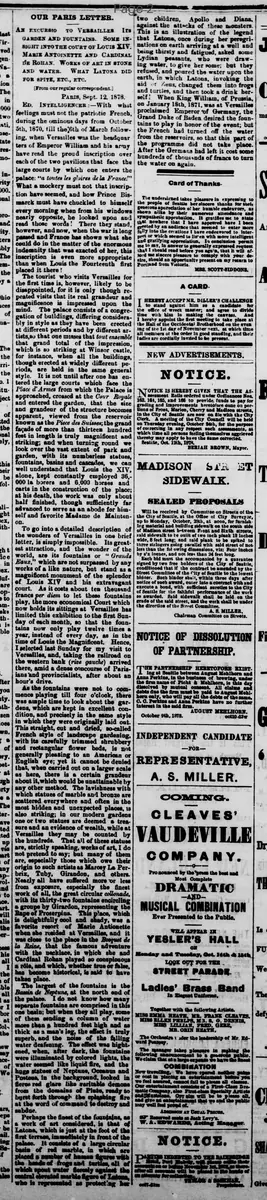
AN EXCURSION TO VERSAILLES. ITS GARDEN AND FOUNTAINS.
SOME IY SIGHT INTO THE COURT OF LOUIS XIV.
MARIE ANTOINETTE AND CARDINAL De ROHAN.
WORKS OF ART IN STONE AND WATER.
WHAT LATONA DID FOR SPITE, ETC., ETC.
[From our regular correspondent.]
PARIS, Sept. 12, 1878.
ED. INTELLIGENCER:- With what feelings must not the patriotic French, during the ominous days from October 5th, 1870, till the 6th of March following, when Versailles was the headquarters of Emperor William and his army have read the proud inscription over each of the two pavilions that face the large courts by which one enters the palace: "A toutes les gloires de la France!" What a mockery must not that inscription have seemed, and how Prince Bismarck must have chuckled to himself every morning when from his windows nearly opposite, he looked upon and read those words! There they stand, however, and now, when the war is long passed and France has shown what she could do in the matter of the enormous indemnity that was exacted of her, this inscription is even more appropriate than when Louis the Fourteenth first placed it there!
The tourist who visits Versailles for the first time is, however, likely to be disappointed, for it is only though repeated visits that its real grandeur and magnificence is impressed upon the mind. The palace consists of a congregation of buildings, differing considerably in style as they have been erected at different periods and by different artists, so that one misses that tout ensemble that grand total of the impression, which is so striking at Windsor castle, for instance, when all the buildings, though erected at widely different periods, are held in the same general style. It is not until after one has entered the large courts which face the Place d'Armes from which the Palace is approached, crossed at the Cour Royale and entered the garden, that the size and grandeur of the structure becomes apparent, viewed from the reservoir known as the Piece des Suisses; the grand facade of more than thirteen hundred feet in length is truly magnificent and striking: and when turning round we look over the vast extent of park and garden, with its numberless statues, fountains, basins and cascades, we can well understand that Louis the XIV. alone, kept constantly employed 36,000 laborers and 6,000 horses and carts in the construction of the place; at his death, the work was only about half finished, though sufficiently far advanced to serve as an abode for himself and favorite Madame de Maintenon.
To go into a detailed description of the wonders of Versailles in one brief letter, is simply impossible. Its greatest attraction, and the wonder of the world, are its fountains or "Grands Eaux," which are not surpassed by any works of a like nature, but stand as a magnificent monument of the splendor of Louis XIV and his extravagant court. As it costs about ten thousand francs per diem to let these fountains play, the more economical Court which now holds its sittings at Versailles has limited this exhibition to the first Sunday of each month, so that the fountains now only play twelve times a year, instead of every day, as in the time of Louis the Magnificent. Hence, I selected last Sunday for my visit to Versailles, and, taking the railroad on the western bank (rive gauche) arrived there, amid a dense concourse of Parisians and provincialists, after about an hour's drive.
As the fountains were not to commence playing till four o'clock, there was ample time to look about the gardens, which are kept in excellent condition, and precisely in the same style in which they were originally laid out. This straight, cut and dried, so-called French style of landscape gardening, with its carefully trimmed shrubbery and rectangular flower beds, is not generally pleasing to an American or English eye; yet it cannot be denied that, when carried out on a larger scale as here, there is a certain grandeur about it, which would be unattainable by any other method. The lavishness with which statues of marble and bronze are scattered everywhere and often in the most hidden and unexpected places, is also striking; in our modern gardens one or two statues are deemed a treasure and an evidence of wealth, while at Versailles they may be counted by the hundreds. That all of these statues are, strictly speaking, works of art, I do not pretend to say; but many of them are, especially those which owe their origin to such artists as Marcy La Perbrix, Tuby, Girardon, and others. Nearly all have suffered more or less from exposure, especially the finest work of all, the great circular colonnade, with its thirty-two fountains encircling groupe by Girardon, representing the Rape of Proserpine. This place, which is delightfully cool and shady, was a favorite resort of Marie Antoinette when she resided at Versailles, and it was close to the place in the Bosquet de la Reine, that the famous adventure with the necklace, in which she and Cardinal Rohan played so conspicuous a role, and which, whether true or false, has become historical, is said to have taken place.
The largest of the fountains is the Bassin de Neptune, at the north end of the palace. I do not know how many separate fountains are comprised in this one basin; but when they all play, some of them sending a column of water more than a hundred feet high and as thick as a man's leg, the effect is truly superb, and the noise of the falling water deafening. The effect was heightened, when, after dark, the fountains were illuminated by colored lights, the water seemed like liquid fire, and the huge statues of Neptune, Oceanus and Proteus, in the background, looked in the fierce red glare like veritable demons from the domains of Pluto, ready to burst forth through the splashing fire at the word of command to destroy and subdue.
Perhaps the finest of the fountains, as a work of art considered, is that of Latona, which is just at the foot of the first terrace, immediately in front of the palace. It consists of a large circular basin of red marble, in which are placed number of human figures with the heads of frogs and turtles, all of which spout water ferociously against the central elevated marble statue of Latona who is represented as protecting her two children, Apollo and Diana against the attacks of these monsters. This is an illustration of the legend that Latona, once during her peregrinations on earth arriving at a well and being thirsty and fatigued, asked some Lydian peasants, who were drawing water, to give her some; but they refused, and poured the water upon the earth, in which Latona, invoking the aid of Zeus, changed them into frogs and turtles, and then took a drink herself! When King William, of Prussia, on January 18th, 1871, was at Versailles proclaimed Emperor of Germany, the Grand Duke of Baden desired the fountains to play in honor of the event; but the French had turned off the water from the reservoirs, so that this part of the programme did not take place. After the Germans had left it cost some hundreds of thousands of francs to turn the water on again.
What sub-type of article is it?
What keywords are associated?
What entities or persons were involved?
Where did it happen?
Foreign News Details
Primary Location
Versailles
Event Date
Last Sunday Before Sept. 12, 1878
Key Persons
Outcome
france paid enormous indemnity after the war; fountains play 12 times a year at cost of 10,000 francs per diem; cost hundreds of thousands of francs to turn water on after germans left
Event Details
Correspondent visits Versailles on last Sunday, describes palace grandeur, gardens, fountains like Bassin de Neptune and Latona; historical context of Louis XIV's construction employing 36,000 laborers; occupation by Germans Oct. 5, 1870 to March 6, 1871 with Bismarck at windows opposite inscription 'A toutes les gloires de la France!'; Marie Antoinette's favorite spots and necklace adventure with Cardinal Rohan; fountains illuminated at night; Germans unable to play fountains during proclamation Jan. 18, 1871