Thank you for visiting SNEWPapers!
Sign up free
Gazette Of The United States, & Philadelphia Daily Advertiser
Philadelphia, Philadelphia County, Pennsylvania
What is this article about?
In the British House of Commons on April 26, Mr. Wilberforce proposed limiting slave numbers per ton on ships to prepare for abolition and encourage better treatment, but withdrew the motion after debate. The house requested accounts of slave imports and deaths from Africa to West Indies, 1789-1794.
Clipping
OCR Quality
Full Text
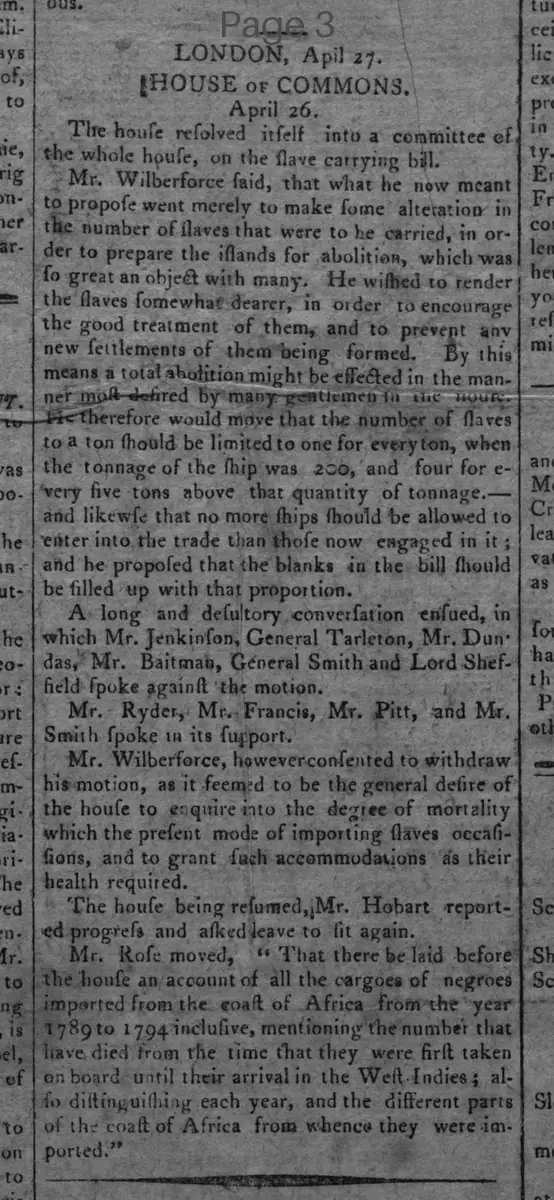
HOUSE OF COMMONS.
April 26.
The house resolved itself into a committee of the whole house, on the slave carrying bill.
Mr. Wilberforce said, that what he now meant to propose went merely to make some alteration in the number of slaves that were to be carried, in order to prepare the islands for abolition, which was so great an object with many. He wished to render the slaves somewhat dearer, in order to encourage the good treatment of them, and to prevent any new settlements of them being formed. By this means a total abolition might be effected in the manner most desired by many gentlemen in the house. He therefore would move that the number of slaves to a ton should be limited to one for every ton, when the tonnage of the ship was 200, and four for every five tons above that quantity of tonnage.—and likewise that no more ships should be allowed to enter into the trade than those now engaged in it; and he proposed that the blanks in the bill should be filled up with that proportion.
A long and desultory conversation ensued, in which Mr. Jenkinson, General Tarleton, Mr. Dundas, Mr. Baillie, General Smith and Lord Sheffield spoke against the motion.
Mr. Ryder, Mr. Francis, Mr. Pitt, and Mr. Smith spoke in its support.
Mr. Wilberforce, however consented to withdraw his motion, as it seemed to be the general desire of the house to enquire into the degree of mortality which the present mode of importing slaves occasions, and to grant such accommodations as their health required.
The house being resumed, Mr. Hobart reported progress and asked leave to sit again.
Mr. Rose moved, "That there be laid before the house an account of all the cargoes of negroes imported from the coast of Africa from the year 1789 to 1794 inclusive, mentioning the number that have died from the time that they were first taken on board until their arrival in the West-Indies; also distinguishing each year, and the different parts of the coast of Africa from whence they were imported."
What sub-type of article is it?
What keywords are associated?
What entities or persons were involved?
Where did it happen?
Foreign News Details
Primary Location
West Indies
Event Date
April 26
Key Persons
Outcome
motion withdrawn; house requests account of slave cargoes and deaths from africa to west indies, 1789-1794.
Event Details
The House of Commons committee debated the slave carrying bill. Mr. Wilberforce moved to limit slaves to one per ton for ships up to 200 tons and four per five tons above, and restrict new ships in the trade. Opponents included Mr. Jenkinson, General Tarleton, Mr. Dundas, Mr. Baillie, General Smith, and Lord Sheffield; supporters were Mr. Ryder, Mr. Francis, Mr. Pitt, and Mr. Smith. Wilberforce withdrew the motion to allow inquiry into slave mortality. Mr. Hobart reported progress. Mr. Rose moved for accounts of negro imports and deaths.