Thank you for visiting SNEWPapers!
Sign up free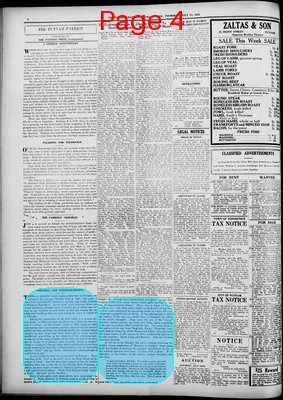
Story
July 13, 1933
Putnam Patriot
Putnam, Windham County, Connecticut
What is this article about?
Article contrasts motion picture technology at 1893 Chicago World's Fair (zoopraxascope) with 1933 Exposition (sound films), recalls early Putnam nickelodeons, trick films, horror, chases, and describes 1903 short 'A Race for a Kiss.'
Clipping
OCR Quality
98%
Excellent
Full Text
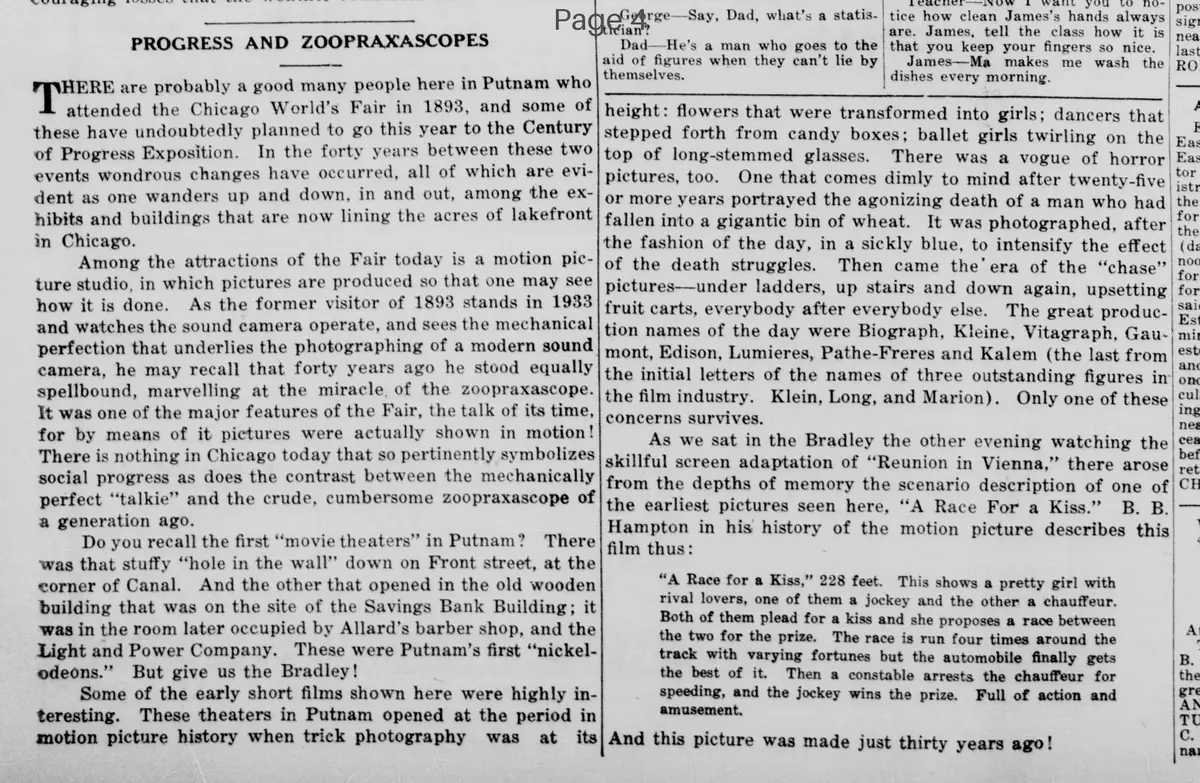
PROGRESS AND ZOOPRAXASCOPES
THERE are probably a good many people here in Putnam who attended the Chicago World's Fair in 1893, and some of these have undoubtedly planned to go this year to the Century of Progress Exposition. In the forty years between these two events wondrous changes have occurred, all of which are evident as one wanders up and down, in and out, among the exhibits and buildings that are now lining the acres of lakefront in Chicago.
Among the attractions of the Fair today is a motion picture studio, in which pictures are produced so that one may see how it is done. As the former visitor of 1893 stands in 1933 and watches the sound camera operate, and sees the mechanical perfection that underlies the photographing of a modern sound camera, he may recall that forty years ago he stood equally spellbound, marvelling at the miracle, of the zoopraxascope.
It was one of the major features of the Fair, the talk of its time, for by means of it pictures were actually shown in motion! There is nothing in Chicago today that so pertinently symbolizes social progress as does the contrast between the mechanically perfect "talkie" and the crude, cumbersome zoopraxascope of a generation ago.
Do you recall the first "movie theaters" in Putnam? There was that stuffy "hole in the wall" down on Front street, at the corner of Canal. And the other that opened in the old wooden building that was on the site of the Savings Bank Building; it was in the room later occupied by Allard's barber shop, and the Light and Power Company. These were Putnam's first "nickel-odeons." But give us the Bradley!
Some of the early short films shown here were highly interesting. These theaters in Putnam opened at the period in motion picture history when trick photography was at its height: flowers that were transformed into girls; dancers that stepped forth from candy boxes; ballet girls twirling on the top of long-stemmed glasses.
There was a vogue of horror pictures, too. One that comes dimly to mind after twenty-five or more years portrayed the agonizing death of a man who had fallen into a gigantic bin of wheat. It was photographed, after the fashion of the day, in a sickly blue, to intensify the effect of the death struggles. Then came the era of the "chase" pictures--under ladders, up stairs and down again, upsetting fruit carts, everybody after everybody else. The great production names of the day were Biograph, Kleine, Vitagraph, Gaumont, Edison, Lumieres, Pathe-Freres and Kalem (the last from the initial letters of the names of three outstanding figures in the film industry, Klein, Long, and Marion). Only one of these concerns survives.
As we sat in the Bradley the other evening watching the skillful screen adaptation of "Reunion in Vienna," there arose from the depths of memory the scenario description of one of the earliest pictures seen here, "A Race For a Kiss." B. B. Hampton in his history of the motion picture describes this film thus:
"A Race for a Kiss," 228 feet. This shows a pretty girl with rival lovers, one of them a jockey and the other a chauffeur. Both of them plead for a kiss and she proposes a race between the two for the prize. The race is run four times around the track with varying fortunes but the automobile finally gets the best of it. Then a constable arrests the chauffeur for speeding, and the jockey wins the prize. Full of action and amusement.
And this picture was made just thirty years ago!
THERE are probably a good many people here in Putnam who attended the Chicago World's Fair in 1893, and some of these have undoubtedly planned to go this year to the Century of Progress Exposition. In the forty years between these two events wondrous changes have occurred, all of which are evident as one wanders up and down, in and out, among the exhibits and buildings that are now lining the acres of lakefront in Chicago.
Among the attractions of the Fair today is a motion picture studio, in which pictures are produced so that one may see how it is done. As the former visitor of 1893 stands in 1933 and watches the sound camera operate, and sees the mechanical perfection that underlies the photographing of a modern sound camera, he may recall that forty years ago he stood equally spellbound, marvelling at the miracle, of the zoopraxascope.
It was one of the major features of the Fair, the talk of its time, for by means of it pictures were actually shown in motion! There is nothing in Chicago today that so pertinently symbolizes social progress as does the contrast between the mechanically perfect "talkie" and the crude, cumbersome zoopraxascope of a generation ago.
Do you recall the first "movie theaters" in Putnam? There was that stuffy "hole in the wall" down on Front street, at the corner of Canal. And the other that opened in the old wooden building that was on the site of the Savings Bank Building; it was in the room later occupied by Allard's barber shop, and the Light and Power Company. These were Putnam's first "nickel-odeons." But give us the Bradley!
Some of the early short films shown here were highly interesting. These theaters in Putnam opened at the period in motion picture history when trick photography was at its height: flowers that were transformed into girls; dancers that stepped forth from candy boxes; ballet girls twirling on the top of long-stemmed glasses.
There was a vogue of horror pictures, too. One that comes dimly to mind after twenty-five or more years portrayed the agonizing death of a man who had fallen into a gigantic bin of wheat. It was photographed, after the fashion of the day, in a sickly blue, to intensify the effect of the death struggles. Then came the era of the "chase" pictures--under ladders, up stairs and down again, upsetting fruit carts, everybody after everybody else. The great production names of the day were Biograph, Kleine, Vitagraph, Gaumont, Edison, Lumieres, Pathe-Freres and Kalem (the last from the initial letters of the names of three outstanding figures in the film industry, Klein, Long, and Marion). Only one of these concerns survives.
As we sat in the Bradley the other evening watching the skillful screen adaptation of "Reunion in Vienna," there arose from the depths of memory the scenario description of one of the earliest pictures seen here, "A Race For a Kiss." B. B. Hampton in his history of the motion picture describes this film thus:
"A Race for a Kiss," 228 feet. This shows a pretty girl with rival lovers, one of them a jockey and the other a chauffeur. Both of them plead for a kiss and she proposes a race between the two for the prize. The race is run four times around the track with varying fortunes but the automobile finally gets the best of it. Then a constable arrests the chauffeur for speeding, and the jockey wins the prize. Full of action and amusement.
And this picture was made just thirty years ago!
What sub-type of article is it?
Historical Event
Curiosity
What themes does it cover?
Triumph
What keywords are associated?
Motion Pictures
Worlds Fair
Zoopraxascope
Nickelodeons
Putnam Theaters
Trick Films
Chase Pictures
A Race For A Kiss
Where did it happen?
Chicago, Putnam
Story Details
Location
Chicago, Putnam
Event Date
1893 To 1933
Story Details
Reflection on cinema progress from crude zoopraxascope in 1893 to modern talkies in 1933, early Putnam theaters showing trick, horror, and chase films, including 'A Race for a Kiss' where jockey wins kiss after chauffeur's arrest.