Thank you for visiting SNEWPapers!
Sign up free
Poem
November 10, 1827
Constitutional Whig
Richmond, Virginia
What is this article about?
A woman's poetic reflection on the pain of a broken promise from a man she trusted, highlighting how such betrayals cause deep, hidden grief for women, unlike men who forget easily, leading to lost hopes and emotional ruin.
Clipping
OCR Quality
95%
Excellent
Full Text
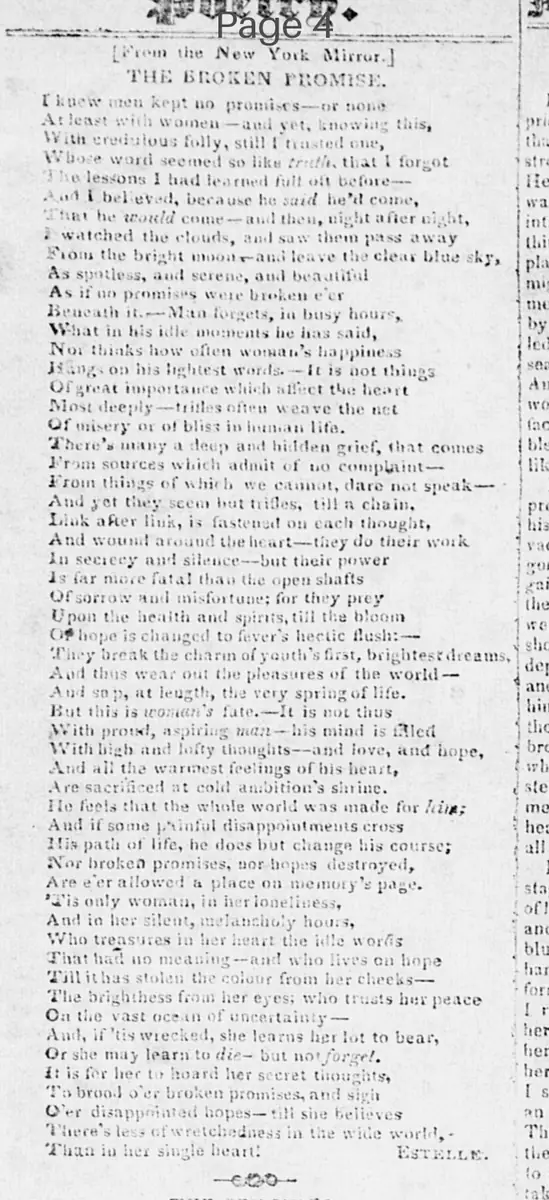
From the New York Mirror.
THE BROKEN PROMISE.
I knew men kept no promises—or none
At least with women—and yet, knowing this,
With credulous folly, still I trusted one,
Whose word seemed so like truth, that I forgot
The lessons I had learned full oft before—
And I believed, because he said he'd come,
That he would come—and then, night after night,
Watched the clouds, and saw them pass away
From the bright moon—and leave the clear blue sky,
As spotless, and serene, and beautiful
As if no promises were broken e'er
Beneath it.—Man forgets, in busy hours,
What in his idle moments he has said,
Nor thinks how often woman's happiness
Hangs on his lightest words.—It is not things
Of great importance which afflict the heart
Most deeply—trials often weave the net
Of misery or of bliss in human life.
There's many a deep and hidden grief, that comes
From sources which admit of no complaint—
From things of which we cannot, dare not speak—
And yet they seem but trifles, till a chain.
Link after link, is fastened on each thought,
And wound around the heart—they do their work
In secrecy and silence—but their power
Is far more fatal than the open shafts
Of sorrow and misfortune; for they prey
Upon the health and spirits, till the bloom
Of hope is changed to fever's hectic flush:—
They break the charm of youth's first, brightest dreams,
And thus wear out the pleasures of the world—
And so, at length, the very spring of life.
But this is woman's fate.—It is not thus
With proud, aspiring man—his mind is filled
With high and lofty thoughts—and love, and hope,
And all the warmest feelings of his heart,
Are sacrificed at cold ambition's shrine.
He feels that the whole world was made for him;
And if some vainful disappointments cross
His path of life, he does but change his course;
Nor broken promises, nor hopes destroyed,
Are e'er allowed a place on memory's page.
'Tis only woman, in her loneliness,
And in her silent, melancholy hours,
Who treasures in her heart the idle words
That had no meaning—and who lives on hope
Till it has stolen the colour from her cheeks—
The brightness from her eyes, who trusts her peace
On the vast ocean of uncertainty—
And, if 'tis wrecked, she learns her lot to bear,
Or she may learn to die—but ne'er forget.
It is for her to hoard her secret thoughts,
To brood o'er broken promises, and sigh
O'er disappointed hopes—till she believes
There's less of wretchedness in the wide world.
Than in her single heart:
ESTELLE.
THE BROKEN PROMISE.
I knew men kept no promises—or none
At least with women—and yet, knowing this,
With credulous folly, still I trusted one,
Whose word seemed so like truth, that I forgot
The lessons I had learned full oft before—
And I believed, because he said he'd come,
That he would come—and then, night after night,
Watched the clouds, and saw them pass away
From the bright moon—and leave the clear blue sky,
As spotless, and serene, and beautiful
As if no promises were broken e'er
Beneath it.—Man forgets, in busy hours,
What in his idle moments he has said,
Nor thinks how often woman's happiness
Hangs on his lightest words.—It is not things
Of great importance which afflict the heart
Most deeply—trials often weave the net
Of misery or of bliss in human life.
There's many a deep and hidden grief, that comes
From sources which admit of no complaint—
From things of which we cannot, dare not speak—
And yet they seem but trifles, till a chain.
Link after link, is fastened on each thought,
And wound around the heart—they do their work
In secrecy and silence—but their power
Is far more fatal than the open shafts
Of sorrow and misfortune; for they prey
Upon the health and spirits, till the bloom
Of hope is changed to fever's hectic flush:—
They break the charm of youth's first, brightest dreams,
And thus wear out the pleasures of the world—
And so, at length, the very spring of life.
But this is woman's fate.—It is not thus
With proud, aspiring man—his mind is filled
With high and lofty thoughts—and love, and hope,
And all the warmest feelings of his heart,
Are sacrificed at cold ambition's shrine.
He feels that the whole world was made for him;
And if some vainful disappointments cross
His path of life, he does but change his course;
Nor broken promises, nor hopes destroyed,
Are e'er allowed a place on memory's page.
'Tis only woman, in her loneliness,
And in her silent, melancholy hours,
Who treasures in her heart the idle words
That had no meaning—and who lives on hope
Till it has stolen the colour from her cheeks—
The brightness from her eyes, who trusts her peace
On the vast ocean of uncertainty—
And, if 'tis wrecked, she learns her lot to bear,
Or she may learn to die—but ne'er forget.
It is for her to hoard her secret thoughts,
To brood o'er broken promises, and sigh
O'er disappointed hopes—till she believes
There's less of wretchedness in the wide world.
Than in her single heart:
ESTELLE.
What sub-type of article is it?
Elegy
What themes does it cover?
Love Courtship
Moral Virtue
Satire Society
What keywords are associated?
Broken Promise
Womens Grief
Gender Roles
Disappointed Love
Hidden Sorrow
What entities or persons were involved?
Estelle.
Poem Details
Title
The Broken Promise.
Author
Estelle.
Form / Style
Rhymed Stanzas
Key Lines
I Knew Men Kept No Promises—Or None
At Least With Women—And Yet, Knowing This,
With Credulous Folly, Still I Trusted One,
Man Forgets, In Busy Hours,
What In His Idle Moments He Has Said,
Nor Thinks How Often Woman's Happiness
Hangs On His Lightest Words.
'Tis Only Woman, In Her Loneliness,
And In Her Silent, Melancholy Hours,
Who Treasures In Her Heart The Idle Words
That Had No Meaning—And Who Lives On Hope