Thank you for visiting SNEWPapers!
Sign up free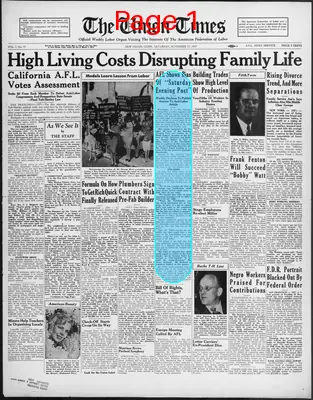
Story
November 22, 1947
The Union Times
New Haven, New Haven County, Connecticut
What is this article about?
The American Federation of Labor accuses the Saturday Evening Post of bias for refusing to publish a rebuttal to an article praising the Taft-Hartley Law, written by a law partner of Senator Taft. Editor Ben Hibbs defends the magazine's one-sided stance.
Clipping
OCR Quality
98%
Excellent
Full Text
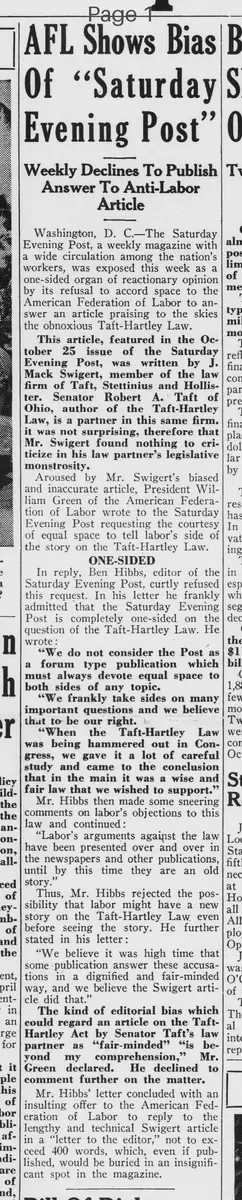
AFL Shows Bias Of "Saturday Evening Post"
Weekly Declines To Publish Answer To Anti-Labor Article
Washington, D. C.-The Saturday Evening Post, a weekly magazine with a wide circulation among the nation's workers, was exposed this week as a one-sided organ of reactionary opinion by its refusal to accord space to the American Federation of Labor to answer an article praising to the skies the obnoxious Taft-Hartley Law.
This article, featured in the October 25 issue of the Saturday Evening Post, was written by J. Mack Swigert, member of the law firm of Taft, Stettinius and Hollister. Senator Robert A. Taft of Ohio, author of the Taft-Hartley Law, is a partner in this same firm. It was not surprising, therefore that Mr. Swigert found nothing to criticize in his law partner's legislative monstrosity.
Aroused by Mr. Swigert's biased and inaccurate article. President William Green of the American Federation of Labor wrote to the Saturday Evening Post requesting the courtesy of equal space to tell labor's side of the story on the Taft-Hartley Law.
ONE-SIDED
In reply, Ben Hibbs, editor of the Saturday Evening Post, curtly refused this request. In his letter he frankly admitted that the Saturday Evening Post is completely one-sided on the question of the Taft-Hartley Law. He wrote:
"We do not consider the Post as a forum type publication which must always devote equal space to both sides of any topic.
"We frankly take sides on many important questions and we believe that to be our right.
"When the Taft-Hartley Law was being hammered out in Congress, we gave it a lot of careful study and came to the conclusion that in the main it was a wise and fair law that we wished to support."
Mr. Hibbs then made some sneering comments on labor's objections to this law and continued:
"Labor's arguments against the law have been presented over and over in the newspapers and other publications, until by this time they are an old story
Thus, Mr. Hibbs rejected the possibility that labor might have a new story on the Taft-Hartley Law even before seeing the story. He further stated in his letter:
"We believe it was high time that some publication answer these accusations in a dignified and fair-minded way, and we believe the Swigert article did that."
The kind of editorial bias which could regard an article on the Taft-Hartley Act by Senator Taft's law partner as "fair-minded" is beyond my comprehension,
Mr. Green declared. He declined to comment further on the matter.
Mr. Hibbs' letter concluded with an insulting offer to the American Federation of Labor to reply to the lengthy and technical Swigert article in a "letter to the editor," not to exceed 400 words, which, even if published, would be buried in an insignificant spot in the magazine.
Weekly Declines To Publish Answer To Anti-Labor Article
Washington, D. C.-The Saturday Evening Post, a weekly magazine with a wide circulation among the nation's workers, was exposed this week as a one-sided organ of reactionary opinion by its refusal to accord space to the American Federation of Labor to answer an article praising to the skies the obnoxious Taft-Hartley Law.
This article, featured in the October 25 issue of the Saturday Evening Post, was written by J. Mack Swigert, member of the law firm of Taft, Stettinius and Hollister. Senator Robert A. Taft of Ohio, author of the Taft-Hartley Law, is a partner in this same firm. It was not surprising, therefore that Mr. Swigert found nothing to criticize in his law partner's legislative monstrosity.
Aroused by Mr. Swigert's biased and inaccurate article. President William Green of the American Federation of Labor wrote to the Saturday Evening Post requesting the courtesy of equal space to tell labor's side of the story on the Taft-Hartley Law.
ONE-SIDED
In reply, Ben Hibbs, editor of the Saturday Evening Post, curtly refused this request. In his letter he frankly admitted that the Saturday Evening Post is completely one-sided on the question of the Taft-Hartley Law. He wrote:
"We do not consider the Post as a forum type publication which must always devote equal space to both sides of any topic.
"We frankly take sides on many important questions and we believe that to be our right.
"When the Taft-Hartley Law was being hammered out in Congress, we gave it a lot of careful study and came to the conclusion that in the main it was a wise and fair law that we wished to support."
Mr. Hibbs then made some sneering comments on labor's objections to this law and continued:
"Labor's arguments against the law have been presented over and over in the newspapers and other publications, until by this time they are an old story
Thus, Mr. Hibbs rejected the possibility that labor might have a new story on the Taft-Hartley Law even before seeing the story. He further stated in his letter:
"We believe it was high time that some publication answer these accusations in a dignified and fair-minded way, and we believe the Swigert article did that."
The kind of editorial bias which could regard an article on the Taft-Hartley Act by Senator Taft's law partner as "fair-minded" is beyond my comprehension,
Mr. Green declared. He declined to comment further on the matter.
Mr. Hibbs' letter concluded with an insulting offer to the American Federation of Labor to reply to the lengthy and technical Swigert article in a "letter to the editor," not to exceed 400 words, which, even if published, would be buried in an insignificant spot in the magazine.
What sub-type of article is it?
Historical Event
Deception Fraud
What themes does it cover?
Deception
Justice
What keywords are associated?
Media Bias
Taft Hartley Law
Afl Response
Editorial Refusal
Labor Rights
What entities or persons were involved?
William Green
J. Mack Swigert
Ben Hibbs
Robert A. Taft
American Federation Of Labor
Saturday Evening Post
Where did it happen?
Washington, D. C.
Story Details
Key Persons
William Green
J. Mack Swigert
Ben Hibbs
Robert A. Taft
American Federation Of Labor
Saturday Evening Post
Location
Washington, D. C.
Event Date
October 25
Story Details
The Saturday Evening Post publishes a pro-Taft-Hartley article by J. Mack Swigert, a partner of Senator Taft. AFL President William Green requests equal space for rebuttal, but editor Ben Hibbs refuses, admitting the magazine's bias and offering only a short letter to the editor.