Thank you for visiting SNEWPapers!
Sign up free
Literary
November 23, 1739
The Virginia Gazette
Richmond, Williamsburg, Richmond County, Virginia
What is this article about?
Biographical conclusion extolling Dr. Herman Boerhaave's exceptional virtues, piety, temperance, and devotion to God, detailing his daily prayers, views on Scripture, and humility. Lists his marriage in 1710 and major medical publications from 1707 to 1734.
Merged-components note: The footnote component contains related Latin text and repetitions from the main biography, indicating it is part of the overall literary piece on Dr. Boerhaave.
Clipping
OCR Quality
85%
Good
Full Text
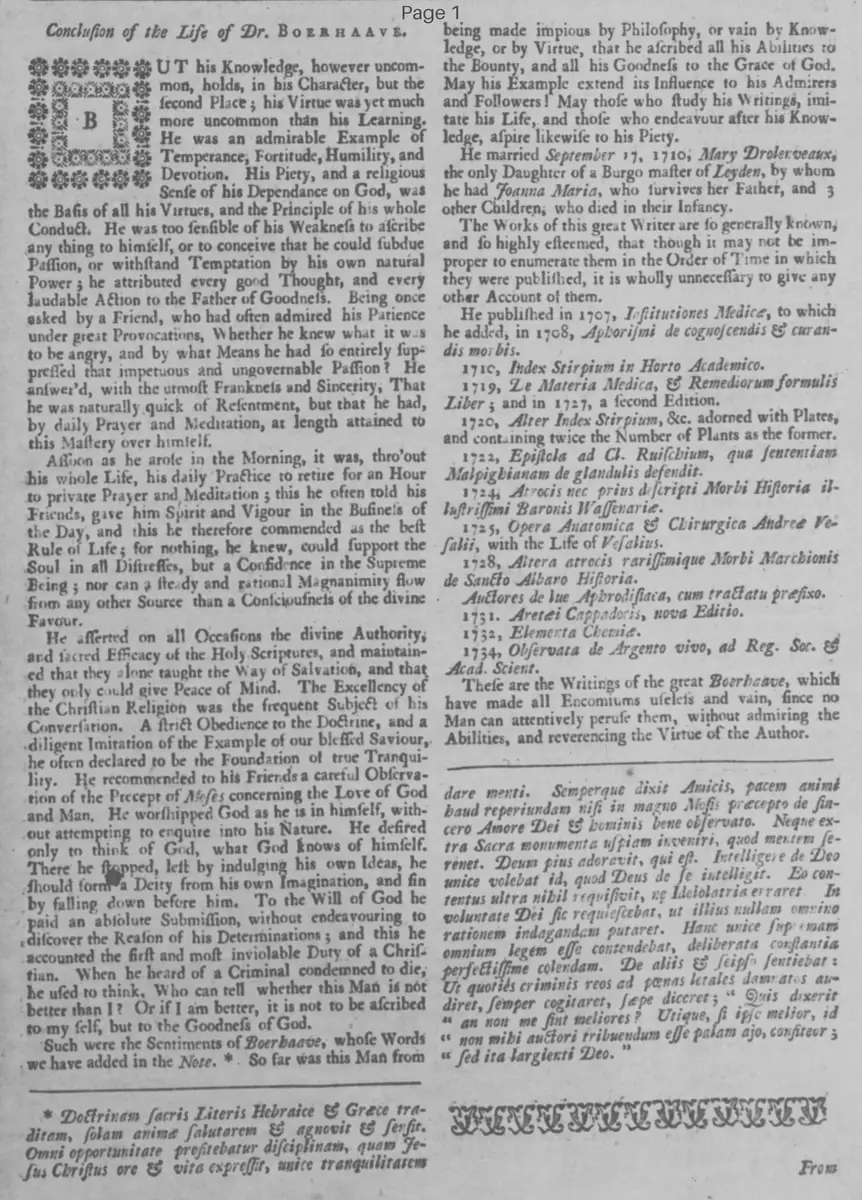
Conclusion of the Life of Dr. BOERHAAVE.
But his Knowledge, however uncommon, holds in his Character, but the second Place; his Virtue was yet much more uncommon than his Learning.
He was an admirable Example of Temperance, Fortitude, Humility, and Devotion.
His Piety, and a religious Sense of his Dependance on God, was the Basis of all his Virtues, and the Principle of his whole Conduct.
He was too sensible of his Weakness to ascribe any thing to himself, or to conceive that he could subdue Passion, or withstand Temptation by his own natural Power;
he attributed every good Thought, and every laudable Action to the Father of Goodness.
Being once asked by a Friend, who had often admired his Patience under great Provocations, Whether he knew what it was to be angry, and by what Means he had so entirely up-prest that impetuous and ungovernable Passion? He answer'd, with the utmost Frankness and Sincerity, That he was naturally quick of Resentment, but that he had, by daily Prayer and Meditation, at length attained to this Mastery over himself.
As soon as he arose in the Morning, it was, thro'out his whole Life, his daily Practice to retire for an Hour to private Prayer and Meditation;
this he often told his Friends, gave him Spirit and Vigour in the Business of the Day, and therefore commended as the best Rule of Life; for nothing, he knew, could support the Soul in all Distresses, but a Confidence in the Supreme Being; nor can steady and rational Magnanimity flow from any other Source than a Consciousness of the divine Favour.
He exerted on all Occasions the divine Authority, and sacred Efficacy of the Holy Scriptures, and maintained that they alone taught the Way of Salvation, and that they only could give Peace of Mind.
The Excellency of the Christian Religion was the frequent Subject of his Conversation.
A strict Obedience to the Doctrine, and a diligent Imitation of the Example of our blessed Saviour, he often declared to be the Foundation of true Tranquility.
He recommended to his Friends a careful Observation of the Precept of Moses concerning the Love of God and Man.
He worshipped God as he is in himself, without attempting to enquire into his Nature.
He desired only to think of God, what God knows of himself.
There he stopped, lest by indulging his own Ideas, he should form a Deity from his own Imagination, and sin by falling down before him.
To the Will of God he paid an absolute Submission, without endeavouring to discover the Reason of his Determinations; and this he accounted the first and most inviolable Duty of a Christian.
When he heard of a Criminal condemned to die, he used to think, Who can tell whether this Man is not better than I? Or if I am better, it is not to be ascribed to myself, but to the Goodness of God.
Such were the Sentiments of Boerhaave, whose Words we have added in the Note.
*. So far was this Man from being made impious by Philosophy, or vain by Knowledge, or by Virtue, that he ascribed all his Abilities to the Bounty, and all his Goodness to the Grace of God.
May his Example extend its Influence to his Admirers and Followers! May those who study his Writings, imitate his Life, and those who endeavour after his Knowledge, aspire likewise to his Piety.
He married September 17, 1710, Mary Drolerveaux, the only Daughter of a Burgo-master of Leyden, by whom he had Joanna Maria, who survives her Father, and 3 other Children, who died in their Infancy.
The Works of this great Writer are so generally known, and so highly esteemed, that though it may not be improper to enumerate them in the Order of Time in which they were published, it is wholly unnecessary to give any other Account of them.
He published in 1707, Institutiones Medicae, to which he added, in 1708, Aphorismi de cognoscendis & curandis morbis.
1710, Index Stirpium in Horto Academico.
1719, Libri Materia Medica, FC Remediorum formulis Liber; and in 1727, a second Edition.
1720, Alter Index Stirpium, &c. adorned with Plates, and containing twice the Number of Plants as the former.
1722, Epistola ad Cl. Ruischium, qua sententiam Malpigbianam de glandulis defendit.
1724, Atrociis nec prius descripti Morbi Historia illustriissimi Baronis Waffenarici.
1725, Opera Anatomica & Chirurgica Andreae Vesalii, with the Life of Vesalius.
1728, Alterius atrociorique Morbi Marchionis de Sancto Albano Historia.
Auctores de lue Aphrodisiaca, cum tractatu praefixo.
1731. Aretei Cappadonis, nova Editio.
1732, Elementa Chemiae.
1734, Observationes de Argento vivo, ad Reg. Soc. Acad. Scient.
These are the Writings of the great Boerhaave, which have made all Encomiums useless and vain, since no Man can attentively peruse them, without admiring the Abilities, and reverencing the Virtue of the Author.
[Note in Latin, partially garbled: dare menti. Semperque dixit Amicis, pacem animi baud reperiundam nisi in s magno Moysis precepto de in- cero Amore Dei hominis bene observato.
Neque extra Sacra monumenta upiam inveniri, quod mentem e- renet.
Deum pius adoravit, qui et. Intelligere de Deo unice volebam id quod Deus de le intelligit.
Eo con- voluntate Dei tentus ultra a nihil ic requiescebar, ut illius nullam omnino requirivit, u Idciolatria erraret
In rationem indagandam putaret.
Hanc unice supremam omnium legem esse contendebat, deliberata constantia
Ut quoties criminis reos ad poenas letales damnatos au- perfecitissime colendam.
De aliis & eipsentiensbar: diret, emper cogitaret, Sapediceret;
Qnis dixerit non mibi autori tribuendum esse piam ajo, confiteor ; an non me int meliores?
Urique, i iqfc melior, id ed ita largienti Deo.
Doctrinam Sacris Literis Hebraicæ & Græcæ tra- ditam, solam anime Salutarem agnovit & sensuit.
Omni opportunitate profitebatur disciplinam, quam Je- fus Christus ore vita expressit, unice tranquillitatem]
But his Knowledge, however uncommon, holds in his Character, but the second Place; his Virtue was yet much more uncommon than his Learning.
He was an admirable Example of Temperance, Fortitude, Humility, and Devotion.
His Piety, and a religious Sense of his Dependance on God, was the Basis of all his Virtues, and the Principle of his whole Conduct.
He was too sensible of his Weakness to ascribe any thing to himself, or to conceive that he could subdue Passion, or withstand Temptation by his own natural Power;
he attributed every good Thought, and every laudable Action to the Father of Goodness.
Being once asked by a Friend, who had often admired his Patience under great Provocations, Whether he knew what it was to be angry, and by what Means he had so entirely up-prest that impetuous and ungovernable Passion? He answer'd, with the utmost Frankness and Sincerity, That he was naturally quick of Resentment, but that he had, by daily Prayer and Meditation, at length attained to this Mastery over himself.
As soon as he arose in the Morning, it was, thro'out his whole Life, his daily Practice to retire for an Hour to private Prayer and Meditation;
this he often told his Friends, gave him Spirit and Vigour in the Business of the Day, and therefore commended as the best Rule of Life; for nothing, he knew, could support the Soul in all Distresses, but a Confidence in the Supreme Being; nor can steady and rational Magnanimity flow from any other Source than a Consciousness of the divine Favour.
He exerted on all Occasions the divine Authority, and sacred Efficacy of the Holy Scriptures, and maintained that they alone taught the Way of Salvation, and that they only could give Peace of Mind.
The Excellency of the Christian Religion was the frequent Subject of his Conversation.
A strict Obedience to the Doctrine, and a diligent Imitation of the Example of our blessed Saviour, he often declared to be the Foundation of true Tranquility.
He recommended to his Friends a careful Observation of the Precept of Moses concerning the Love of God and Man.
He worshipped God as he is in himself, without attempting to enquire into his Nature.
He desired only to think of God, what God knows of himself.
There he stopped, lest by indulging his own Ideas, he should form a Deity from his own Imagination, and sin by falling down before him.
To the Will of God he paid an absolute Submission, without endeavouring to discover the Reason of his Determinations; and this he accounted the first and most inviolable Duty of a Christian.
When he heard of a Criminal condemned to die, he used to think, Who can tell whether this Man is not better than I? Or if I am better, it is not to be ascribed to myself, but to the Goodness of God.
Such were the Sentiments of Boerhaave, whose Words we have added in the Note.
*. So far was this Man from being made impious by Philosophy, or vain by Knowledge, or by Virtue, that he ascribed all his Abilities to the Bounty, and all his Goodness to the Grace of God.
May his Example extend its Influence to his Admirers and Followers! May those who study his Writings, imitate his Life, and those who endeavour after his Knowledge, aspire likewise to his Piety.
He married September 17, 1710, Mary Drolerveaux, the only Daughter of a Burgo-master of Leyden, by whom he had Joanna Maria, who survives her Father, and 3 other Children, who died in their Infancy.
The Works of this great Writer are so generally known, and so highly esteemed, that though it may not be improper to enumerate them in the Order of Time in which they were published, it is wholly unnecessary to give any other Account of them.
He published in 1707, Institutiones Medicae, to which he added, in 1708, Aphorismi de cognoscendis & curandis morbis.
1710, Index Stirpium in Horto Academico.
1719, Libri Materia Medica, FC Remediorum formulis Liber; and in 1727, a second Edition.
1720, Alter Index Stirpium, &c. adorned with Plates, and containing twice the Number of Plants as the former.
1722, Epistola ad Cl. Ruischium, qua sententiam Malpigbianam de glandulis defendit.
1724, Atrociis nec prius descripti Morbi Historia illustriissimi Baronis Waffenarici.
1725, Opera Anatomica & Chirurgica Andreae Vesalii, with the Life of Vesalius.
1728, Alterius atrociorique Morbi Marchionis de Sancto Albano Historia.
Auctores de lue Aphrodisiaca, cum tractatu praefixo.
1731. Aretei Cappadonis, nova Editio.
1732, Elementa Chemiae.
1734, Observationes de Argento vivo, ad Reg. Soc. Acad. Scient.
These are the Writings of the great Boerhaave, which have made all Encomiums useless and vain, since no Man can attentively peruse them, without admiring the Abilities, and reverencing the Virtue of the Author.
[Note in Latin, partially garbled: dare menti. Semperque dixit Amicis, pacem animi baud reperiundam nisi in s magno Moysis precepto de in- cero Amore Dei hominis bene observato.
Neque extra Sacra monumenta upiam inveniri, quod mentem e- renet.
Deum pius adoravit, qui et. Intelligere de Deo unice volebam id quod Deus de le intelligit.
Eo con- voluntate Dei tentus ultra a nihil ic requiescebar, ut illius nullam omnino requirivit, u Idciolatria erraret
In rationem indagandam putaret.
Hanc unice supremam omnium legem esse contendebat, deliberata constantia
Ut quoties criminis reos ad poenas letales damnatos au- perfecitissime colendam.
De aliis & eipsentiensbar: diret, emper cogitaret, Sapediceret;
Qnis dixerit non mibi autori tribuendum esse piam ajo, confiteor ; an non me int meliores?
Urique, i iqfc melior, id ed ita largienti Deo.
Doctrinam Sacris Literis Hebraicæ & Græcæ tra- ditam, solam anime Salutarem agnovit & sensuit.
Omni opportunitate profitebatur disciplinam, quam Je- fus Christus ore vita expressit, unice tranquillitatem]
What sub-type of article is it?
Essay
What themes does it cover?
Religious
Moral Virtue
What keywords are associated?
Boerhaave
Piety
Temperance
Devotion
Medical Works
Christian Virtue
Literary Details
Title
Conclusion Of The Life Of Dr. Boerhaave.
Form / Style
Biographical Essay On Virtues And Works
Key Lines
That He Was Naturally Quick Of Resentment, But That He Had, By Daily Prayer And Meditation, At Length Attained To This Mastery Over Himself.
He Married September 17, 1710, Mary Drolerveaux, The Only Daughter Of A Burgo Master Of Leyden, By Whom He Had Joanna Maria, Who Survives Her Father, And 3 Other Children, Who Died In Their Infancy.
These Are The Writings Of The Great Boerhaave, Which Have Made All Encomiums Useless And Vain, Since No Man Can Attentively Peruse Them, Without Admiring The Abilities, And Reverencing The Virtue Of The Author.