Thank you for visiting SNEWPapers!
Sign up free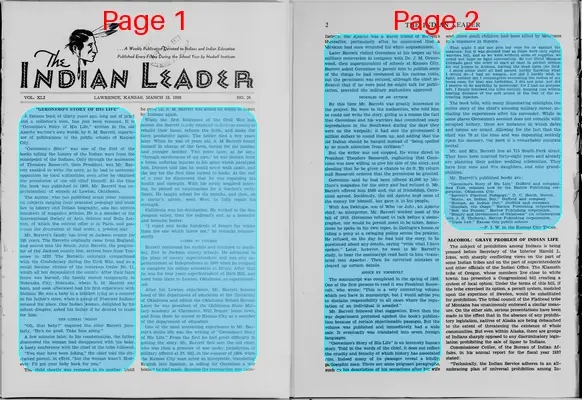
The Indian Leader
Lawrence, Douglas County, Kansas
What is this article about?
Article on the reissuance of S.M. Barrett's 1906 book 'Geronimo's Story of His Life,' detailing Barrett's family history in Jackson County, personal anecdotes like a near-kidnapping by Indians and recovery from paralysis, his teaching career, and the challenges in interviewing Geronimo with Roosevelt's aid.
Merged-components note: Continuation of the Geronimo biography story across pages 1 and 2, as the text flows directly from one to the next.
Clippings
1 of 2
OCR Quality
Full Text
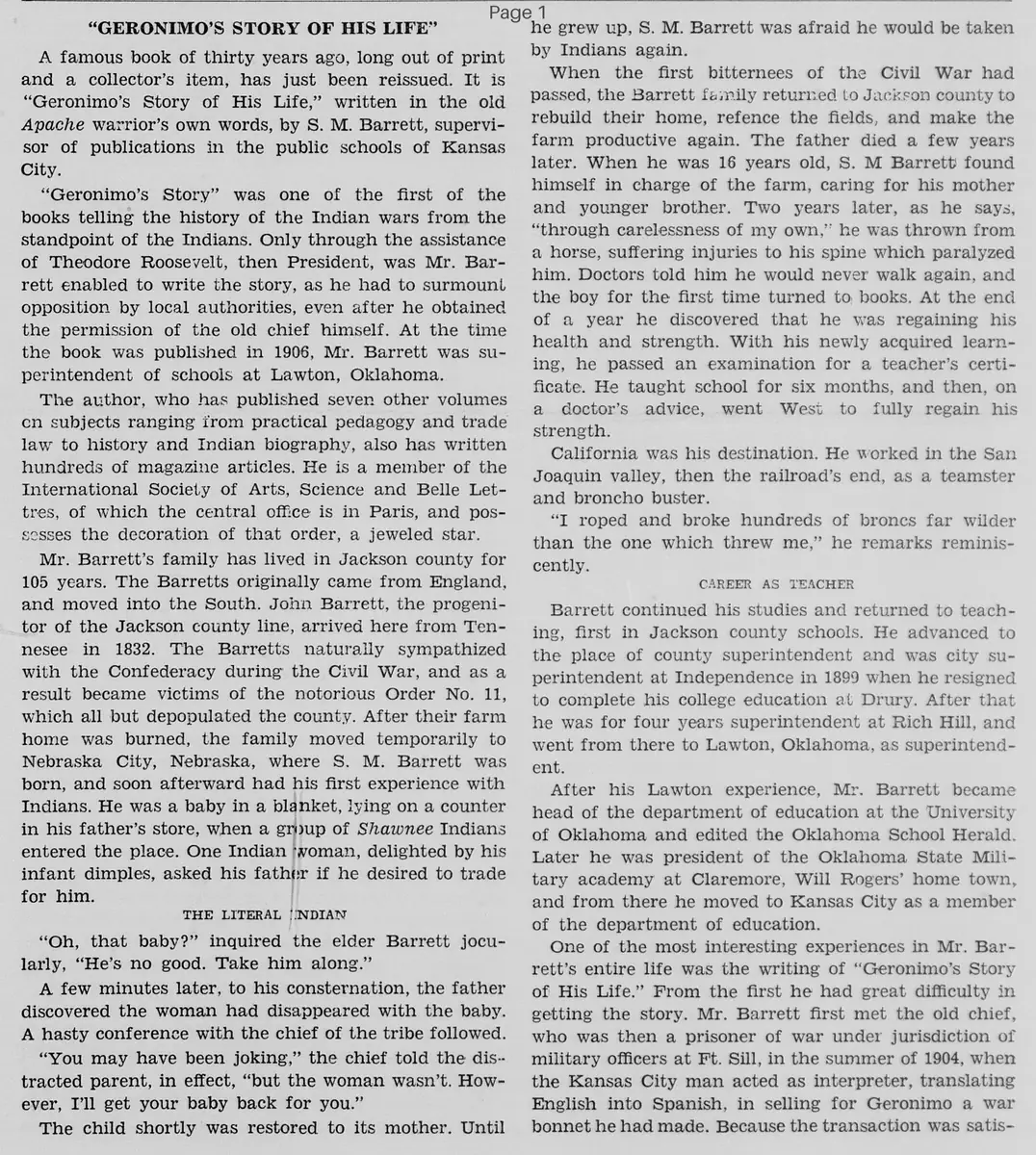
A famous book of thirty years ago, long out of print and a collector's item, has just been reissued. It is "Geronimo's Story of His Life," written in the old Apache warrior's own words, by S. M. Barrett, supervisor of publications in the public schools of Kansas City.
"Geronimo's Story" was one of the first of the books telling the history of the Indian wars from the standpoint of the Indians. Only through the assistance of Theodore Roosevelt, then President, was Mr. Barrett enabled to write the story, as he had to surmount opposition by local authorities, even after he obtained the permission of the old chief himself. At the time the book was published in 1906, Mr. Barrett was superintendent of schools at Lawton, Oklahoma.
The author, who has published seven other volumes on subjects ranging from practical pedagogy and trade law to history and Indian biography, also has written hundreds of magazine articles. He is a member of the International Society of Arts, Science and Belle Lettres, of which the central office is in Paris, and possesses the decoration of that order, a jeweled star.
Mr. Barrett's family has lived in Jackson county for 105 years. The Barretts originally came from England, and moved into the South. John Barrett, the progenitor of the Jackson county line, arrived here from Tennessee in 1832. The Barretts naturally sympathized with the Confederacy during the Civil War, and as a result became victims of the notorious Order No. 11, which all but depopulated the county. After their farm home was burned, the family moved temporarily to Nebraska City, Nebraska, where S. M. Barrett was born, and soon afterward had his first experience with Indians. He was a baby in a blanket, lying on a counter in his father's store, when a group of Shawnee Indians entered the place. One Indian woman, delighted by his infant dimples, asked his father if he desired to trade for him.
THE LITERAL INDIAN
"Oh, that baby?" inquired the elder Barrett jocularly, "He's no good. Take him along."
A few minutes later, to his consternation, the father discovered the woman had disappeared with the baby. A hasty conference with the chief of the tribe followed.
"You may have been joking," the chief told the distracted parent, in effect, "but the woman wasn't. However, I'll get your baby back for you."
The child shortly was restored to its mother. Until he grew up, S. M. Barrett was afraid he would be taken by Indians again.
When the first bitterness of the Civil War had passed, the Barrett family returned to Jackson county to rebuild their home, re-fence the fields, and make the farm productive again. The father died a few years later. When he was 16 years old, S. M. Barrett found himself in charge of the farm, caring for his mother and younger brother. Two years later, as he says, "through carelessness of my own," he was thrown from a horse, suffering injuries to his spine which paralyzed him. Doctors told him he would never walk again, and the boy for the first time turned to books. At the end of a year he discovered that he was regaining his health and strength. With his newly acquired learning, he passed an examination for a teacher's certificate. He taught school for six months, and then, on a doctor's advice, went West to fully regain his strength.
California was his destination. He worked in the San Joaquin valley, then the railroad's end, as a teamster and broncho buster.
"I roped and broke hundreds of broncs far wilder than the one which threw me," he remarks reminiscently.
CAREER AS TEACHER
Barrett continued his studies and returned to teaching, first in Jackson county schools. He advanced to the place of county superintendent and was city superintendent at Independence in 1899 when he resigned to complete his college education at Drury. After that he was for four years superintendent at Rich Hill, and went from there to Lawton, Oklahoma, as superintendent.
After his Lawton experience, Mr. Barrett became head of the department of education at the University of Oklahoma and edited the Oklahoma School Herald. Later he was president of the Oklahoma State Military academy at Claremore, Will Rogers' home town, and from there he moved to Kansas City as a member of the department of education.
One of the most interesting experiences in Mr. Barrett's entire life was the writing of "Geronimo's Story of His Life." From the first he had great difficulty in getting the story. Mr. Barrett first met the old chief, who was then a prisoner of war under jurisdiction of military officers at Ft. Sill, in the summer of 1904, when the Kansas City man acted as interpreter, translating English into Spanish, in selling for Geronimo a war bonnet he had made. Because the transaction was satisfactory, the Apache was a warm friend of Barrett's thereafter, particularly after he discovered that a Mexican had once wounded his white acquaintance.
Later Barrett visited Geronimo at his teepee on the military reservation in company with Dr. J. M. Greenwood, then superintendent of schools at Kansas City.
Barrett asked Geronimo to permit him to publish some of the things he had recounted in his various visits, but the permission was refused, although the chief indicated that if he were paid he might talk for publication, provided the military authorities approved.
TROUBLES OF AN AUTHOR
By this time Mr. Barrett was greatly interested in the project. He went to the authorities, who told him he could not write the story, giving as a reason the fact that Geronimo and his warriors had committed many depredations in the Southwest during the days they were on the warpath; it had cost the government 2 million dollars to round them up, and adding that the old Indian should be hanged instead of "being spoiled by so much attention from civilians."
But the writer was not stopped. He wrote direct to President Theodore Roosevelt, explaining that Geronimo was now willing to give his side of the story, and pleading that he be given a chance to do it. By return mail Roosevelt ordered that the permission be granted.
Geronimo said he had been offered $1,000 by McClure's magazine for the story and had refused it. Mr. Barrett offered him $500 and, out of friendship, Geronimo agreed. Incidentally, the old Apache kept none of the money for himself, but gave it to his people.
With Asa Deklugie, son of Who (or Juh), an Apache chief, as interpreter, Mr. Barrett worked most of the fall of 1905. Geronimo refused to talk before a stenographer, nor would he permit notes to be taken. Sometimes he spoke in his own tepee, in Deklugie's house, or riding a pony at a swinging gallop across the prairies.
He refused, on the day he had told the story, to be questioned about any details, saying "write what I have spoken." Later, however, he went to Mr. Barrett's study, to hear the manuscript read back to him (translated into Apache). Then he corrected mistakes or cleared up certain details.
ADVICE BY ROOSEVELT
The manuscript was completed in the spring of 1906. One of the first persons to read it was President Roosevelt, who wrote: "This is a very interesting volume which you have in manuscript, but I would advise you to disclaim responsibility in all cases where the reputation of an individual is assailed."
Mr. Barrett followed that suggestion. Even then the war department protested against the book's publication because of certain objectionable passages. But the volume was published and immediately had a wide sale. It eventually was translated into seven foreign languages.
"Geronimo's Story of His Life" is an intensely human story. Told in the words of the chief, it does not reflect the cruelty and ferocity of which history has associated him. Indeed many of its passages reveal a kindly, philosophic man. There are some poignant paragraphs, such as his description of his sensations after his wife and three small children had been killed by Mexicans in a massacre in Sonora.
That night I did not give my vote for or against the measure; but it was decided that as there were only eighty warriors left, and as we were without arms or supplies, we could not hope to fight successfully. So our Chief Mangus Colorado gave the order to start at once in perfect silence for our homes in Arizona, leaving the dead upon the field.
I stood alone until all had passed, hardly knowing what I would do I had no weapon, nor did I hardly wish to fight, neither did I contemplate recovering the bodies of my loved ones, for that was forbidden. I did not pray, nor did I resolve to do anything in particular, for I had no purpose left. I finally followed the tribe silently, keeping just within hearing distance of the soft sound of the feet of the retreating Apaches.
The book tells, with many illuminating sidelights, the entire story of the chief's amazing military career, including the experiences after his surrender. While in some places Geronimo's account does not coincide with accepted history, these are instances in which dates and names are mixed. Allowing for the fact that the chief was 70 at the time and was depending entirely upon his memory, the book is a remarkably accurate recital.
Mr. and Mrs. Barrett live at 715 South Park street. They have been married forty-eight years and already are planning their golden wedding celebration. They have four sons and five daughters, and nine grandchildren.
Mr. Barrett's published books are:
"Geronimo's Story of His Life," Duffield and company, New York, reissued now by the Harlow Publishing corporation, Oklahoma City.
"Barrett's Practical Pedagogy," D. C. Heath, Boston.
"Mocco, an Indian Boy," Duffield and company.
"Hoistah, an Indian Girl," Duffield and company.
"Shinkah, the Osage," Harlow Publishing corporation.
"Bob, the Pioneer," Harlow Publishing corporation.
"History and Government of Oklahoma" (in collaboration with J. B. Thoburn), Harlow Publishing corporation.
"Trade Law," Kansas City public schools.
P. I. W. in the Kansas City Times.
What sub-type of article is it?
What themes does it cover?
What keywords are associated?
What entities or persons were involved?
Where did it happen?
Story Details
Key Persons
Location
Jackson County, Missouri; Lawton, Oklahoma; Ft. Sill, Oklahoma; Kansas City, Missouri; Sonora, Mexico; Arizona
Event Date
1832 To 1937
Story Details
S.M. Barrett's life story, from family settlement in Jackson County, Civil War displacement, childhood near-kidnapping by Shawnee, paralysis recovery through reading, teaching career, and authoring Geronimo's autobiography despite opposition, aided by President Roosevelt; the book recounts Geronimo's Apache experiences and losses.