Thank you for visiting SNEWPapers!
Sign up free
The New Hampshire Gazette And General Advertiser
Portsmouth, Exeter, Rockingham County, New Hampshire
What is this article about?
Colonel Tilghman delivers General Washington's dispatch to Congress announcing the successful siege and surrender of British forces under Lord Cornwallis at Yorktown, Virginia, on October 19, 1781. Includes correspondence between Washington and Cornwallis, and the full articles of capitulation signed by American, French, and British commanders.
Merged-components note: The content on page 3 is a direct continuation of the Yorktown surrender dispatch from page 2, including the articles of capitulation. The original label of 'notice' for the second part is incorrect; it belongs to the same overall story.
Clippings
1 of 2
OCR Quality
Full Text
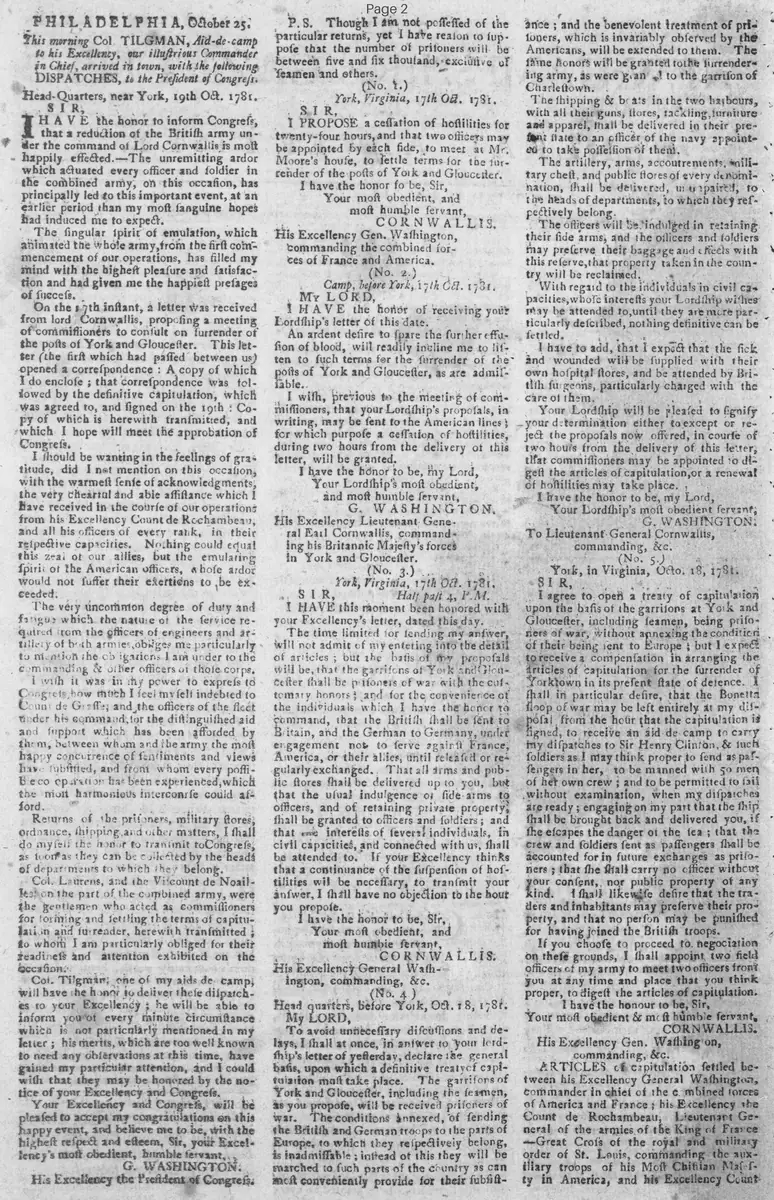
This morning Col. TILGHMAN, Aid-de-camp to his Excellency, our illustrious Commander in Chief, arrived in town, with the following DISPATCHES, to the President of Congress.
Head-Quarters, near York, 19th Oct. 1781.
SIR,
I HAVE the honor to inform Congress that a reduction of the British army under the command of Lord Cornwallis is most happily effected.--The unremitting ardor which actuated every officer and soldier in the combined army, on this occasion, has principally led to this important event, at an earlier period than my most sanguine hopes had induced me to expect.
The singular spirit of emulation, which animated the whole army from the first commencement of our operations, has filled my mind with the highest pleasure and satisfaction and had given me the happiest presages of success.
On the 17th instant, a letter was received from Lord Cornwallis, proposing a meeting of commissioners to consult on surrender of the posts of York and Gloucester. This letter (the first which had passed between us) opened a correspondence: A copy of which I do enclose: that correspondence was followed by the definitive capitulation, which was agreed to and signed on the 19th: Copy of which is herewith transmitted, and which I hope will meet the approbation of Congress.
I should be wanting in the feelings of gratitude, did I not mention on this occasion, with the warmest sense of acknowledgments, the very cheerful and able assistance which I have received in the course of our operations from his Excellency Count de Rochambeau, and all his officers of every rank, in their respective capacities. Nothing could equal this zeal of our allies, but the emulating spirit of the American officers, whose ardor would not suffer their exertions to be exceeded:
The very uncommon degree of duty and fatigue which the nature of the service required from the officers of engineers and artillery of both armies, obliges me particularly to mention the obligations I am under to the commanding & other officers of those corps.
I wish it was in the power to express to Congress how much I feel myself indebted to Count de Grasse, and the officers of the fleet under his command, for the distinguished aid and support which has been afforded by them, between whom and the army the most happy concurrence of sentiments and views have subsisted, and from whom every co-operation have been experienced, which the most harmonious intercourse could afford.
Returns of the prisoners, military stores, ordnance, shipping, and other matters, I shall do myself the honor to transmit to Congress, as soon as they can be collected by the heads of departments to which they belong.
Col. Laurens, and the Viscount de Noailles, on the part of the Combined army, were the gentlemen who acted as Commissioners for forming and settling the terms of capitulation and surrender, herewith transmitted, to whom I am particularly obliged for their steadiness and attention exhibited on the occasion.
Col. Tilghman, one of my aides-de-camp, will have the honor to deliver these dispatches to your Excellency; he will be able to inform you of every minute circumstance which is not particularly mentioned in my letter: his merits, which are too well known to need any observations at this time, have gained my particular attention, and I could wish that they may be noticed by the notice of your Excellency and Congress.
Your Excellency and Congress, will be pleased to accept my congratulations on this happy event, and believe me to be, with the highest respect and esteem, Sir, your Excellency's most obedient, humble servant,
G. WASHINGTON.
His Excellency the President of Congress:
P. S. Though I am not possessed of the particular returns, yet I have reason to suppose that the number of prisoners will be between five and six thousand, exclusive of seamen and others.
(No. 1.)
York, Virginia, 17th Oct. 1781.
SIR,
I PROPOSE a cessation of hostilities for twenty-four hours, and that two officers may be appointed by each side, to meet at Mr. Moore's house, to settle terms for the surrender of the posts of York and Gloucester.
I have the honor to be, Sir,
Your most obedient, and most humble servant,
CORNWALLIS
His Excellency Gen. Washington, commanding the combined forces of France and America.
(No. 2.)
Camp, before York, 17th Oct. 1781.
MY LORD.
I HAVE the honor of receiving your Lordship's letter of this date.
An ardent desire to spare the further effusion of blood, will readily incline me to listen to such terms for the surrender of the posts of York and Gloucester, as are admissible..
I wish, previous to the meeting of commissioners, that your Lordship's proposals, in writing, may be sent to the American lines for which purpose a cessation of hostilities, during two hours from the delivery of this letter, will be granted.
I have the honor to be, my Lord,
Your Lordship's most obedient, and most humble servant,
G. WASHINGTON
His Excellency Lieutenant General Earl Cornwallis, commanding his Britannic Majesty's forces in York and Gloucester.
(No. 3.)
York, Virginia, 17th Oct. 1781.
SIR,
Half past 4, P.M.
I HAVE this moment been honored with your Excellency's letter, dated this day.
The time limited for sending my answer, will not admit of my entering into the detail of articles; but the basis of my proposals will be, that the garrisons of York and Gloucester shall be prisoners of war with the customary honors: and for the convenience of the individuals which I have the honor to command, that the British shall be sent to Britain, and the German to Germany, under engagement not to serve against France; America, or their allies, until released or regularly exchanged.. That all arms and public stores shall be delivered up to you, but that the usual indulgence of side-arms to officers, and of retaining private property, shall be granted to officers and soldiers; and that the interests of several individuals, in civil capacities, and connected with us, shall be attended to. If your Excellency thinks that a continuance of the suspension of hostilities will be necessary, to transmit your answer, I shall have no objection to the hour you propose.
I have the honor to be, Sir.
Your most obedient, and most humble servant,
CORNWALLIS
His Excellency General Washington, commanding, &c.
(No. 4.)
Head-quarters, before York, Oct. 18, 1781.
My LORD.
To avoid unnecessary discussions and delays, I shall at once, in answer to your lordship's letter of yesterday, declare the general basis, upon which a definitive treaty of capitulation may take place. The garrisons of York and Gloucester, including the seamen, as you propose, will be received prisoners of war. The conditions annexed, of sending the British and German troops to the parts of Europe, to which they respectively belong, is inadmissible; instead of this they will be marched to such parts of the country as can most conveniently provide for their subsistence: and the benevolent treatment of prisoners, which is invariably observed by the Americans, will be extended to them. The same honors will be granted to the surrendering army, as were granted to the garrison of Charlestown.
The shipping & boats in the two harbours, with all their guns, stores, tackling, furniture and apparel, shall be delivered in their present state to an officer of the navy appointed to take possession of them.
The artillery, arms, accoutrements, military chest, and public stores of every denomination, shall be delivered, unimpaired, to the heads of departments, to which they respectively belong.
The officers will be indulged in retaining their side arms, and the officers and soldiers may preserve their baggage and effects with this reserve, that property taken in the country will be reclaimed.
With regard to the individuals in civil capacities, whose interests your Lordship wishes may be attended to, until they are more particularly described, nothing definitive can be settled.
I have to add, that I expect that the sick and wounded will be supplied with their own hospital stores, and be attended by British surgeons, particularly charged with the care of them.
Your Lordship will be pleased to notify your determination either to accept or reject the proposals now offered, in course of two hours from the delivery of this letter; that commissioners may be appointed to discuss the articles of capitulation, or a renewal of hostilities may take place.
I have the honor to be, my Lord.
Your Lordship's most obedient servant;
G. WASHINGTON:
To Lieutenant General Cornwallis, commanding, &c.
(No. 5.)
York, in Virginia, Octo. 18, 1781.
SIR,
I agree to open a treaty of capitulation upon the basis of the garrisons at York and Gloucester, including seamen, being prisoners of war, without annexing the condition of their being sent to Europe: but I expect to receive a compensation in arranging the articles of capitulation for the surrender of Yorktown in its present state of defence. I shall in particular desire, that the Bonetta sloop of war may be left entirely at my disposal from the hour that the capitulation is signed, to receive an aide-de-camp to carry my dispatches to Sir Henry Clinton, & such soldiers as I may think proper to send as passengers in her, to be manned with 50 men of her own crew; and to be permitted to sail without examination, when my dispatches are ready; engaging on my part that the ship shall be brought back and delivered you, if she escapes the danger of the sea; that the crew and soldiers sent as passengers shall be accounted for in future exchanges as prisoners; that she shall carry no officer without your consent, nor public property of any kind. I shall likewise desire that traders and inhabitants may preserve their property, and that no person may be punished for having joined the British troops.
If you choose to proceed to negotiation on these grounds, I shall appoint two field officers of my army to meet two officers from you at any time and place that you think proper, to digest the articles of capitulation.
I have the honour to be, Sir.
Your most obedient & most humble servant.
CORNWALLIS.
His Excellency Gen. Washington, commanding. &c.
ARTICLES of capitulation settled between his Excellency General Washington, commander in chief of the combined forces of America and France: his Excellency the Count de Rochambeau, Lieutenant General of the armies of the King of France -Great Cross of the royal and military order of St. Louis, commanding the auxiliary troops of his Most Christian Majesty in America, and his Excellency Count
DE GRASSE. Lieutenant General of the naval armies of his Most Christian Majesty, commander of the order of St. Louis, commanding in chief the naval army of France in the Chesapeake—on the one part—and the right honorable Earl Cornwallis, Lieut. General of his Britannic Majesty's forces commanding the garrisons of York & Gloucester, and Thomas Symonds Esq; commanding his Britannic Majesty's naval forces in York River, in Virginia—on the other part.
Article I. The garrison of York and Gloucester, including the officers and seamen of his Britannic Majesty's ships, as other mariners, to surrender themselves prisoners of war to the combined forces of America and France; the land troops to remain prisoners to the United States; the Navy to the Naval army of his Most Christian Majesty. (Granted.)
Art. II. The artillery, arms, accoutrements, military chest, and public stores of every denomination, shall be delivered, unimpaired, to the heads of departments appointed to receive them. (Granted.)
Art. III. At twelve o'clock this day the redoubts on the left flank of York to be delivered, the one to a detachment of American infantry, the other to a detachment of French grenadiers. The garrison of York will march out to a place to be appointed, in front of the posts, at two o'clock precisely, with shouldered arms, colours cased, and drums beating a British or German march. They are then to ground their arms and return to their encampment, where they will remain until they are dispatched to the place of their destination. Two works on the Gloucester side will be delivered at one o'clock to detachments of French and American troops appointed to possess them. The garrison will march out at three o'clock in the afternoon, the cavalry with their swords drawn, trumpets sounding, and the infantry in the manner prescribed for the garrison of York: They are likewise to return to their encampment until they can be finally marched off. (Granted.)
Art. IV. Officers are to retain their side arms; Both officers and soldiers to keep their private property of every kind, and no part of their baggage or papers to be at any time subject to search or inspection. The baggage and papers of officers and soldiers taken during the siege to be likewise preserved for them. It is understood that any property obviously belonging to the inhabitants of these States, in the possession of the garrison, shall be subject to be reclaimed. (Granted.)
Art. V. The soldiers to be kept in Virginia, Maryland or Pennsylvania, and as much by regiments as possible, and supplied with the same rations of provisions as are allowed to soldiers in the service of America. A field officer from each nation, viz British, Anspach and Hessian, and other officers on parole, in the proportion of one to fifty men, to be allowed to reside near their respective regiments, visit them frequently, and to be witness of their treatment; and that these officers may receive and deliver clothing and other necessaries for them, for which passports are to be granted when applied for.
Art. VI. The general staff and other officers not employed as mentioned in the above article, and who choose it, to be permitted to go on parole to Europe, to New-York, or any other American maritime post, at present in the possession of the British forces, at their own option, and proper vessels to be granted by the Count de Grasse to carry them, under flags of truce, to New York, within ten days from this date, if possible, and they to reside in a district to be agreed upon hereafter, until they embark; the officers of the civil department of the army and navy to be included in this article: Passports to go by land to be granted to those to whom vessel cannot be furnished. (Granted.)
Art. VII. Officers to be allowed to keep soldiers as servants, according to the common practice of the army. Servants not soldiers, are not to be considered as prisoners, and are to be allowed to attend their masters. (Granted.)
Art. VIII. The Bonetta sloop of war to be equipped and navigated by its present captain and crew, and left entirely at the disposal of Lord Cornwallis, from the hour that the capitulation is signed, to receive an aide de camp to carry the dispatches to Sir Henry Clinton, and such soldiers as he may think proper to send to New York, to be permitted to sail without examination, when his dispatches are ready: his Lordship engaging on his part that the ship shall be delivered to the order of Count de Grasse, if she escapes the danger of the sea: That he shall not carry off any public stores. Any part of the crew that may be deficient on her return, and the soldiers passengers, to be accounted for on her delivery. (Granted.)
Art. IX. The traders are to preserve their property, and to be allowed three months to dispose of or remove them; and those traders are not to be considered as prisoners of war.
Answer. The traders will be allowed to dispose of their effects, the allied army having the right of preemption. The traders to be considered as prisoners of war on parole.
Art. X. Natives or inhabitants of different parts of the country, at present at York and Gloucester, are not to be punished on account of having joined the British army.
Answer. This article cannot be assented to, being altogether of civil resort.
Art. XI. Proper hospitals to be furnished for the sick and wounded, They are to be attended by their surgeons on parole, and they are to be furnished with medicines and stores from the American hospitals.
Answer. The hospital stores now in York & Gloucester, shall be delivered for the use of the British sick and wounded. Passports will be granted for procuring them further supplies from New-York, as occasion may require; and proper hospitals will be furnished for the reception of the sick and wounded of the two garrisons.
Art. XII. Waggons to be furnished to carry the baggage of the officers attending the soldiers, and the surgeons when travelling on account of the sick, attending the hospitals, at the public expense.
Answer. They will be furnished if possible.
Art. XIII. The Shipping and boats in the two harbours with all their oars, guns, tackle and apparel shall be delivered up in their present state, to an officer of the navy appointed to take possession of them, previously unloading the private property, part of which had been on board for security during the siege. (Granted.)
Art. XIV. No articles of capitulation to be infringed on pretext of reprisal, and if there be any doubtful expressions in it, they are to be interpreted according to the common meaning and acceptation of the words. (Granted.)
Done at York in Virginia, this nineteenth day of October, 1781.
CORNWALLIS.
(Cony)
THO'S SYMONDS.
Published by order of Congress.
CHARLES THOMSON, Secry.
What sub-type of article is it?
What themes does it cover?
What keywords are associated?
What entities or persons were involved?
Where did it happen?
Story Details
Key Persons
Location
York, Virginia
Event Date
19th Oct. 1781
Story Details
General Washington informs Congress of the successful reduction of British forces at York and Gloucester under Lord Cornwallis through combined American and French efforts. Includes correspondence proposing and negotiating surrender terms, leading to the capitulation on October 19, 1781, with approximately 5-6 thousand prisoners.