Thank you for visiting SNEWPapers!
Sign up free
Poem
June 21, 1821
Alexandria Gazette & Daily Advertiser
Alexandria, Virginia
What is this article about?
A charade riddle in verse, attributed to a lady and published in the New-York Evening Post, satirically describing 'my first' as a common error made by diverse figures from generals to schoolboys, 'my second' as a product of mirth linked to laughter and its gentler kin the kiss, and 'my whole' as a rude, harmful entity feared in war and by criminals.
Clipping
OCR Quality
95%
Excellent
Full Text
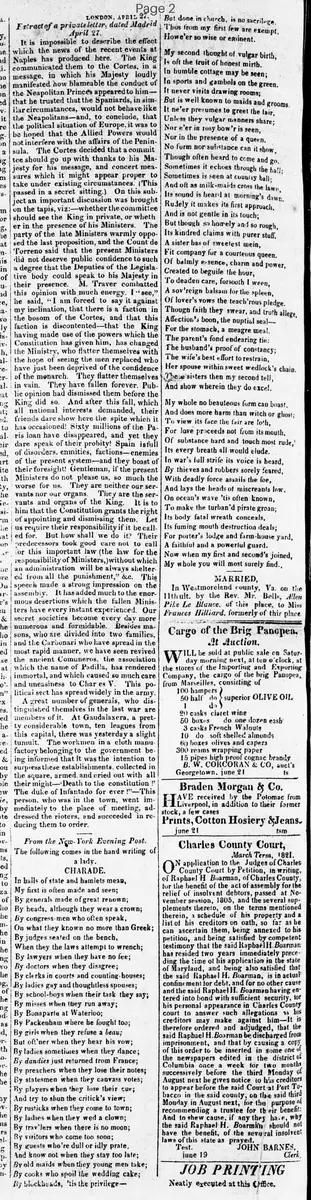
From the New-York Evening Post.
The following comes in the hand writing of a lady.
CHARADE.
In balls of state and hamlets mean,
My first is often made and seen;
By generals made of great renown;
By heads, although they wear a crown;
By congress-men who often speak,
On what they know no more than Greek:
By judges seated on the bench.
When they the laws attempt to wrench:
By lawyers when they have no fee;
By doctors when they disagree;
By clerks in courts and counting-houses;
By ladies gay and thoughtless spouses;
By school-boys when their task they say:
By misses when they run away;
By Bonaparte at Waterloo:
By Pakenham where he fought too;
By girls when they refuse a beau;
But oftener when they hear his vow;
By ladies sometimes when they dance;
By dandies just returned from France;
By preachers when they lose their notes;
By statesmen when they canvass votes;
By players when they lose their cue;
And try to shun the critic's view;
By rustics when they come to town;
By ladies when they wed a clown:
By travelers when there is no moon;
By visitors who come too soon;
By guests who're dull or idly prate
And know not when they stay too late;
By old maids when they young men take;
By cooks who spoil the wedding cake;
By blockheads, tis the privilege-
But done in church, is no sacrilege.
Thus from my first few are exempt,
Howe'er so wise or eminent.
My second thought of vulgar birth,
Is oft the fruit of honest mirth.
In humble cottage may be seen;
In sports and gambols on the green.
It never visits drawing rooms;
But is well known to maids and grooms.
It ne'er presumes to greet the fair,
Unless they vulgar manners share;
Nor e'er in rosy bower is seen,
Nor in the presence of a queen.
No form nor substance can it show.
Though often heard to come and go.
Sometimes it echoes through the hall;
Sometimes is seen at country ball;
And oft as milk-maids cross the lawn,
Its sound is heard at morning's dawn.
Rudely it makes its first approach.
And is not gentle in its touch;
But though so coarsely and so rough,
Its kindred claims with purer stuff.
A sister has of sweetest mein,
Fit company for a courteous queen.
Of balmy essence, charm and power,
Created to beguile the hour,
To deaden care, forsooth I ween,
A sovereign balsam for the spleen,
Of lover's vows the treacherous pledge.
Though faith they swear, and truth allege,
Affection's boon, the nuptial seal-
For the stomach, a meagre meal.
The parent's fond endearing tie:
The husband's proof of constancy;
The wife's best effort to restrain,
Her spouse within sweet wedlock's chain.
These sisters then my second tell,
And show wherein they do excel.
My whole no beauteous form can boast,
And does more harm than witch or ghost!;
To view its face the fair are loath,
For love proceeds not from its mouth,
Of substance hard and touch most rude,
Its every breath all would elude.
In war's full strife its voice is heard.
By thieves and robbers sorely feared,
With deadly force assails the foe,
And lays the heads of miscreants low.
On ocean's wave 'tis often known,
To make the turban'd pirate groan;
Its body fatal wreath conceals,
Its fuming mouth destruction deals;
For porter's lodge and farm-house yard,
A faithful and a powerful guard.
Now when my first and second's joined,
My whole you will most surely find.
The following comes in the hand writing of a lady.
CHARADE.
In balls of state and hamlets mean,
My first is often made and seen;
By generals made of great renown;
By heads, although they wear a crown;
By congress-men who often speak,
On what they know no more than Greek:
By judges seated on the bench.
When they the laws attempt to wrench:
By lawyers when they have no fee;
By doctors when they disagree;
By clerks in courts and counting-houses;
By ladies gay and thoughtless spouses;
By school-boys when their task they say:
By misses when they run away;
By Bonaparte at Waterloo:
By Pakenham where he fought too;
By girls when they refuse a beau;
But oftener when they hear his vow;
By ladies sometimes when they dance;
By dandies just returned from France;
By preachers when they lose their notes;
By statesmen when they canvass votes;
By players when they lose their cue;
And try to shun the critic's view;
By rustics when they come to town;
By ladies when they wed a clown:
By travelers when there is no moon;
By visitors who come too soon;
By guests who're dull or idly prate
And know not when they stay too late;
By old maids when they young men take;
By cooks who spoil the wedding cake;
By blockheads, tis the privilege-
But done in church, is no sacrilege.
Thus from my first few are exempt,
Howe'er so wise or eminent.
My second thought of vulgar birth,
Is oft the fruit of honest mirth.
In humble cottage may be seen;
In sports and gambols on the green.
It never visits drawing rooms;
But is well known to maids and grooms.
It ne'er presumes to greet the fair,
Unless they vulgar manners share;
Nor e'er in rosy bower is seen,
Nor in the presence of a queen.
No form nor substance can it show.
Though often heard to come and go.
Sometimes it echoes through the hall;
Sometimes is seen at country ball;
And oft as milk-maids cross the lawn,
Its sound is heard at morning's dawn.
Rudely it makes its first approach.
And is not gentle in its touch;
But though so coarsely and so rough,
Its kindred claims with purer stuff.
A sister has of sweetest mein,
Fit company for a courteous queen.
Of balmy essence, charm and power,
Created to beguile the hour,
To deaden care, forsooth I ween,
A sovereign balsam for the spleen,
Of lover's vows the treacherous pledge.
Though faith they swear, and truth allege,
Affection's boon, the nuptial seal-
For the stomach, a meagre meal.
The parent's fond endearing tie:
The husband's proof of constancy;
The wife's best effort to restrain,
Her spouse within sweet wedlock's chain.
These sisters then my second tell,
And show wherein they do excel.
My whole no beauteous form can boast,
And does more harm than witch or ghost!;
To view its face the fair are loath,
For love proceeds not from its mouth,
Of substance hard and touch most rude,
Its every breath all would elude.
In war's full strife its voice is heard.
By thieves and robbers sorely feared,
With deadly force assails the foe,
And lays the heads of miscreants low.
On ocean's wave 'tis often known,
To make the turban'd pirate groan;
Its body fatal wreath conceals,
Its fuming mouth destruction deals;
For porter's lodge and farm-house yard,
A faithful and a powerful guard.
Now when my first and second's joined,
My whole you will most surely find.
What sub-type of article is it?
Riddle
Satire
What themes does it cover?
Satire Society
What keywords are associated?
Charade Riddle
Social Blunders
Satirical Verse
Mirth Laughter
Destructive Force
What entities or persons were involved?
A Lady
Poem Details
Title
Charade.
Author
A Lady
Key Lines
In Balls Of State And Hamlets Mean, My First Is Often Made And Seen;
My Whole No Beauteous Form Can Boast, And Does More Harm Than Witch Or Ghost!
In War's Full Strife Its Voice Is Heard, By Thieves And Robbers Sorely Feared,