Thank you for visiting SNEWPapers!
Sign up free
Editorial
June 17, 1800
The New Hampshire Gazette
Portsmouth, Rockingham County, New Hampshire
What is this article about?
An editorial promotes a proposed cheap edition of John Adams' 'Defence of the American Constitutions,' praising it as a vital defense of balanced government against anarchy and factions. Includes an outline of the work's arguments for three-branch separation, checks and balances, and subscription terms by publisher John Russell in Boston, June 5.
Clipping
OCR Quality
98%
Excellent
Full Text
Political Miscellany.
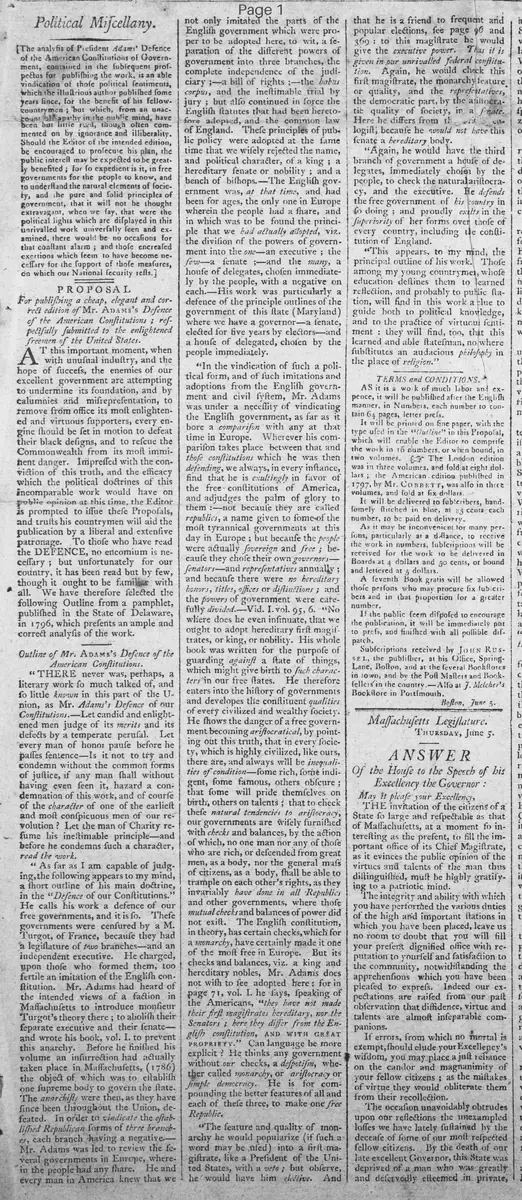
The analysis of President Adams' Defence of the American Constitutions of Government, contained in the subjoined prospectus for publishing the work, is an able vindication of those political sentiments, which the illustrious author published some years since, for the benefit of his fellow-countrymen; but which, from an unaccountable apathy in the public mind, have been but little read, though often commented on by ignorance and illiberality. Should the Editor of the intended edition, be encouraged to prosecute his plan, the public interest may be expected to be greatly benefited; for so expedient is it, in free governments for the people to know, and to understand the natural elements of society, and the pure and solid principles of government, that it will not be thought extravagant, when we say, that were the political lights which are displayed in this unrivalled work universally seen and examined, there would be no occasion for that constant alarm; and those increased exertions which seem to have become necessary for the support of those measures, on which our National security rests.
PROPOSAL For publishing a cheap, elegant and correct edition of Mr. Adams's Defence of the American Constitutions: respectfully submitted to the enlightened freemen of the United States.
At this important moment, when with unusual industry, and the hope of success, the enemies of our excellent government are attempting to undermine its foundation, and by calumnies and misrepresentation, to remove from office its most enlightened and virtuous supporters, every engine should be set in motion to defeat their black designs, and to rescue the Commonwealth from its most imminent danger. Impressed with the conviction of this truth, and the efficacy which the political doctrines of this incomparable work would have on public opinion at this time, the Editor is prompted to issue these Proposals, and trusts his countrymen will aid the publication by a liberal and extensive patronage. To those who have read the DEFENCE, no encomium is necessary; but unfortunately for our country, it has been read but by few, though it ought to be familiar with all. We have therefore selected the following Outline from a pamphlet, published in the State of Delaware, in 1796, which presents an ample and correct analysis of the work.
Outline of Mr. Adams's Defence of the American Constitutions.
"THERE never was, perhaps, a literary work so much talked of, and so little known in this part of the Union, as Mr. Adams's Defence of our Constitutions.--Let candid and enlightened men judge of its merits and its defects by a temperate perusal. Let every man of honor pause before he passes sentence. Is it not to try and condemn without the common forms of justice, if any man shall without having even seen it, hazard a condemnation of this work, and of course of the character of one of the earliest and most conspicuous men of our revolution? Let the man of Charity resume his inestimable principle and before he condemns such a character, read the work.
"As far as I am capable of judging, the following appears to my mind, a short outline of his main doctrine, in the "Defence of our Constitutions."
He calls his work a defence of our free governments, and it is so. These governments were censured by a M. Turgot, of France, because they had a legislature of two branches--and an independent executive. He charged, upon those who formed them, too fertile an imitation of the English constitution. Mr. Adams had heard of the intended views of a faction in Massachusetts to introduce monsieur Turgot's theory there; to abolish their separate executive and their senate-- and wrote his book, vol. I. to prevent this anarchy. Before he finished his volume an insurrection had actually taken place in Massachusetts, (1786) the object of which was to establish one supreme body to govern the state. The anarchists were then, as they have since been throughout the Union, defeated. In order to vindicate the established Republican forms of three branches, each branch having a negative. Mr. Adams was led to review the several governments in Europe, wherein the people had any share. He and every man in America knew that we not only imitated the parts of the English government which were proper to be adopted here, to wit, a separation of the different powers of government into three branches, the complete independence of the judiciary :--a bill of rights ;--the habeas corpus, and the inestimable trial by jury ; but also continued in force the English statutes that had been heretofore adopted, and the common law of England. These principles of public policy were adopted at the same time that we wisely rejected the name, and political character, of a king ; a hereditary senate or nobility ; and a bench of bishops.--The English government was, at that time, and had been for ages, the only one in Europe wherein the people had a share, and in which was to be found the principle that we had actually adopted, viz. the division of the powers of government into the one--an executive ; the few--a senate ;-and the many, a house of delegates, chosen immediately by the people, with a negative on each.--His work was particularly a defence of the principle outlines of the government of this state (Maryland) where we have a governor-a senate, elected for five years by electors-and a house of delegates, chosen by the people immediately.
"In the vindication of such a political form, and of such imitations and adoptions from the English government and civil system, Mr. Adams was under a necessity of vindicating the English government, as far as it bore a comparison with any at that time in Europe. Wherever his comparison takes place between that and those constitutions which he was then defending, we always, in every instance, find that he is exultingly in favor of the free-constitutions of America, and adjudges the palm of glory to them :--not because they are called republics, a name given to some of the most tyrannical governments at this day in Europe : but because the people were actually sovereign and free : because they chose their own governors- senators-and representatives annually ; and because there were no hereditary honors, titles, offices or distinctions ; and the powers of government were carefully divided.-Vid. I. vol. 95, 6. "No where does he even insinuate, that we ought to adopt hereditary first magistrates, or king, or nobility. His whole book was written for the purpose of guarding again a state of things, which might give birth to such characters in our free states. He therefore enters into the history of governments and develops the constituent qualities of every civilized and wealthy society. He shows the danger of a free government becoming aristocratical, by pointing out this truth, that in every society, which is highly civilized, like ours, there are, and always will be inequalities of condition-some rich, some indigent, some famous, others obscure ; that some will pride themselves on birth, others on talents ; that to check these natural tendencies to aristocracy, our governments are wisely furnished with checks and balances, by the action of which, no one man nor any of those who are rich, or descended from great men, as a body, nor the general mass of citizens, as a body, shall be able to trample on each other's rights, as they invariably have done in all Republics and other governments, where those mutual checks and balances of power did not exist. The English constitution, in theory, has certain checks, which for a monarchy, have certainly made it one of the most free in Europe. But its checks and balances, viz. a king and hereditary nobles, Mr. Adams does not wish to see adopted here: for in page 71, vol. I. he says, speaking of the Americans, "they have not made their first magistrates hereditary, nor the Senators ; here they differ from the English constitution, AND WITH GREAT Propriety." Can language be more explicit ? He thinks any government without our checks, a despotism, whether called monarchy, or aristocracy or simple democracy. He is for compounding the better features of all and each of these three, to make one free Republic.
"The feature and quality of monarchy he would popularize (if such a word may be used) into a first magistrate, like a President of the United States, with a veto ; but observe, he would have him elective. And that he is a friend to frequent and popular elections, see page 96 and 369 : to this magistrate he would give the executive power. Thus it is given in our unrivalled federal constitution. Again, he would check this first magistrate, the monarchy feature or quality, and the representatives, the democratic part, by the aristocratical quality of society, in a senate. Here he differs from the aristocrats. cit. logicit; because he would not have this senate a hereditary body.
"Again, he would have the third branch of government a house of delegates, immediately chosen by the people, to check the natural aristocracy, and the executive. He defends the free government of his country in so doing ; and proudly exults in the superiority of her forms over those of every country, including the constitution of England.
"This appears to my mind, the principal outline of his work. Those among my young countrymen, whose education destines them to learned reflection, and probably to public station, will find in this work a clue to guide both to political knowledge, and to the practice of virtuous sentiment : they will find, too, that this learned and able statesman, no where substitutes an audacious philosophy in the place of religion."
TERMS and CONDITIONS.
AS it is a work of much labor and expense, it will be published after the English manner, in Numbers, each number to contain 64 pages, letter press.
It will be printed on fine paper, with the type used in the "Outline" in this Proposal, which will enable the Editor to comprise the work in 16 numbers. or when bound, in two volumes. (The London edition was in three volumes, and sold at eight dollars; the American edition published in 1797, by Mr. COBBETT, was also in three volumes, and sold at six dollars.)
It will be delivered to subscribers, handsomely stitched in blue, at 25 cents each number, to be paid on delivery.
As it may be inconvenient for many persons, particularly at a distance, to receive the work in numbers, subscriptions will be received for the work to be delivered in Boards at 4 dollars and 50 cents, or bound and lettered at 5 dollars.
A seventh Book gratis will be allowed those persons who may procure six subscribers and in that proportion for a greater number.
If the public seem disposed to encourage the publication, it will be immediately put to press, and finished with all possible dispatch.
Subscriptions received by JOHN RUSSELL, the publisher, at his Office, Spring-Lane, Boston, and at the Several Bookstores in town, and by the Post Masters and Booksellers in the country.--Also at T. Melcher's Book store in Portsmouth.
Boston, June 5.
The analysis of President Adams' Defence of the American Constitutions of Government, contained in the subjoined prospectus for publishing the work, is an able vindication of those political sentiments, which the illustrious author published some years since, for the benefit of his fellow-countrymen; but which, from an unaccountable apathy in the public mind, have been but little read, though often commented on by ignorance and illiberality. Should the Editor of the intended edition, be encouraged to prosecute his plan, the public interest may be expected to be greatly benefited; for so expedient is it, in free governments for the people to know, and to understand the natural elements of society, and the pure and solid principles of government, that it will not be thought extravagant, when we say, that were the political lights which are displayed in this unrivalled work universally seen and examined, there would be no occasion for that constant alarm; and those increased exertions which seem to have become necessary for the support of those measures, on which our National security rests.
PROPOSAL For publishing a cheap, elegant and correct edition of Mr. Adams's Defence of the American Constitutions: respectfully submitted to the enlightened freemen of the United States.
At this important moment, when with unusual industry, and the hope of success, the enemies of our excellent government are attempting to undermine its foundation, and by calumnies and misrepresentation, to remove from office its most enlightened and virtuous supporters, every engine should be set in motion to defeat their black designs, and to rescue the Commonwealth from its most imminent danger. Impressed with the conviction of this truth, and the efficacy which the political doctrines of this incomparable work would have on public opinion at this time, the Editor is prompted to issue these Proposals, and trusts his countrymen will aid the publication by a liberal and extensive patronage. To those who have read the DEFENCE, no encomium is necessary; but unfortunately for our country, it has been read but by few, though it ought to be familiar with all. We have therefore selected the following Outline from a pamphlet, published in the State of Delaware, in 1796, which presents an ample and correct analysis of the work.
Outline of Mr. Adams's Defence of the American Constitutions.
"THERE never was, perhaps, a literary work so much talked of, and so little known in this part of the Union, as Mr. Adams's Defence of our Constitutions.--Let candid and enlightened men judge of its merits and its defects by a temperate perusal. Let every man of honor pause before he passes sentence. Is it not to try and condemn without the common forms of justice, if any man shall without having even seen it, hazard a condemnation of this work, and of course of the character of one of the earliest and most conspicuous men of our revolution? Let the man of Charity resume his inestimable principle and before he condemns such a character, read the work.
"As far as I am capable of judging, the following appears to my mind, a short outline of his main doctrine, in the "Defence of our Constitutions."
He calls his work a defence of our free governments, and it is so. These governments were censured by a M. Turgot, of France, because they had a legislature of two branches--and an independent executive. He charged, upon those who formed them, too fertile an imitation of the English constitution. Mr. Adams had heard of the intended views of a faction in Massachusetts to introduce monsieur Turgot's theory there; to abolish their separate executive and their senate-- and wrote his book, vol. I. to prevent this anarchy. Before he finished his volume an insurrection had actually taken place in Massachusetts, (1786) the object of which was to establish one supreme body to govern the state. The anarchists were then, as they have since been throughout the Union, defeated. In order to vindicate the established Republican forms of three branches, each branch having a negative. Mr. Adams was led to review the several governments in Europe, wherein the people had any share. He and every man in America knew that we not only imitated the parts of the English government which were proper to be adopted here, to wit, a separation of the different powers of government into three branches, the complete independence of the judiciary :--a bill of rights ;--the habeas corpus, and the inestimable trial by jury ; but also continued in force the English statutes that had been heretofore adopted, and the common law of England. These principles of public policy were adopted at the same time that we wisely rejected the name, and political character, of a king ; a hereditary senate or nobility ; and a bench of bishops.--The English government was, at that time, and had been for ages, the only one in Europe wherein the people had a share, and in which was to be found the principle that we had actually adopted, viz. the division of the powers of government into the one--an executive ; the few--a senate ;-and the many, a house of delegates, chosen immediately by the people, with a negative on each.--His work was particularly a defence of the principle outlines of the government of this state (Maryland) where we have a governor-a senate, elected for five years by electors-and a house of delegates, chosen by the people immediately.
"In the vindication of such a political form, and of such imitations and adoptions from the English government and civil system, Mr. Adams was under a necessity of vindicating the English government, as far as it bore a comparison with any at that time in Europe. Wherever his comparison takes place between that and those constitutions which he was then defending, we always, in every instance, find that he is exultingly in favor of the free-constitutions of America, and adjudges the palm of glory to them :--not because they are called republics, a name given to some of the most tyrannical governments at this day in Europe : but because the people were actually sovereign and free : because they chose their own governors- senators-and representatives annually ; and because there were no hereditary honors, titles, offices or distinctions ; and the powers of government were carefully divided.-Vid. I. vol. 95, 6. "No where does he even insinuate, that we ought to adopt hereditary first magistrates, or king, or nobility. His whole book was written for the purpose of guarding again a state of things, which might give birth to such characters in our free states. He therefore enters into the history of governments and develops the constituent qualities of every civilized and wealthy society. He shows the danger of a free government becoming aristocratical, by pointing out this truth, that in every society, which is highly civilized, like ours, there are, and always will be inequalities of condition-some rich, some indigent, some famous, others obscure ; that some will pride themselves on birth, others on talents ; that to check these natural tendencies to aristocracy, our governments are wisely furnished with checks and balances, by the action of which, no one man nor any of those who are rich, or descended from great men, as a body, nor the general mass of citizens, as a body, shall be able to trample on each other's rights, as they invariably have done in all Republics and other governments, where those mutual checks and balances of power did not exist. The English constitution, in theory, has certain checks, which for a monarchy, have certainly made it one of the most free in Europe. But its checks and balances, viz. a king and hereditary nobles, Mr. Adams does not wish to see adopted here: for in page 71, vol. I. he says, speaking of the Americans, "they have not made their first magistrates hereditary, nor the Senators ; here they differ from the English constitution, AND WITH GREAT Propriety." Can language be more explicit ? He thinks any government without our checks, a despotism, whether called monarchy, or aristocracy or simple democracy. He is for compounding the better features of all and each of these three, to make one free Republic.
"The feature and quality of monarchy he would popularize (if such a word may be used) into a first magistrate, like a President of the United States, with a veto ; but observe, he would have him elective. And that he is a friend to frequent and popular elections, see page 96 and 369 : to this magistrate he would give the executive power. Thus it is given in our unrivalled federal constitution. Again, he would check this first magistrate, the monarchy feature or quality, and the representatives, the democratic part, by the aristocratical quality of society, in a senate. Here he differs from the aristocrats. cit. logicit; because he would not have this senate a hereditary body.
"Again, he would have the third branch of government a house of delegates, immediately chosen by the people, to check the natural aristocracy, and the executive. He defends the free government of his country in so doing ; and proudly exults in the superiority of her forms over those of every country, including the constitution of England.
"This appears to my mind, the principal outline of his work. Those among my young countrymen, whose education destines them to learned reflection, and probably to public station, will find in this work a clue to guide both to political knowledge, and to the practice of virtuous sentiment : they will find, too, that this learned and able statesman, no where substitutes an audacious philosophy in the place of religion."
TERMS and CONDITIONS.
AS it is a work of much labor and expense, it will be published after the English manner, in Numbers, each number to contain 64 pages, letter press.
It will be printed on fine paper, with the type used in the "Outline" in this Proposal, which will enable the Editor to comprise the work in 16 numbers. or when bound, in two volumes. (The London edition was in three volumes, and sold at eight dollars; the American edition published in 1797, by Mr. COBBETT, was also in three volumes, and sold at six dollars.)
It will be delivered to subscribers, handsomely stitched in blue, at 25 cents each number, to be paid on delivery.
As it may be inconvenient for many persons, particularly at a distance, to receive the work in numbers, subscriptions will be received for the work to be delivered in Boards at 4 dollars and 50 cents, or bound and lettered at 5 dollars.
A seventh Book gratis will be allowed those persons who may procure six subscribers and in that proportion for a greater number.
If the public seem disposed to encourage the publication, it will be immediately put to press, and finished with all possible dispatch.
Subscriptions received by JOHN RUSSELL, the publisher, at his Office, Spring-Lane, Boston, and at the Several Bookstores in town, and by the Post Masters and Booksellers in the country.--Also at T. Melcher's Book store in Portsmouth.
Boston, June 5.
What sub-type of article is it?
Constitutional
Partisan Politics
What keywords are associated?
John Adams
American Constitutions
Checks And Balances
Political Defense
Three Branches
Republican Government
Shays Rebellion
Turgot Theory
What entities or persons were involved?
John Adams
M. Turgot
John Russell
William Cobbett
Editorial Details
Primary Topic
Vindication And Promotion Of John Adams' Defence Of The American Constitutions
Stance / Tone
Strongly Supportive Of Adams' Constitutional Principles Against Anarchy And Factions
Key Figures
John Adams
M. Turgot
John Russell
William Cobbett
Key Arguments
Defense Of Three Branch Government With Checks And Balances
Critique Of Turgot's Theory And Massachusetts Insurrection Of 1786
Superiority Of American Constitutions Over European Models
Rejection Of Hereditary Monarchy Or Nobility
Promotion Of Elective Executive And Senate To Prevent Aristocracy
Importance Of Reading Adams' Work For National Security