Thank you for visiting SNEWPapers!
Sign up free
Editorial
March 3, 1814
Daily National Intelligencer
Washington, District Of Columbia
What is this article about?
Editorial opposes Mr. Wright's motion to suspend the embargo, deeming it unnecessary and ill-timed given the President's authority and lack of trust in British sincerity, while emphasizing continued war preparations despite negotiation proposals.
Clipping
OCR Quality
98%
Excellent
Full Text
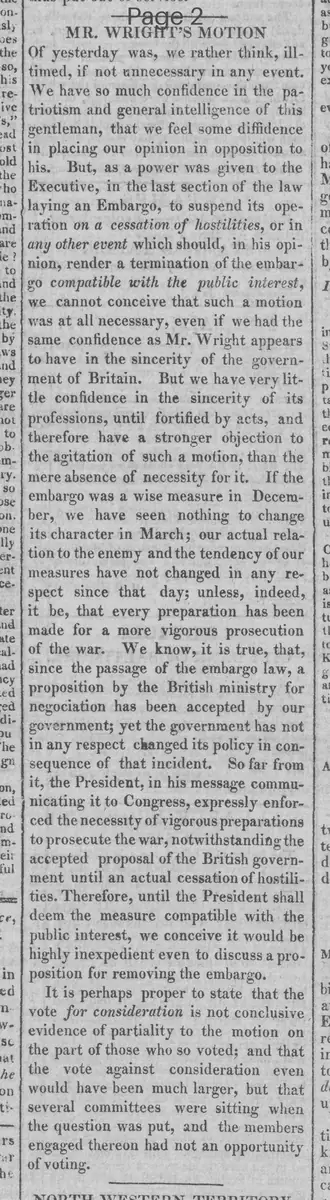
MR. WRIGHT'S MOTION
Of yesterday was, we rather think, ill-timed, if not unnecessary in any event. We have so much confidence in the patriotism and general intelligence of this gentleman, that we feel some diffidence in placing our opinion in opposition to his. But, as a power was given to the Executive, in the last section of the law laying an Embargo, to suspend its operation on a cessation of hostilities, or in any other event which should, in his opinion, render a termination of the embargo compatible with the public interest, we cannot conceive that such a motion was at all necessary, even if we had the same confidence as Mr. Wright appears to have in the sincerity of the government of Britain. But we have very little confidence in the sincerity of its professions, until fortified by acts, and therefore have a stronger objection to the agitation of such a motion, than the mere absence of necessity for it. If the embargo was a wise measure in December, we have seen nothing to change its character in March; our actual relation to the enemy and the tendency of our measures have not changed in any respect since that day; unless, indeed, it be, that every preparation has been made for a more vigorous prosecution of the war. We know, it is true, that, since the passage of the embargo law, a proposition by the British ministry for negociation has been accepted by our government; yet the government has not in any respect changed its policy in consequence of that incident. So far from it, the President, in his message communicating it to Congress, expressly enforced the necessity of vigorous preparations to prosecute the war, notwithstanding the accepted proposal of the British government until an actual cessation of hostilities. Therefore, until the President shall deem the measure compatible with the public interest, we conceive it would be highly inexpedient even to discuss a proposition for removing the embargo.
It is perhaps proper to state that the vote for consideration is not conclusive evidence of partiality to the motion on the part of those who so voted; and that the vote against consideration even would have been much larger, but that several committees were sitting when the question was put, and the members engaged thereon had not an opportunity of voting.
Of yesterday was, we rather think, ill-timed, if not unnecessary in any event. We have so much confidence in the patriotism and general intelligence of this gentleman, that we feel some diffidence in placing our opinion in opposition to his. But, as a power was given to the Executive, in the last section of the law laying an Embargo, to suspend its operation on a cessation of hostilities, or in any other event which should, in his opinion, render a termination of the embargo compatible with the public interest, we cannot conceive that such a motion was at all necessary, even if we had the same confidence as Mr. Wright appears to have in the sincerity of the government of Britain. But we have very little confidence in the sincerity of its professions, until fortified by acts, and therefore have a stronger objection to the agitation of such a motion, than the mere absence of necessity for it. If the embargo was a wise measure in December, we have seen nothing to change its character in March; our actual relation to the enemy and the tendency of our measures have not changed in any respect since that day; unless, indeed, it be, that every preparation has been made for a more vigorous prosecution of the war. We know, it is true, that, since the passage of the embargo law, a proposition by the British ministry for negociation has been accepted by our government; yet the government has not in any respect changed its policy in consequence of that incident. So far from it, the President, in his message communicating it to Congress, expressly enforced the necessity of vigorous preparations to prosecute the war, notwithstanding the accepted proposal of the British government until an actual cessation of hostilities. Therefore, until the President shall deem the measure compatible with the public interest, we conceive it would be highly inexpedient even to discuss a proposition for removing the embargo.
It is perhaps proper to state that the vote for consideration is not conclusive evidence of partiality to the motion on the part of those who so voted; and that the vote against consideration even would have been much larger, but that several committees were sitting when the question was put, and the members engaged thereon had not an opportunity of voting.
What sub-type of article is it?
War Or Peace
Economic Policy
Foreign Affairs
What keywords are associated?
Embargo Suspension
Mr Wright Motion
British Sincerity
War Preparations
Presidential Authority
Congressional Vote
What entities or persons were involved?
Mr. Wright
Executive
President
British Government
British Ministry
Congress
Editorial Details
Primary Topic
Opposition To Suspending The Embargo
Stance / Tone
Critical Of Motion To Suspend Embargo
Key Figures
Mr. Wright
Executive
President
British Government
British Ministry
Congress
Key Arguments
Motion Is Ill Timed And Unnecessary
Executive Has Power To Suspend Embargo If Compatible With Public Interest
Little Confidence In British Sincerity Without Acts
Embargo Remains Wise Despite Negotiations
War Preparations Continue Vigorously
Inexpedient To Discuss Removal Until President Deems Fit
Vote For Consideration Not Indicative Of Support