Thank you for visiting SNEWPapers!
Sign up free
Editorial
November 24, 1931
The Bismarck Tribune
Bismarck, Mandan, Burleigh County, Morton County, North Dakota
What is this article about?
Mrs. John D. Sherman appeals to American women to loosen purse strings and spend more, as they control 85% of family incomes, to stimulate business, prevent job losses, and maintain living standards during economic downturn.
Clipping
OCR Quality
98%
Excellent
Full Text
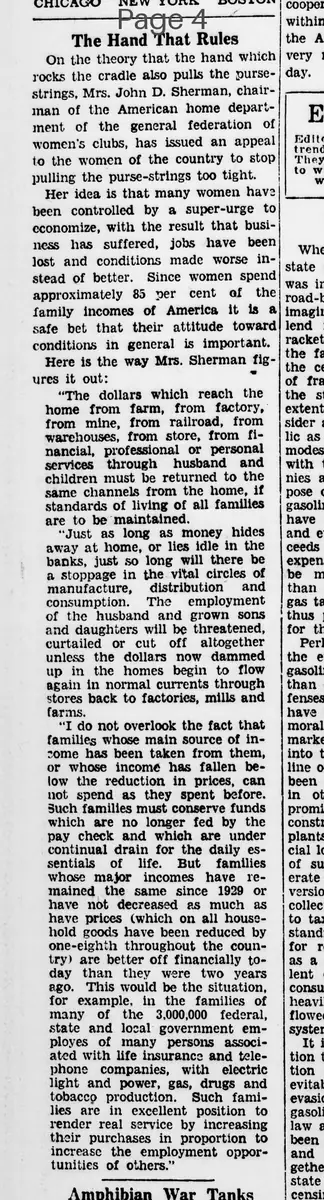
The Hand That Rules
On the theory that the hand which rocks the cradle also pulls the purse-strings. Mrs. John D. Sherman. chairman of the American home department of the general federation of women's clubs, has issued an appeal to the women of the country to stop pulling the purse-strings too tight.
Her idea is that many women have been controlled by a super-urge to economize, with the result that business has suffered, jobs have been lost and conditions made worse instead of better. Since women spend approximately 85 per cent of the family incomes of America it is a safe bet that their attitude toward conditions in general is important.
Here is the way Mrs. Sherman figures it out:
"The dollars which reach the home from farm, from factory. from mine, from railroad, from warehouses, from store. from financial, professional or personal services through husband and children must be returned to the same channels from the home. if standards of living of all families are to be maintained.
"Just as long as money hides away at home, or lies idle in the banks, just so long will there be a stoppage in the vital circles of manufacture. distribution and consumption. The employment of the husband and grown sons and daughters will be threatened. curtailed or cut off altogether unless the dollars now dammed up in the homes begin to flow again in normal currents through stores back to factories, mills and farms.
"I do not overlook the fact that families whose main source of income has been taken from them, or whose income has fallen below the reduction in prices. can not spend as they spent before.
Such families must conserve funds which are no longer fed by the pay check and which are under continual drain for the daily essentials of life. But families whose major incomes have remained the same since 1929 or have not decreased as much as have prices (which on all household goods have been reduced by one-eighth throughout the country) are better off financially today than they were two years ago. This would be the situation, for example, in the families of many of the 3,000,000 federal. state and local government employees of many persons associated with life insurance and telephone companies. with electric light and power, gas, drugs and tobacco production. Such families are in excellent position to render real service by increasing their purchases in proportion to increase the employment opportunities of others."
On the theory that the hand which rocks the cradle also pulls the purse-strings. Mrs. John D. Sherman. chairman of the American home department of the general federation of women's clubs, has issued an appeal to the women of the country to stop pulling the purse-strings too tight.
Her idea is that many women have been controlled by a super-urge to economize, with the result that business has suffered, jobs have been lost and conditions made worse instead of better. Since women spend approximately 85 per cent of the family incomes of America it is a safe bet that their attitude toward conditions in general is important.
Here is the way Mrs. Sherman figures it out:
"The dollars which reach the home from farm, from factory. from mine, from railroad, from warehouses, from store. from financial, professional or personal services through husband and children must be returned to the same channels from the home. if standards of living of all families are to be maintained.
"Just as long as money hides away at home, or lies idle in the banks, just so long will there be a stoppage in the vital circles of manufacture. distribution and consumption. The employment of the husband and grown sons and daughters will be threatened. curtailed or cut off altogether unless the dollars now dammed up in the homes begin to flow again in normal currents through stores back to factories, mills and farms.
"I do not overlook the fact that families whose main source of income has been taken from them, or whose income has fallen below the reduction in prices. can not spend as they spent before.
Such families must conserve funds which are no longer fed by the pay check and which are under continual drain for the daily essentials of life. But families whose major incomes have remained the same since 1929 or have not decreased as much as have prices (which on all household goods have been reduced by one-eighth throughout the country) are better off financially today than they were two years ago. This would be the situation, for example, in the families of many of the 3,000,000 federal. state and local government employees of many persons associated with life insurance and telephone companies. with electric light and power, gas, drugs and tobacco production. Such families are in excellent position to render real service by increasing their purchases in proportion to increase the employment opportunities of others."
What sub-type of article is it?
Economic Policy
Labor
Social Reform
What keywords are associated?
Women Spending
Economic Recovery
Money Circulation
Family Incomes
Employment Opportunities
What entities or persons were involved?
Mrs. John D. Sherman
General Federation Of Women's Clubs
American Home Department
Editorial Details
Primary Topic
Appeal For Women To Increase Spending To Stimulate Economy
Stance / Tone
Urging Increased Consumer Spending By Women
Key Figures
Mrs. John D. Sherman
General Federation Of Women's Clubs
American Home Department
Key Arguments
Women Control 85% Of Family Incomes
Economizing By Women Harms Business And Jobs
Dollars Must Circulate From Homes Back To Production Channels
Families With Stable Incomes Since 1929 Should Increase Purchases
Such Spending Aids Employment In Factories, Mills, Farms