Thank you for visiting SNEWPapers!
Sign up free
The Charlotte Journal
Charlotte, Mecklenburg County, North Carolina
What is this article about?
The new Post Office Bill, passed by the Senate, proposes uniform low postage rates for letters and publications, restricts franking privileges to Congress members during sessions, prohibits private expresses and unauthorized mail transport, and allocates funds for postal deficiencies. It continues franking for ex-Presidents and widows. Expected to pass the House amid public demand for lower rates.
Clipping
OCR Quality
Full Text
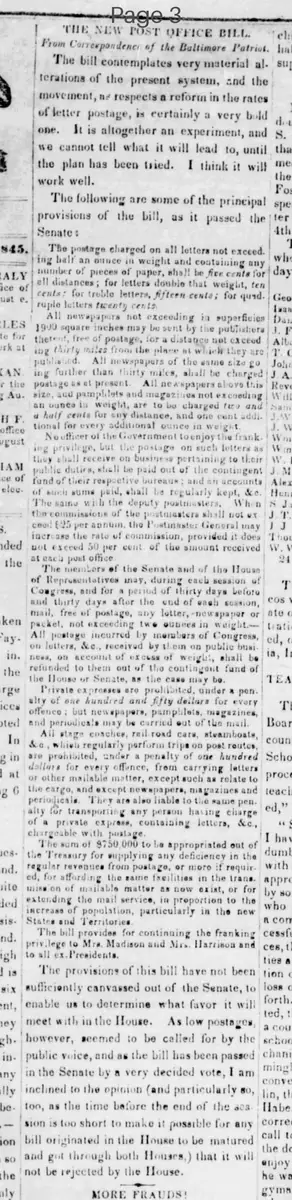
From Correspondence of the Baltimore Patriot.
The bill contemplates very material alterations of the present system, and the movement, as respects a reform in the rates of letter postage, is certainly a very bold one. It is altogether an experiment, and we cannot tell what it will lead to, until the plan has been tried. I think it will work well.
The following are some of the principal provisions of the bill, as it passed the Senate:
The postage charged on all letters not exceeding half an ounce in weight and containing any number of pieces of paper, shall be five cents for all distances; for letters double that weight, ten cents: for triple letters, fifteen cents; for quadruple letters twenty cents.
All newspapers not exceeding in superficies 1900 square inches may be sent by the publishers there, free of postage, for a distance not exceeding thirty miles from the place at which they are published. All newspapers of the same size going further than thirty miles, shall be charged postage as at present All newspapers above this size, and pamphlets and magazines not exceeding an ounce in weight, are to be charged two and a half cents for any distance, and one cent additional for every additional ounce in weight
No officer of the Government to enjoy the franking privilege, but the postage on such letters as they shall receive on business pertaining to their public duties, shall be paid out of the contingent fund of their respective bureaus; and an account of such sums paid, shall be regularly kept, &c. The same with the deputy postmasters. When the commissions of the postmasters shall not exceed $25 per annum, the Postmaster General may increase the rate of commission, provided it does not exceed 50 per cent of the amount received at each post office
The members of the Senate and of the House of Representatives may, during each session of Congress, and for a period of thirty days before and thirty days after the end of each session, mail, free of postage, any letter, newspaper or packet, not exceeding two ounces in weight.
All postage incurred by members of Congress, on letters, &c, received by them on public business, on account of excess of weight, shall be refunded to them out of the contingent fund of the House or Senate, as the case may be.
Private expresses are prohibited, under a penalty of one hundred and fifty dollars for every offence, but newspapers, pamphlets, magazines, and periodicals may be carried out of the mail.
All stage coaches, rail road cars, steamboats, &c, which regularly perform trips on post routes, are prohibited, under a penalty of one hundred dollars for every offence, from carrying letters or other mailable matter, except such as relate to the cargo, and except newspapers, magazines and periodicals. They are also liable to the same penalty for transporting any person having charge of a private express, containing letters, &c. chargeable with postage.
The sum of $750,000 to be appropriated out of the Treasury for supplying any deficiency in the regular revenues from postage, or more if required, for affording the same facilities in the transmission of mailable matter as now exist, or for extending the mail service, in proportion to the increase of population, particularly in the new States and Territories
The bill provides for continuing the franking privilege to Mrs. Madison and Mrs. Harrison and to all ex-Presidents.
The provisions of this bill have not been sufficiently canvassed out of the Senate, to enable us to determine what favor it will meet with in the House. As low postages however, seem to be called for by the public voice, and as the bill has been passed in the Senate by a very decided vote, I am inclined to the opinion (and particularly so, too, as the time before the end of the session is too short to make it possible for any bill originated in the House to be matured and got through both Houses,) that it will not be rejected by the House.
What sub-type of article is it?
What keywords are associated?
What entities or persons were involved?
Domestic News Details
Key Persons
Outcome
bill passed the senate by a decided vote; expected to pass the house due to public demand for low postages and time constraints.
Event Details
The bill proposes uniform postage rates of five cents for letters up to half an ounce regardless of distance, with increases for heavier letters; free local newspaper mailing within 30 miles; reduced rates for publications; restricted franking privileges for government officers but retained for Congress members during sessions; prohibition of private expresses and unauthorized mail transport by vehicles; appropriation of $750,000 for postal deficiencies; continued franking for ex-Presidents and specified widows.