Thank you for visiting SNEWPapers!
Sign up free
Editorial
April 11, 1843
The New Hampshire Gazette
Portsmouth, Rockingham County, New Hampshire
What is this article about?
This 1844 editorial urges open discussion of Democratic presidential candidates like Van Buren and Calhoun before the National Convention. It advocates for a May 1844 meeting in Baltimore, delegate selection by districts, and per capita voting to ensure fair representation, criticizing state-based voting that suppresses minorities.
Clipping
OCR Quality
98%
Excellent
Full Text
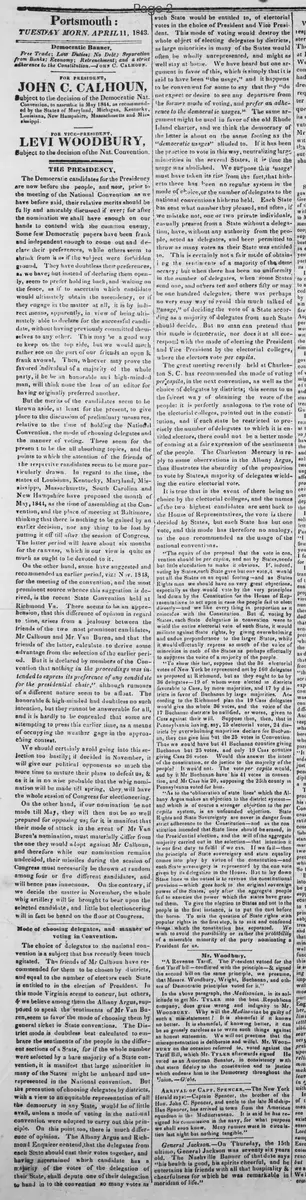
THE PRESIDENCY.
The Democratic candidates for the Presidency are now before the people, and now, prior to the meeting of the National Convention as we have before said, their relative merits should be fully and amicably discussed if ever; for after the nomination we shall have enough on our hands to contend with the common enemy.
Some few Democratic papers have been frank and independent enough to come out and declare their preferences, while others seem to shrink from it as if the subject were forbidden ground. They have doubtless their preferences, we have; but instead of declaring them openly, seem to prefer holding back, and waiting on the fence, as if to ascertain which candidate would ultimately obtain the ascendency, or if they engage in the matter at all, it is by indirect means, apparently, in view of being ultimately able to declare for the successful candidate, without having previously committed themselves to any other. This may be a good way to keep on the top side, but we would much rather see on the part of our friends an open & frank avowal. Then, whoever may prove the favored individual of a majority of the whole party, if he be an honorable and high-minded man, will think none the less of an editor for having originally preferred another.
But the merits of the candidates seem to be thrown aside, at least for the present, to give place to the discussion of preliminary measures, relative to the time of holding the National Convention, the mode of choosing delegates and the manner of voting. These seem for the present to be the all absorbing topics, and the points to which the attention of the friends of the respective candidates seem to be more particularly drawn. In regard to the time, the states of Louisiana, Kentucky, Maryland, Mississippi, Massachusetts, South Carolina and New Hampshire have proposed the month of May, 1844, as the time of assembling at the Convention, and the place of meeting at Baltimore, thinking that there is nothing to be gained by an earlier decision, nor any thing to be lost by putting it off till after the session of Congress. The latter period will leave about six months for the canvass, which in our view is quite as much as ought to be devoted to it.
On the other hand, some have suggested and recommended an earlier period, viz: Nov. 1843, for the meeting of the convention, and the most prominent source whence this suggestion is derived, is the recent State Convention held at Richmond Va. There seems to be an apprehension, that this difference of opinion in regard to time, arises from a jealousy between the friends of the two most prominent candidates, Mr Calhoun and Mr Van Buren, and that the friends of the latter, calculate to derive some advantage from the selection of the earlier period. But it is declared by members of the Convention that nothing in the proceedings was intended to express its preference of any candidate for the presidential chair, although rumours of a different nature seem to be afloat. The honorable & high-minded had doubtless no such intention, but they cannot be answerable for all, and it is hardly to be concealed that some are attempting to press this earlier time, as a means of occupying the weather gage in the approaching contest.
We should certainly avoid going into this selection too hastily; if decided in November, it will give our political opponents so much the more time to mature their plans to defeat us, & as it is in no wise probable that the whig nomination will be made till spring, they will have the whole session of Congress for electioneering. On the other hand, if our nomination be not made till May, they will then not be so well prepared for opposing us; for it is manifest that their mode of attack in the event of Mr Van Buren's nomination, must materially differ from the one they would adopt against Mr Calhoun, and therefore while our nomination remains undecided, their missiles during the session of Congress must necessarily be thrown at random among four or five different candidates, and will hence pass innocuous. On the contrary, if we decide the matter in November, the whole whig artillery will be brought to bear upon the selected candidate, and little but electioneering will in fact be heard on the floor of Congress.
Mode of choosing delegates, and manner of voting in Convention.
The choice of delegates to the national convention is a subject that has recently been much agitated. The friends of Mr Calhoun have recommended for them to be chosen by districts, and equal to the number of electors each State is entitled to in the election of President. In this mode Virginia seems to concur, but others, & we believe among them the Albany Argus, supposed to speak the sentiments of Mr Van Buren, seem to favor the mode of choosing them by general ticket in State conventions. The District mode is doubtless best calculated to embrace the sentiments of the people in the different sections of a State, for if the whole number were selected by a bare majority of a State convention, it is manifest that large minorities in many of the States might be unheard and unrepresented in the National convention. But the precaution of choosing delegates by districts, with a view to an equitable representation of all the democracy in any State, would be of little avail, unless a mode of voting in the national convention were adopted to carry out this principle. On this point too, there is much difference of opinion. The Albany Argus and Richmond Enquirer contend, that the delegates from each State should cast their votes together, and having ascertained which candidate has a majority of the votes of the delegation of their State, shall depute one of their delegation to hand in to the convention as many votes as such State would be entitled to, of electoral votes in the choice of President and Vice President. This mode of voting would destroy the whole object of electing delegates by districts, as large minorities in many of the States would often be wholly unrepresented, and might as well stay at home. We have heard but one argument in favor of this, which is simply that it is said to have been "the usage," and it happens to be convenient for some to say that they "do not expect or desire to see any departure from the former mode of voting, and prefer an adherence to the democratic usages." The same argument might be used in favor of the old Rhode Island charter, and we think the democracy of the latter is about on the same footing as the "democratic usages" alluded to. If it has been the practice to vote in this way, neutralizing large minorities in the several States, it is time the usage was abolished. We suppose this 'usage' must have taken its rise from the fact, that hitherto there has been no regular system in the mode of choice, or the number of delegates to the national conventions hitherto held. Each State has sent what number they pleased, and often, if we mistake not, one or two private individuals, casually present from a State without a delegation, have, without any authority from the people, acted as delegates, and been permitted to throw as many votes as their State was entitled to. This is certainly not a fair mode of obtaining the sentiments of a majority of the democracy; but when there has been no uniformity in the number of delegates, when some States send one, and others ten and others fifty or may be one hundred delegates, there was perhaps no very easy way to avoid this much talked of "usage," of deciding the vote of a State according to a majority of delegates from such State should decide. But no man can pretend that this mode is democratic, nor does it at all correspond with the mode of electing the President and Vice President by the electoral colleges, where the electors vote per capita.
The great meeting recently held at Charleston S. C. has recommended the mode of voting per capita, in the next convention, as well as the choice of delegates by districts; this seems to us the fairest way of obtaining the voice of the people: it is perfectly analogous to the vote of the electoral colleges, pointed out in the constitution, and if each state be restricted to precisely the number of delegates to which it is entitled electors, there could not be a better mode of coming at a fair expression of the sentiments of the people. The Charleston Mercury in reply to some observations in the Albany Argus, thus illustrates the absurdity of the proposition to vote by States, a majority of delegates wielding the entire electoral vote.
It is true that in the event of there being no choice by the electoral colleges, and the names of the two highest candidates are sent back to the House of Representatives, the vote is there decided by States, but each State has but one vote, and this mode has therefore no analogy, to the one recommended as the usage of the national conventions.
"The equity of the proposal that the vote in convention should be per capita, and not by States, needs but little elucidation to make it obvious. If, indeed, voting by States, each State gave but one vote, it would put all the States on an equal footing—and as States Rights men we should have no very great objections, especially as they would vote by the very principles laid down by the Constitution for the House of Representatives to act upon in case the people fail to elect directly—and we like every thing in proportion as it coincides with the Constitution. But if, voting by States, each State delegation in convention were to wield the entire electoral vote of such State, it would militate against State rights, by giving overwhelming and undue preponderance to the larger States, while it would effectually repress so much of the voice of minorities in each of the States as perhaps effectually to suppress the voice of a majority of the people.
"To show this last, suppose that the 36 electoral votes of New York be represented not by 160 delegates as proposed at Richmond, but as they ought to be by 36 delegates—19 of whom were elected in districts favorable to Cass, by mere majorities, and 17 by districts in favor of Buchanan by large majorities. According to the Richmond plan the 19 Cass delegates would give the whole 36 votes, and the voice of the 17 Buchanan districts be nullified, or worse, given to Cass against their will. Suppose then, that in Pennsylvania having, say, 25 electoral votes, 24 districts by overwhelming majorities declare for Buchanan, they can give him but the 25 votes in Convention. Thus we would have but 41 Buchanan counties giving Buchanan but 25 votes, and only 19 Cass counties giving Cass 36 votes. Would this answer the intent of the constitution, or do justice to the majority of the people? It would not. The vote per capita would, and by it Mr Buchanan would have his 41 votes in convention, and Mr Cass his 19, supposing the 25th county in Pennsylvania voted for him.
"As to the 'obliteration of state lines' which the Albany Argus makes an objection to the district system—and which is of course a stronger objection to the per capita system, is an unfounded objection. State Rights and State Sovereignty are never in danger from strict adherence to the Constitution—and as the constitution intended that State lines should be erased, in the Presidential election, and the will of the aggregate majority carried out in the selection—that intention it is our first duty to fulfil if we can. If we fail—then the principle of State sovereignty and state equality comes into play by virtue of the constitution—and each State sovereignty is represented by the one vote given by its delegation in the House. But to lay down State lines in the outset is to reverse the constitutional provision—which goes back to the original sovereign power of the States, only after the aggregate people fail to exercise the power which the states have granted them. To give the election to States and not to the people in the first instance, is to put the cart before the horse. To mix the question of State rights with popular rights in the first step, is to mix and confound things which the constitution has separated. We wish to avoid the possibility or rather the probability of a miserable minority of the party nominating a President for us."
The Democratic candidates for the Presidency are now before the people, and now, prior to the meeting of the National Convention as we have before said, their relative merits should be fully and amicably discussed if ever; for after the nomination we shall have enough on our hands to contend with the common enemy.
Some few Democratic papers have been frank and independent enough to come out and declare their preferences, while others seem to shrink from it as if the subject were forbidden ground. They have doubtless their preferences, we have; but instead of declaring them openly, seem to prefer holding back, and waiting on the fence, as if to ascertain which candidate would ultimately obtain the ascendency, or if they engage in the matter at all, it is by indirect means, apparently, in view of being ultimately able to declare for the successful candidate, without having previously committed themselves to any other. This may be a good way to keep on the top side, but we would much rather see on the part of our friends an open & frank avowal. Then, whoever may prove the favored individual of a majority of the whole party, if he be an honorable and high-minded man, will think none the less of an editor for having originally preferred another.
But the merits of the candidates seem to be thrown aside, at least for the present, to give place to the discussion of preliminary measures, relative to the time of holding the National Convention, the mode of choosing delegates and the manner of voting. These seem for the present to be the all absorbing topics, and the points to which the attention of the friends of the respective candidates seem to be more particularly drawn. In regard to the time, the states of Louisiana, Kentucky, Maryland, Mississippi, Massachusetts, South Carolina and New Hampshire have proposed the month of May, 1844, as the time of assembling at the Convention, and the place of meeting at Baltimore, thinking that there is nothing to be gained by an earlier decision, nor any thing to be lost by putting it off till after the session of Congress. The latter period will leave about six months for the canvass, which in our view is quite as much as ought to be devoted to it.
On the other hand, some have suggested and recommended an earlier period, viz: Nov. 1843, for the meeting of the convention, and the most prominent source whence this suggestion is derived, is the recent State Convention held at Richmond Va. There seems to be an apprehension, that this difference of opinion in regard to time, arises from a jealousy between the friends of the two most prominent candidates, Mr Calhoun and Mr Van Buren, and that the friends of the latter, calculate to derive some advantage from the selection of the earlier period. But it is declared by members of the Convention that nothing in the proceedings was intended to express its preference of any candidate for the presidential chair, although rumours of a different nature seem to be afloat. The honorable & high-minded had doubtless no such intention, but they cannot be answerable for all, and it is hardly to be concealed that some are attempting to press this earlier time, as a means of occupying the weather gage in the approaching contest.
We should certainly avoid going into this selection too hastily; if decided in November, it will give our political opponents so much the more time to mature their plans to defeat us, & as it is in no wise probable that the whig nomination will be made till spring, they will have the whole session of Congress for electioneering. On the other hand, if our nomination be not made till May, they will then not be so well prepared for opposing us; for it is manifest that their mode of attack in the event of Mr Van Buren's nomination, must materially differ from the one they would adopt against Mr Calhoun, and therefore while our nomination remains undecided, their missiles during the session of Congress must necessarily be thrown at random among four or five different candidates, and will hence pass innocuous. On the contrary, if we decide the matter in November, the whole whig artillery will be brought to bear upon the selected candidate, and little but electioneering will in fact be heard on the floor of Congress.
Mode of choosing delegates, and manner of voting in Convention.
The choice of delegates to the national convention is a subject that has recently been much agitated. The friends of Mr Calhoun have recommended for them to be chosen by districts, and equal to the number of electors each State is entitled to in the election of President. In this mode Virginia seems to concur, but others, & we believe among them the Albany Argus, supposed to speak the sentiments of Mr Van Buren, seem to favor the mode of choosing them by general ticket in State conventions. The District mode is doubtless best calculated to embrace the sentiments of the people in the different sections of a State, for if the whole number were selected by a bare majority of a State convention, it is manifest that large minorities in many of the States might be unheard and unrepresented in the National convention. But the precaution of choosing delegates by districts, with a view to an equitable representation of all the democracy in any State, would be of little avail, unless a mode of voting in the national convention were adopted to carry out this principle. On this point too, there is much difference of opinion. The Albany Argus and Richmond Enquirer contend, that the delegates from each State should cast their votes together, and having ascertained which candidate has a majority of the votes of the delegation of their State, shall depute one of their delegation to hand in to the convention as many votes as such State would be entitled to, of electoral votes in the choice of President and Vice President. This mode of voting would destroy the whole object of electing delegates by districts, as large minorities in many of the States would often be wholly unrepresented, and might as well stay at home. We have heard but one argument in favor of this, which is simply that it is said to have been "the usage," and it happens to be convenient for some to say that they "do not expect or desire to see any departure from the former mode of voting, and prefer an adherence to the democratic usages." The same argument might be used in favor of the old Rhode Island charter, and we think the democracy of the latter is about on the same footing as the "democratic usages" alluded to. If it has been the practice to vote in this way, neutralizing large minorities in the several States, it is time the usage was abolished. We suppose this 'usage' must have taken its rise from the fact, that hitherto there has been no regular system in the mode of choice, or the number of delegates to the national conventions hitherto held. Each State has sent what number they pleased, and often, if we mistake not, one or two private individuals, casually present from a State without a delegation, have, without any authority from the people, acted as delegates, and been permitted to throw as many votes as their State was entitled to. This is certainly not a fair mode of obtaining the sentiments of a majority of the democracy; but when there has been no uniformity in the number of delegates, when some States send one, and others ten and others fifty or may be one hundred delegates, there was perhaps no very easy way to avoid this much talked of "usage," of deciding the vote of a State according to a majority of delegates from such State should decide. But no man can pretend that this mode is democratic, nor does it at all correspond with the mode of electing the President and Vice President by the electoral colleges, where the electors vote per capita.
The great meeting recently held at Charleston S. C. has recommended the mode of voting per capita, in the next convention, as well as the choice of delegates by districts; this seems to us the fairest way of obtaining the voice of the people: it is perfectly analogous to the vote of the electoral colleges, pointed out in the constitution, and if each state be restricted to precisely the number of delegates to which it is entitled electors, there could not be a better mode of coming at a fair expression of the sentiments of the people. The Charleston Mercury in reply to some observations in the Albany Argus, thus illustrates the absurdity of the proposition to vote by States, a majority of delegates wielding the entire electoral vote.
It is true that in the event of there being no choice by the electoral colleges, and the names of the two highest candidates are sent back to the House of Representatives, the vote is there decided by States, but each State has but one vote, and this mode has therefore no analogy, to the one recommended as the usage of the national conventions.
"The equity of the proposal that the vote in convention should be per capita, and not by States, needs but little elucidation to make it obvious. If, indeed, voting by States, each State gave but one vote, it would put all the States on an equal footing—and as States Rights men we should have no very great objections, especially as they would vote by the very principles laid down by the Constitution for the House of Representatives to act upon in case the people fail to elect directly—and we like every thing in proportion as it coincides with the Constitution. But if, voting by States, each State delegation in convention were to wield the entire electoral vote of such State, it would militate against State rights, by giving overwhelming and undue preponderance to the larger States, while it would effectually repress so much of the voice of minorities in each of the States as perhaps effectually to suppress the voice of a majority of the people.
"To show this last, suppose that the 36 electoral votes of New York be represented not by 160 delegates as proposed at Richmond, but as they ought to be by 36 delegates—19 of whom were elected in districts favorable to Cass, by mere majorities, and 17 by districts in favor of Buchanan by large majorities. According to the Richmond plan the 19 Cass delegates would give the whole 36 votes, and the voice of the 17 Buchanan districts be nullified, or worse, given to Cass against their will. Suppose then, that in Pennsylvania having, say, 25 electoral votes, 24 districts by overwhelming majorities declare for Buchanan, they can give him but the 25 votes in Convention. Thus we would have but 41 Buchanan counties giving Buchanan but 25 votes, and only 19 Cass counties giving Cass 36 votes. Would this answer the intent of the constitution, or do justice to the majority of the people? It would not. The vote per capita would, and by it Mr Buchanan would have his 41 votes in convention, and Mr Cass his 19, supposing the 25th county in Pennsylvania voted for him.
"As to the 'obliteration of state lines' which the Albany Argus makes an objection to the district system—and which is of course a stronger objection to the per capita system, is an unfounded objection. State Rights and State Sovereignty are never in danger from strict adherence to the Constitution—and as the constitution intended that State lines should be erased, in the Presidential election, and the will of the aggregate majority carried out in the selection—that intention it is our first duty to fulfil if we can. If we fail—then the principle of State sovereignty and state equality comes into play by virtue of the constitution—and each State sovereignty is represented by the one vote given by its delegation in the House. But to lay down State lines in the outset is to reverse the constitutional provision—which goes back to the original sovereign power of the States, only after the aggregate people fail to exercise the power which the states have granted them. To give the election to States and not to the people in the first instance, is to put the cart before the horse. To mix the question of State rights with popular rights in the first step, is to mix and confound things which the constitution has separated. We wish to avoid the possibility or rather the probability of a miserable minority of the party nominating a President for us."
What sub-type of article is it?
Partisan Politics
Constitutional
What keywords are associated?
Democratic Convention
Presidential Candidates
Delegate Selection
Voting Method
Van Buren
Calhoun
Per Capita Voting
State Rights
What entities or persons were involved?
Mr Van Buren
Mr Calhoun
Mr Cass
Mr Buchanan
Albany Argus
Richmond Enquirer
Charleston Mercury
Richmond Va Convention
Charleston S C Meeting
Editorial Details
Primary Topic
Democratic National Convention Procedures For 1844 Presidential Nomination
Stance / Tone
Advocacy For Fair Representation Through District Delegates And Per Capita Voting, Preference For May 1844 Convention
Key Figures
Mr Van Buren
Mr Calhoun
Mr Cass
Mr Buchanan
Albany Argus
Richmond Enquirer
Charleston Mercury
Richmond Va Convention
Charleston S C Meeting
Key Arguments
Encourage Open Discussion Of Candidates Before Nomination
Prefer May 1844 Convention In Baltimore To Limit Whig Preparation Time
Select Delegates By Districts To Represent Sectional Sentiments
Adopt Per Capita Voting In Convention To Avoid Suppressing Minorities
Criticize State Based Voting As Undemocratic And Contrary To Constitutional Electoral Process
Earlier November 1843 Convention Benefits Opponents By Allowing Focused Attacks