Thank you for visiting SNEWPapers!
Sign up free
Editorial
July 9, 1845
Mississippi Democrat
Carrollton, Carroll County, Mississippi
What is this article about?
Editorial critiques Secretary Walker's defense of handling a Senatorial commission for Mr. Thompson's resignation, highlighting discrepancies with the Governor's statements and unusual political maneuvers involving Democratic Party issues like the Rhode Island controversy.
Clipping
OCR Quality
95%
Excellent
Full Text
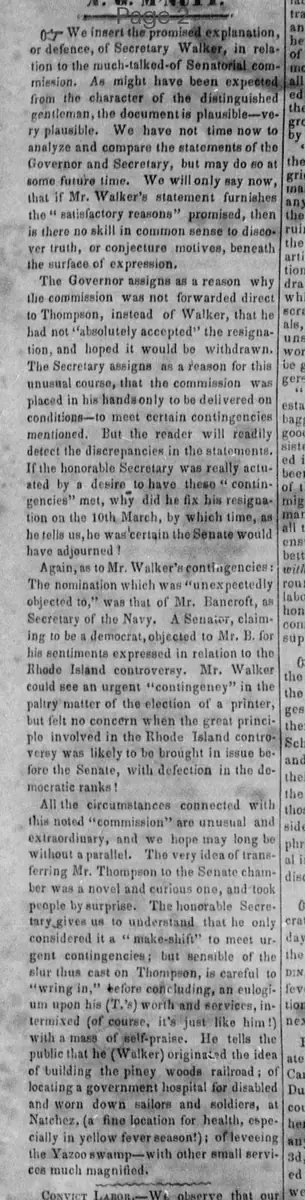
We insert the promised explanation, or defence, of Secretary Walker, in relation to the much-talked-of Senatorial commission. As might have been expected from the character of the distinguished gentleman, the document is plausible-very plausible. We have not time now to analyze and compare the statements of the Governor and Secretary, but may do so at some future time. We will only say now, that if Mr. Walker's statement furnishes the "satisfactory reasons" promised, then is there no skill in common sense to discover truth, or conjecture motives, beneath the surface of expression.
The Governor assigns as a reason why the commission was not forwarded direct to Thompson, instead of Walker, that he had not "absolutely accepted" the resignation, and hoped it would be withdrawn. The Secretary assigns as a reason for this unusual course, that the commission was placed in his hands only to be delivered on conditions-to meet certain contingencies mentioned. But the reader will readily detect the discrepancies in the statements.
If the honorable Secretary was really actuated by a desire to have these "contingencies" met, why did he fix his resignation on the 10th March, by which time, as he tells us, he was certain the Senate would have adjourned?
Again, as to Mr. Walker's contingencies: The nomination which was "unexpectedly objected to," was that of Mr. Bancroft, as Secretary of the Navy. A Senator, claiming to be a democrat, objected to Mr. B. for his sentiments expressed in relation to the Rhode Island controversy. Mr. Walker could see an urgent "contingency" in the paltry matter of the election of a printer, but felt no concern when the great principle involved in the Rhode Island controversy was likely to be brought in issue before the Senate, with defection in the democratic ranks!
All the circumstances connected with this noted "commission" are unusual and extraordinary, and we hope may long be without a parallel. The very idea of transferring Mr. Thompson to the Senate chamber was a novel and curious one, and took people by surprise. The honorable Secretary gives us to understand that he only considered it a "make-shift" to meet urgent contingencies; but sensible of the slur thus cast on Thompson, is careful to "wring in," before concluding, an eulogium upon his (T.'s) worth and services, intermixed (of course, it's just like him!) with a mass of self-praise. He tells the public that he (Walker) originated the idea of building the piney woods railroad; of locating a government hospital for disabled and worn down sailors and soldiers, at Natchez. (a fine location for health, especially in yellow fever season!); of leveeing the Yazoo swamp-with other small services much magnified.
The Governor assigns as a reason why the commission was not forwarded direct to Thompson, instead of Walker, that he had not "absolutely accepted" the resignation, and hoped it would be withdrawn. The Secretary assigns as a reason for this unusual course, that the commission was placed in his hands only to be delivered on conditions-to meet certain contingencies mentioned. But the reader will readily detect the discrepancies in the statements.
If the honorable Secretary was really actuated by a desire to have these "contingencies" met, why did he fix his resignation on the 10th March, by which time, as he tells us, he was certain the Senate would have adjourned?
Again, as to Mr. Walker's contingencies: The nomination which was "unexpectedly objected to," was that of Mr. Bancroft, as Secretary of the Navy. A Senator, claiming to be a democrat, objected to Mr. B. for his sentiments expressed in relation to the Rhode Island controversy. Mr. Walker could see an urgent "contingency" in the paltry matter of the election of a printer, but felt no concern when the great principle involved in the Rhode Island controversy was likely to be brought in issue before the Senate, with defection in the democratic ranks!
All the circumstances connected with this noted "commission" are unusual and extraordinary, and we hope may long be without a parallel. The very idea of transferring Mr. Thompson to the Senate chamber was a novel and curious one, and took people by surprise. The honorable Secretary gives us to understand that he only considered it a "make-shift" to meet urgent contingencies; but sensible of the slur thus cast on Thompson, is careful to "wring in," before concluding, an eulogium upon his (T.'s) worth and services, intermixed (of course, it's just like him!) with a mass of self-praise. He tells the public that he (Walker) originated the idea of building the piney woods railroad; of locating a government hospital for disabled and worn down sailors and soldiers, at Natchez. (a fine location for health, especially in yellow fever season!); of leveeing the Yazoo swamp-with other small services much magnified.
What sub-type of article is it?
Partisan Politics
What keywords are associated?
Senatorial Commission
Walker Defense
Thompson Resignation
Political Discrepancies
Rhode Island Controversy
Democratic Defection
What entities or persons were involved?
Secretary Walker
Governor
Mr. Thompson
Mr. Bancroft
Senate
Editorial Details
Primary Topic
Critique Of Secretary Walker's Defense On Senatorial Commission Handling
Stance / Tone
Critical And Skeptical
Key Figures
Secretary Walker
Governor
Mr. Thompson
Mr. Bancroft
Senate
Key Arguments
Walker's Statement Is Plausible But Lacks Satisfactory Reasons
Discrepancies Between Governor And Secretary's Explanations
Unusual Course Of Not Forwarding Commission Directly
Walker's Resignation Timing Suggests Insincerity
Hypocrisy In Prioritizing Printer Election Over Rhode Island Principle
Overall Circumstances Are Extraordinary And Self Praising