Thank you for visiting SNEWPapers!
Sign up free
Letter to Editor
October 2, 1849
The Arkansas Banner
Little Rock, Pulaski County, Arkansas
What is this article about?
In a 1849 letter from London, an American traveler critiques the exorbitant hotel bills and stingy portions in Liverpool, uncomfortable second-class railroad cars on the Liverpool-London route, and the unremarkable cultivated English countryside, contrasting it unfavorably with American standards.
Clipping
OCR Quality
98%
Excellent
Full Text
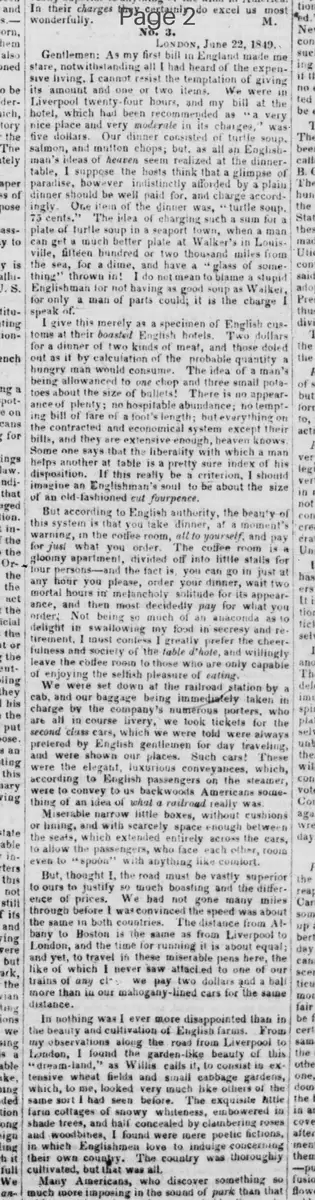
No. 3.
London, June 22, 1849.
Gentlemen: As my first bill in England made me stare, notwithstanding all I had heard of the expensive living, I cannot resist the temptation of giving its amount and one or two items. We were in Liverpool twenty-four hours, and my bill at the hotel, which had been recommended as 'a very nice place and very moderate in its charges,' was five dollars. Our dinner consisted of turtle soup, salmon, and mutton chops; but, as all an Englishman's ideas of heaven seem realized at the dinner-table, I suppose the hosts think that a glimpse of paradise, however indistinctly afforded by a plain dinner should be well paid for, and charge accordingly. One item of the dinner was, 'turtle soup, 75 cents.' The idea of charging such a sum for a plate of turtle soup in a seaport town, when a man can get a much better plate at Walker's in Louisville, fifteen hundred or two thousand miles from the sea, for a dime, and have a 'glass of something' thrown in! I do not mean to blame a stupid Englishman for not having as good soup as Walker, for only a man of parts could; it is the charge I speak of.
I give this merely as a specimen of English customs at their boasted English hotels. Two dollars for a dinner of two kinds of meat, and those doled out as if by calculation of the probable quantity a hungry man would consume. The idea of a man's being allowed one chop and three small potatoes about the size of bullets! There is no appearance of plenty; no hospitable abundance; no tempting bill of fare of a foot's length; but everything on the contracted and economical system except their bills, and they are extensive enough, heaven knows.
Some one says that the liberality with which a man helps another at table is a pretty sure index of his disposition. If this really be a criterion, I should imagine an Englishman's soul to be about the size of an old-fashioned cut fourpence.
But according to English authority, the beauty of this system is that you take dinner, at a moment's warning, in the coffee room, all to yourself, and pay for just what you order. The coffee room is a gloomy apartment, divided off into little stalls for four persons—and the fact is, you can go in just at any hour you please, order your dinner, wait two mortal hours in melancholy solitude for its appearance, and then most decidedly pay for what you order; Not being so much of an anaconda as to delight in swallowing my food in secrecy and retirement, I must confess I greatly prefer the cheerfulness and society of the table d'hôte, and willingly leave the coffee room to those who are only capable of enjoying the selfish pleasure of eating.
We were set down at the railroad station by a cab, and our baggage being immediately taken in charge by the company's numerous porters, who are all in course livery, we took tickets for the second class cars, which we were told were always preferred by English gentlemen for day traveling, and were shown our places. Such cars! These were the elegant, luxurious conveyances, which, according to English passengers on the steamer, were to convey to us backwoods Americans something of an idea of what a railroad really was.
Miserable narrow little boxes, without cushions or lining, and with scarcely space enough between the seats, which extended entirely across the cars, to allow the passengers, who face each other, room even to 'spoon' with anything like comfort.
But, thought I, the road must be vastly superior to ours to justify so much boasting and the difference of prices.' We had not gone many miles through before I was convinced the speed was about the same in both countries. The distance from Albany to Boston is the same as from Liverpool to London, and the time for running it is about equal; and yet, to travel in these miserable pens here, the like of which I never saw attached to one of our trains of any class we pay two dollars and a half more than in our mahogany-lined cars for the same distance.
In nothing was I ever more disappointed than in the beauty and cultivation of English farms. From my observations along the road from Liverpool to London, I found the garden-like beauty of this 'dream-land,' as Willis calls it, to consist in extensive wheat fields and small cabbage gardens, which, to me, looked very much like others of the same sort I had seen before. The exquisite little farm cottages of snowy whiteness, embowered in shade trees, and half concealed by clambering roses and woodbines, I found were mere poetic fictions, in which Englishmen love to indulge concerning their own country. The country was thoroughly cultivated, but that was all.
London, June 22, 1849.
Gentlemen: As my first bill in England made me stare, notwithstanding all I had heard of the expensive living, I cannot resist the temptation of giving its amount and one or two items. We were in Liverpool twenty-four hours, and my bill at the hotel, which had been recommended as 'a very nice place and very moderate in its charges,' was five dollars. Our dinner consisted of turtle soup, salmon, and mutton chops; but, as all an Englishman's ideas of heaven seem realized at the dinner-table, I suppose the hosts think that a glimpse of paradise, however indistinctly afforded by a plain dinner should be well paid for, and charge accordingly. One item of the dinner was, 'turtle soup, 75 cents.' The idea of charging such a sum for a plate of turtle soup in a seaport town, when a man can get a much better plate at Walker's in Louisville, fifteen hundred or two thousand miles from the sea, for a dime, and have a 'glass of something' thrown in! I do not mean to blame a stupid Englishman for not having as good soup as Walker, for only a man of parts could; it is the charge I speak of.
I give this merely as a specimen of English customs at their boasted English hotels. Two dollars for a dinner of two kinds of meat, and those doled out as if by calculation of the probable quantity a hungry man would consume. The idea of a man's being allowed one chop and three small potatoes about the size of bullets! There is no appearance of plenty; no hospitable abundance; no tempting bill of fare of a foot's length; but everything on the contracted and economical system except their bills, and they are extensive enough, heaven knows.
Some one says that the liberality with which a man helps another at table is a pretty sure index of his disposition. If this really be a criterion, I should imagine an Englishman's soul to be about the size of an old-fashioned cut fourpence.
But according to English authority, the beauty of this system is that you take dinner, at a moment's warning, in the coffee room, all to yourself, and pay for just what you order. The coffee room is a gloomy apartment, divided off into little stalls for four persons—and the fact is, you can go in just at any hour you please, order your dinner, wait two mortal hours in melancholy solitude for its appearance, and then most decidedly pay for what you order; Not being so much of an anaconda as to delight in swallowing my food in secrecy and retirement, I must confess I greatly prefer the cheerfulness and society of the table d'hôte, and willingly leave the coffee room to those who are only capable of enjoying the selfish pleasure of eating.
We were set down at the railroad station by a cab, and our baggage being immediately taken in charge by the company's numerous porters, who are all in course livery, we took tickets for the second class cars, which we were told were always preferred by English gentlemen for day traveling, and were shown our places. Such cars! These were the elegant, luxurious conveyances, which, according to English passengers on the steamer, were to convey to us backwoods Americans something of an idea of what a railroad really was.
Miserable narrow little boxes, without cushions or lining, and with scarcely space enough between the seats, which extended entirely across the cars, to allow the passengers, who face each other, room even to 'spoon' with anything like comfort.
But, thought I, the road must be vastly superior to ours to justify so much boasting and the difference of prices.' We had not gone many miles through before I was convinced the speed was about the same in both countries. The distance from Albany to Boston is the same as from Liverpool to London, and the time for running it is about equal; and yet, to travel in these miserable pens here, the like of which I never saw attached to one of our trains of any class we pay two dollars and a half more than in our mahogany-lined cars for the same distance.
In nothing was I ever more disappointed than in the beauty and cultivation of English farms. From my observations along the road from Liverpool to London, I found the garden-like beauty of this 'dream-land,' as Willis calls it, to consist in extensive wheat fields and small cabbage gardens, which, to me, looked very much like others of the same sort I had seen before. The exquisite little farm cottages of snowy whiteness, embowered in shade trees, and half concealed by clambering roses and woodbines, I found were mere poetic fictions, in which Englishmen love to indulge concerning their own country. The country was thoroughly cultivated, but that was all.
What sub-type of article is it?
Satirical
Comedic
Social Critique
What themes does it cover?
Commerce Trade
Infrastructure
Social Issues
What keywords are associated?
English Hotels
Expensive Dining
Railroad Cars
Cultural Critique
American Traveler
Liverpool London
English Countryside
What entities or persons were involved?
Gentlemen
Letter to Editor Details
Recipient
Gentlemen
Main Argument
english hotels, railroads, and countryside fail to meet american expectations, with high costs, poor comfort, and overhyped beauty compared to u.s. equivalents.
Notable Details
Turtle Soup Charged 75 Cents In Liverpool
Comparison To Walker's In Louisville For 10 Cents
Second Class Cars Described As Narrow Boxes Without Cushions
Englishman's Soul Size Likened To Old Fashioned Cut Fourpence
Reference To Willis's 'Dream Land'