Thank you for visiting SNEWPapers!
Sign up free
Keowee Courier
Walhalla, Pickens, Oconee County, Pickens County, South Carolina
What is this article about?
Edward Ketchum, of Ketchum & Son brokers, forges gold checks to secure loans for gold speculation in New York, causing Wall Street panic, his firm's failure, and his flight with $60,000; he is later arrested. Charles Graham & Co. suffers ruin.
Clipping
OCR Quality
Full Text
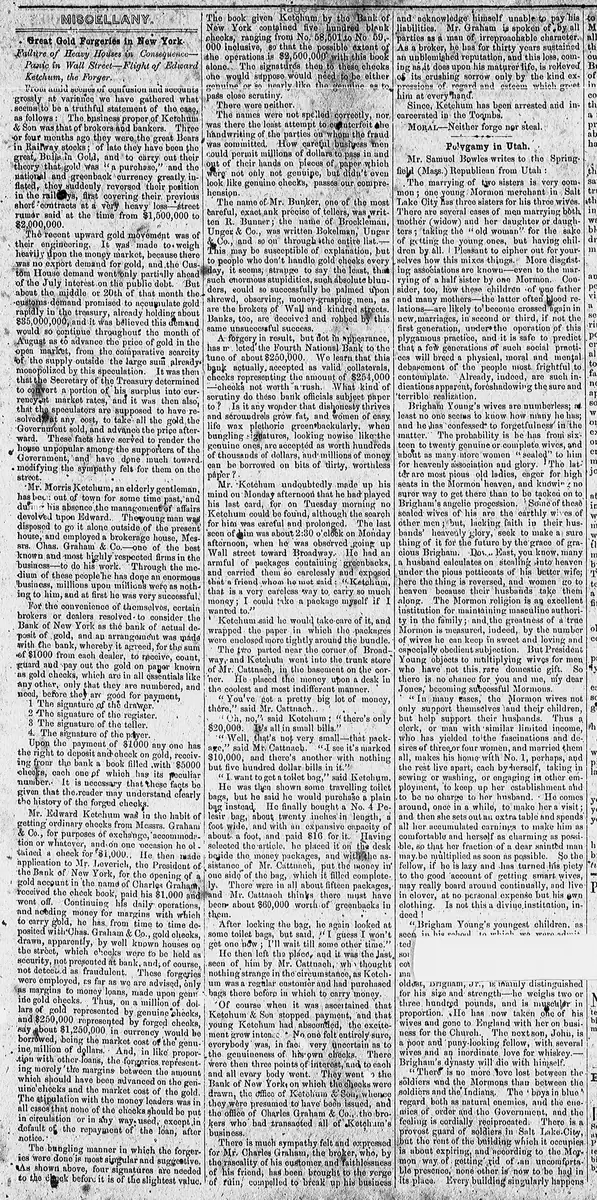
Panic in Wall Street. Flight of Edward Ketchum, the Forger.
From all the rumors of collusion and accounts grossly at variance we have gathered what seems to be a truthful statement of the case, as follows: The business proper of Ketchum & Son was that of brokers and bankers. Three or four months ago they were the great Bears in Railway stocks; of late they have been the great Bulls in Gold, and to carry out their theory that gold was 'a purchase,' and the national and greenback currency greatly inflated, they suddenly reversed their position in the railways, first covering their previous short contracts at a very heavy loss—street rumor said at the time from $1,500,000 to $2,000,000.
The recent upward gold movement was of their engineering: It was made to weigh heavily upon the money market, because there was no export demand for gold, and the Custom House demand went only partially ahead of the July interest on the public debt. But about the middle or 20th of that month the customs demand promised to accumulate gold rapidly in the treasury, already holding about $35,000,000 and it was believed this demand would so continue throughout the month of August as to advance the price of gold in the open market, from the comparative scarcity of the supply outside the large sum already monopolized by this speculation. It was then that the Secretary of the Treasury determined to convert a portion of his surplus into currency at market rates, and it was then also, that the speculators are supposed to have resolved at any cost, to take all the gold the Government sold, and advance the price afterward. These facts have served to render the house unpopular among the supporters of the Government, and have done much toward modifying the sympathy felt for them on the street.
Mr. Morris Ketchum, an elderly gentleman, has been out of town for some time past, and during his absence the management of affairs devolved upon Edward. The young man was disposed to go it alone outside of the present house, and employed a brokerage house, Messrs. Chas. Graham & Co.—one of the best known and most highly respected firms in the business—to do his work. Through the medium of these people he has done an enormous business, millions upon millions were as nothing to him, and at first he was very successful.
For the convenience of themselves, certain brokers or dealers resolved to consider the Bank of New York as the bank of actual deposit of gold, and an arrangement was made with the bank, whereby it agreed, for the sum of $1000 from each dealer, to receive, count, guard and pay out the gold on paper known as gold checks, which are in all essentials like any other, only that they are numbered, and need, before they are good for payment,
1 The signature of the drawer.
2 The signature of the register.
3 The signature of the teller.
4. The signature of the payer.
Upon the payment of $1000 any one has the right to deposit and check on gold, receiving from the bank a book filled with $5000 checks, each one of which has its peculiar number. It is necessary that these facts be given that the reader may understand clearly the history of the forged checks.
Mr. Edward Ketchum was in the habit of getting ordinary checks from Messrs. Graham & Co., for purposes of exchange, accommodation or whatever, and on one occasion he obtained a check for $1,000. He then made application to Mr. Leverich, the President of the Bank of New York, for the opening of a gold account in the name of Charles Graham. He received the check book, paid his $1,000 and went off. Continuing his daily operations, and needing money for margins with which to carry gold, he has, from time to time deposited with Chas. Graham & Co., gold checks, drawn, apparently, by well known houses on the street, which checks were to be held as security, not presented at bank, and, of course, not detected as fraudulent. These forgeries were employed, as far as we are advised, only as margins to money loans, made upon genuine gold checks. Thus, on a million of dollars of gold represented by genuine checks, and $250,000 represented by forged checks, say about $1,250,000, in currency would be borrowed, being the market cost of the genuine million of dollars. And, in like proportion with other loans, the forgeries representing merely the margins between the amount which should have been advanced on the genuine checks and the market cost of the gold.
The stipulation with the money lenders was in all cases that none of the checks should be put in circulation or in any way used; except in default of the repayment of the loan, after notice.
The bungling manner in which the forgeries were done is most singular and suggestive. As shown above, four signatures are needed to the check before it is of the slightest value.
The book given Ketchum by the Bank of New York contained five hundred blank checks, ranging from No. 58,501 to No. 59,000 inclusive, so that the possible extent of the operations is $2,500,000 with this book alone. The signatures, then to these checks one would suppose would need to be either genuine or so nearly like the genuine as to pass close scrutiny.
There were neither.
The names were not spelled correctly, nor, was there the least attempt to counterfeit the handwriting of the parties on whom the fraud was committed. How careful business men could permit millions of dollars to pass in and out of their hands on pieces of paper which were not only not genuine, but didn't even look like genuine checks, passes our comprehension.
The name of Mr. Bunker, one of the most careful, exact and precise of tellers, was written R. Bunner; the name of Brockleman, Unger & Co., was written Bokelman, Ungar & Co., and so on through the entire list.
This may be susceptible of explanation, but to people who don't handle gold checks every day, it seems, strange to say the least, that such enormous stupidities, such absolute blunders, could so successfully be palmed upon shrewd, observing, money-grasping men, as are the brokers of Wall and kindred streets.
Banks, too, are deceived and robbed by this same unsuccessful success.
A forgery in result, but not in appearance, has reflected the Fourth National Bank to the tune of about $250,000. We learn that this bank actually accepted as valid collaterals, checks representing the amount of $254,000—checks not worth a rush. What kind of scrutiny do these bank officials subject paper to? Is it any wonder that dishonesty thrives and scoundrels grow fat, and women of easy life wax plethoric greenbackularly, when bungling signatures, looking nowise like the genuine ones, are accepted as worth hundreds of thousands of dollars, and millions of money can be borrowed on bits of dirty, worthless paper?
Mr. Ketchum undoubtedly made up his mind on Monday afternoon that he had played his last card, for on Tuesday morning no Ketchum could be found, although the search for him was careful and prolonged. The last seen of him was about 2:30 o'clock on Monday afternoon, when he was observed going up Wall street toward Broadway. He had an armful of packages containing greenbacks and carried them so carelessly and exposed that a friend whom he met said: "O Ketchum, that is a very careless way to carry so much money; I could take a package myself if I wanted to."
Ketchum said he would take care of it, and wrapped the paper in which the packages were enclosed more tightly around the bundle.
The two parted near the corner of Broadway and Ketchum went into the trunk store of Mr. Cattnach, in the basement on the corner. He placed the money upon a desk in the coolest and most indifferent manner.
"You've got a pretty big lot of money, there," said Mr. Cattnach.
"Oh, no," said Ketchum; "there's only $20,000. It's all in small bills."
"Well, that's not very small—that package," said Mr. Cattnach. "I see it's marked $10,000; and there's another with nothing but five hundred dollar bills in it."
"I want to get a toilet bag," said Ketchum.
He was then shown some travelling toilet bags, but he said he would purchase a plain bag instead. He finally bought a No. 4 Pelissier bag, about twenty inches in length, a foot wide, and with an expansive capacity of about a foot, and paid $16 for it. Having selected the article, he placed it on the desk beside the money packages, and with the assistance of Mr. Cattnach, put the money in one side of the bag, which it filled completely. There were in all about fifteen packages, and Mr. Cattnach thinks there must have been about $60,000 worth of greenbacks in them.
After locking the bag, he again looked at some toilet bags, but said, "I guess I won't get one now; I'll wait till some other time."
He then left the place, and it was the last seen of him by Mr. Cattnach, who thought nothing strange in the circumstance, as Ketchum was a regular customer and had purchased bags there before in which to carry money.
Of course when it was ascertained that Ketchum & Son stopped payment, and that young Ketchum had absconded, the excitement grew intense. No one felt entirely sure, everybody was, in fact, very uncertain as to the genuineness of his own checks. There were then three points of interest, and to each and all everybody went. They went to the Bank of New York, on which the checks were drawn, the office of Ketchum & Son whence they were presumed to have been issued, and the office of Charles Graham & Co the brokers who had transacted all of Ketchum's business.
There is much sympathy felt and expressed for Mr. Charles Graham, the broker, who, by the rascality of his customer and faithlessness of his friend has been brought to the verge of ruin, compelled to break up his business and acknowledge himself unable to pay his liabilities. Mr. Graham is spoken of by all parties as a man of irreproachable character. As a broker, he has for thirty years sustained an unblemished reputation, and this loss, coming as it does upon his maturer life, is relieved of its crushing sorrow only by the kind expressions of regard and esteem which greet him at every hand.
Since, Ketchum has been arrested and incarcerated in the Tombs.
MORAL—Neither forge nor steal.
What sub-type of article is it?
What themes does it cover?
What keywords are associated?
What entities or persons were involved?
Where did it happen?
Story Details
Key Persons
Location
New York, Wall Street
Event Date
About The Middle Or 20th Of That Month (July), Three Or Four Months Ago
Story Details
Edward Ketchum forges gold checks from the Bank of New York under Charles Graham's name to secure loans for gold speculation, leading to massive losses, firm collapse, his flight with $60,000 in greenbacks, Wall Street panic, and eventual arrest in the Tombs.