Thank you for visiting SNEWPapers!
Sign up free
Editorial
September 12, 1944
Imperial Valley Press
El Centro, Imperial County, California
What is this article about?
Editorial expresses hope that the secret Quebec Conference between Churchill and Roosevelt will coordinate Allied efforts to intensify the Pacific War against Japan, critiques piecemeal strategy and exclusion of other allies like Stalin, amid European victories.
Clipping
OCR Quality
98%
Excellent
Full Text
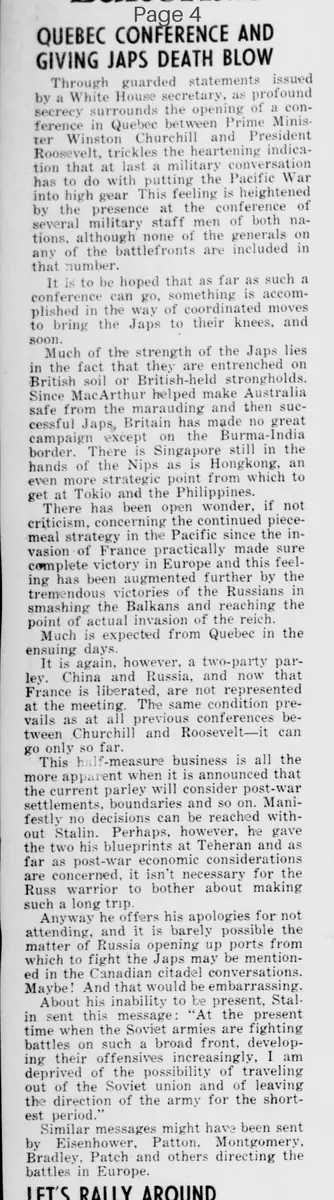
QUEBEC CONFERENCE AND
GIVING JAPS DEATH BLOW
Through guarded statements issued by a White House secretary, as profound secrecy surrounds the opening of a conference in Quebec between Prime Minister Winston Churchill and President Roosevelt, trickles the heartening indication that at last a military conversation has to do with putting the Pacific War into high gear. This feeling is heightened by the presence at the conference of several military staff men of both nations, although none of the generals on any of the battlefronts are included in that number.
It is to be hoped that as far as such a conference can go, something is accomplished in the way of coordinated moves to bring the Japs to their knees, and soon.
Much of the strength of the Japs lies in the fact that they are entrenched on British soil or British-held strongholds. Since MacArthur helped make Australia safe from the marauding and then successful Japs, Britain has made no great campaign except on the Burma-India border. There is Singapore still in the hands of the Nips as is Hongkong, an even more strategic point from which to get at Tokio and the Philippines.
There has been open wonder, if not criticism, concerning the continued piecemeal strategy in the Pacific since the invasion of France practically made sure complete victory in Europe and this feeling has been augmented further by the tremendous victories of the Russians in smashing the Balkans and reaching the point of actual invasion of the reich.
Much is expected from Quebec in the ensuing days.
It is again, however, a two-party parley. China and Russia, and now that France is liberated, are not represented at the meeting. The same condition prevails as at all previous conferences between Churchill and Roosevelt—it can go only so far.
This half-measure business is all the more apparent when it is announced that the current parley will consider post-war settlements, boundaries and so on. Manifestly no decisions can be reached without Stalin. Perhaps, however, he gave the two his blueprints at Teheran and as far as post-war economic considerations are concerned, it isn't necessary for the Russ warrior to bother about making such a long trip.
Anyway he offers his apologies for not attending, and it is barely possible the matter of Russia opening up ports from which to fight the Japs may be mentioned in the Canadian citadel conversations. Maybe! And that would be embarrassing.
About his inability to be present, Stalin sent this message: "At the present time when the Soviet armies are fighting battles on such a broad front, developing their offensives increasingly, I am deprived of the possibility of traveling out of the Soviet union and of leaving the direction of the army for the shortest period."
Similar messages might have been sent by Eisenhower, Patton, Montgomery, Bradley, Patch and others directing the battles in Europe.
GIVING JAPS DEATH BLOW
Through guarded statements issued by a White House secretary, as profound secrecy surrounds the opening of a conference in Quebec between Prime Minister Winston Churchill and President Roosevelt, trickles the heartening indication that at last a military conversation has to do with putting the Pacific War into high gear. This feeling is heightened by the presence at the conference of several military staff men of both nations, although none of the generals on any of the battlefronts are included in that number.
It is to be hoped that as far as such a conference can go, something is accomplished in the way of coordinated moves to bring the Japs to their knees, and soon.
Much of the strength of the Japs lies in the fact that they are entrenched on British soil or British-held strongholds. Since MacArthur helped make Australia safe from the marauding and then successful Japs, Britain has made no great campaign except on the Burma-India border. There is Singapore still in the hands of the Nips as is Hongkong, an even more strategic point from which to get at Tokio and the Philippines.
There has been open wonder, if not criticism, concerning the continued piecemeal strategy in the Pacific since the invasion of France practically made sure complete victory in Europe and this feeling has been augmented further by the tremendous victories of the Russians in smashing the Balkans and reaching the point of actual invasion of the reich.
Much is expected from Quebec in the ensuing days.
It is again, however, a two-party parley. China and Russia, and now that France is liberated, are not represented at the meeting. The same condition prevails as at all previous conferences between Churchill and Roosevelt—it can go only so far.
This half-measure business is all the more apparent when it is announced that the current parley will consider post-war settlements, boundaries and so on. Manifestly no decisions can be reached without Stalin. Perhaps, however, he gave the two his blueprints at Teheran and as far as post-war economic considerations are concerned, it isn't necessary for the Russ warrior to bother about making such a long trip.
Anyway he offers his apologies for not attending, and it is barely possible the matter of Russia opening up ports from which to fight the Japs may be mentioned in the Canadian citadel conversations. Maybe! And that would be embarrassing.
About his inability to be present, Stalin sent this message: "At the present time when the Soviet armies are fighting battles on such a broad front, developing their offensives increasingly, I am deprived of the possibility of traveling out of the Soviet union and of leaving the direction of the army for the shortest period."
Similar messages might have been sent by Eisenhower, Patton, Montgomery, Bradley, Patch and others directing the battles in Europe.
What sub-type of article is it?
War Or Peace
Foreign Affairs
Military Affairs
What keywords are associated?
Quebec Conference
Pacific War
Japan Defeat
Churchill Roosevelt
Stalin Absence
Military Strategy
British Strongholds
Russian Victories
What entities or persons were involved?
Winston Churchill
President Roosevelt
Joseph Stalin
Douglas Macarthur
Eisenhower
Patton
Montgomery
Bradley
Patch
Editorial Details
Primary Topic
Quebec Conference Strategy Against Japan In Pacific War
Stance / Tone
Hopeful For Coordinated Military Action, Critical Of Piecemeal Strategy And Limited Participation
Key Figures
Winston Churchill
President Roosevelt
Joseph Stalin
Douglas Macarthur
Eisenhower
Patton
Montgomery
Bradley
Patch
Key Arguments
Conference Focuses On Accelerating Pacific War Efforts
Hope For Coordinated Moves To Defeat Japan Soon
Japan's Strength From British Held Strongholds Like Singapore And Hong Kong
Criticism Of Piecemeal Pacific Strategy Post France Invasion
Expectations Heightened By Russian Victories In Europe
Conference Limited Without China, Russia, And France
Post War Discussions Incomplete Without Stalin
Stalin's Absence Due To Soviet Offensives
Possible Mention Of Russian Ports For Anti Japanese Operations