Thank you for visiting SNEWPapers!
Sign up free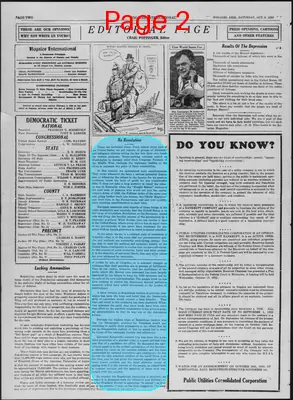
Editorial
October 8, 1932
Nogales International
Nogales, Santa Cruz County, Arizona
What is this article about?
Editorial argues that US unrest from depression-era protests by veterans and farmers does not signal revolution, due to democratic processes and ongoing social evolution. Critiques Hoover's failed promises and praises Roosevelt's effective campaign on agriculture, railroads, tariffs, and water power.
Clipping
OCR Quality
95%
Excellent
Full Text
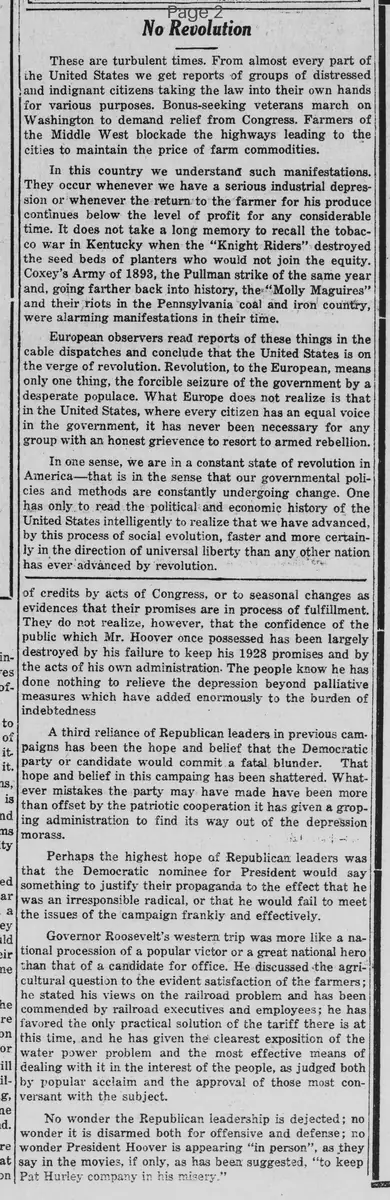
No Revolution
These are turbulent times. From almost every part of the United States we get reports of groups of distressed and indignant citizens taking the law into their own hands for various purposes. Bonus-seeking veterans march on Washington to demand relief from Congress. Farmers of the Middle West blockade the highways leading to the cities to maintain the price of farm commodities.
In this country we understand such manifestations.
They occur whenever we have a serious industrial depression or whenever the return to the farmer for his produce continues below the level of profit for any considerable time. It does not take a long memory to recall the tobacco war in Kentucky when the "Knight Riders" destroyed the seed beds of planters who would not join the equity. Coxey's Army of 1893, the Pullman strike of the same year and, going farther back into history, the "Molly Maguires" and their riots in the Pennsylvania coal and iron country, were alarming manifestations in their time.
European observers read reports of these things in the cable dispatches and conclude that the United States is on the verge of revolution. Revolution, to the European, means only one thing: the forcible seizure of the government by a desperate populace. What Europe does not realize is that in the United States, where every citizen has an equal voice in the government, it has never been necessary for any group with an honest grievance to resort to armed rebellion.
In one sense, we are in a constant state of revolution in America--that is in the sense that our governmental policies and methods are constantly undergoing change. One has only to read the political and economic history of the United States intelligently to realize that we have advanced, by this process of social evolution, faster and more certainly in the direction of universal liberty than any other nation has ever advanced by revolution.
of credits by acts of Congress, or to seasonal changes as evidences that their promises are in process of fulfillment.
They do not realize, however, that the confidence of the public which Mr. Hoover once possessed has been largely destroyed by his failure to keep his 1928 promises and by the acts of his own administration. The people know he has done nothing to relieve the depression beyond palliative measures which have added enormously to the burden of indebtedness.
A third reliance of Republican leaders in previous campaigns has been the hope and belief that the Democratic party or candidate would commit a fatal blunder. That hope and belief in this campaign has been shattered. Whatever mistakes the party may have made have been more than offset by the patriotic cooperation it has given a groping administration to find its way out of the depression morass.
Perhaps the highest hope of Republican leaders was that the Democratic nominee for President would say something to justify their propaganda to the effect that he was an irresponsible radical, or that he would fail to meet the issues of the campaign frankly and effectively.
Governor Roosevelt's western trip was more like a national procession of a popular victor or a great national hero than that of a candidate for office. He discussed the agricultural question to the evident satisfaction of the farmers; he stated his views on the railroad problem and has been commended by railroad executives and employees; he has favored the only practical solution of the tariff there is at this time, and he has given the clearest exposition of the water power problem and the most effective means of dealing with it in the interest of the people, as judged both by popular acclaim and the approval of those most conversant with the subject.
No wonder the Republican leadership is dejected; no wonder it is disarmed both for offensive and defense; no wonder President Hoover is appearing "in person", as they say in the movies, if only, as has been suggested, "to keep Pat Hurley company in his misery."
These are turbulent times. From almost every part of the United States we get reports of groups of distressed and indignant citizens taking the law into their own hands for various purposes. Bonus-seeking veterans march on Washington to demand relief from Congress. Farmers of the Middle West blockade the highways leading to the cities to maintain the price of farm commodities.
In this country we understand such manifestations.
They occur whenever we have a serious industrial depression or whenever the return to the farmer for his produce continues below the level of profit for any considerable time. It does not take a long memory to recall the tobacco war in Kentucky when the "Knight Riders" destroyed the seed beds of planters who would not join the equity. Coxey's Army of 1893, the Pullman strike of the same year and, going farther back into history, the "Molly Maguires" and their riots in the Pennsylvania coal and iron country, were alarming manifestations in their time.
European observers read reports of these things in the cable dispatches and conclude that the United States is on the verge of revolution. Revolution, to the European, means only one thing: the forcible seizure of the government by a desperate populace. What Europe does not realize is that in the United States, where every citizen has an equal voice in the government, it has never been necessary for any group with an honest grievance to resort to armed rebellion.
In one sense, we are in a constant state of revolution in America--that is in the sense that our governmental policies and methods are constantly undergoing change. One has only to read the political and economic history of the United States intelligently to realize that we have advanced, by this process of social evolution, faster and more certainly in the direction of universal liberty than any other nation has ever advanced by revolution.
of credits by acts of Congress, or to seasonal changes as evidences that their promises are in process of fulfillment.
They do not realize, however, that the confidence of the public which Mr. Hoover once possessed has been largely destroyed by his failure to keep his 1928 promises and by the acts of his own administration. The people know he has done nothing to relieve the depression beyond palliative measures which have added enormously to the burden of indebtedness.
A third reliance of Republican leaders in previous campaigns has been the hope and belief that the Democratic party or candidate would commit a fatal blunder. That hope and belief in this campaign has been shattered. Whatever mistakes the party may have made have been more than offset by the patriotic cooperation it has given a groping administration to find its way out of the depression morass.
Perhaps the highest hope of Republican leaders was that the Democratic nominee for President would say something to justify their propaganda to the effect that he was an irresponsible radical, or that he would fail to meet the issues of the campaign frankly and effectively.
Governor Roosevelt's western trip was more like a national procession of a popular victor or a great national hero than that of a candidate for office. He discussed the agricultural question to the evident satisfaction of the farmers; he stated his views on the railroad problem and has been commended by railroad executives and employees; he has favored the only practical solution of the tariff there is at this time, and he has given the clearest exposition of the water power problem and the most effective means of dealing with it in the interest of the people, as judged both by popular acclaim and the approval of those most conversant with the subject.
No wonder the Republican leadership is dejected; no wonder it is disarmed both for offensive and defense; no wonder President Hoover is appearing "in person", as they say in the movies, if only, as has been suggested, "to keep Pat Hurley company in his misery."
What sub-type of article is it?
Partisan Politics
Economic Policy
Social Reform
What keywords are associated?
No Revolution
Economic Depression
Farmers Blockade
Veterans March
Hoover Failure
Roosevelt Campaign
Partisan Politics
Social Evolution
What entities or persons were involved?
President Hoover
Governor Roosevelt
Republican Leaders
Farmers
Veterans
Congress
Editorial Details
Primary Topic
No Revolution Despite Economic Unrest; Support For Roosevelt Over Hoover
Stance / Tone
Defensive Of American Democracy; Critical Of Hoover, Laudatory Of Roosevelt
Key Figures
President Hoover
Governor Roosevelt
Republican Leaders
Farmers
Veterans
Congress
Key Arguments
Us Protests Are Normal Responses To Depression, Not Signs Of Revolution
American Democracy Allows Grievances To Be Addressed Without Armed Rebellion
Constant Policy Changes Represent Social Evolution Toward Liberty
Hoover Failed To Keep 1928 Promises And Worsened Indebtedness
Republicans Hoped For Democratic Blunders, But Roosevelt Has Excelled
Roosevelt Effectively Addressed Agriculture, Railroads, Tariffs, And Water Power