Thank you for visiting SNEWPapers!
Sign up free
Voice Of Action
Seattle, King County, Washington
What is this article about?
In Tacoma, Pierce County welfare officials pressure small grocers to adhere strictly to relief lists, using deception like sending a stool pigeon to frame a sympathetic Japanese store owner, forcing workers to buy inferior goods and threatening small businesses.
Clipping
OCR Quality
Full Text
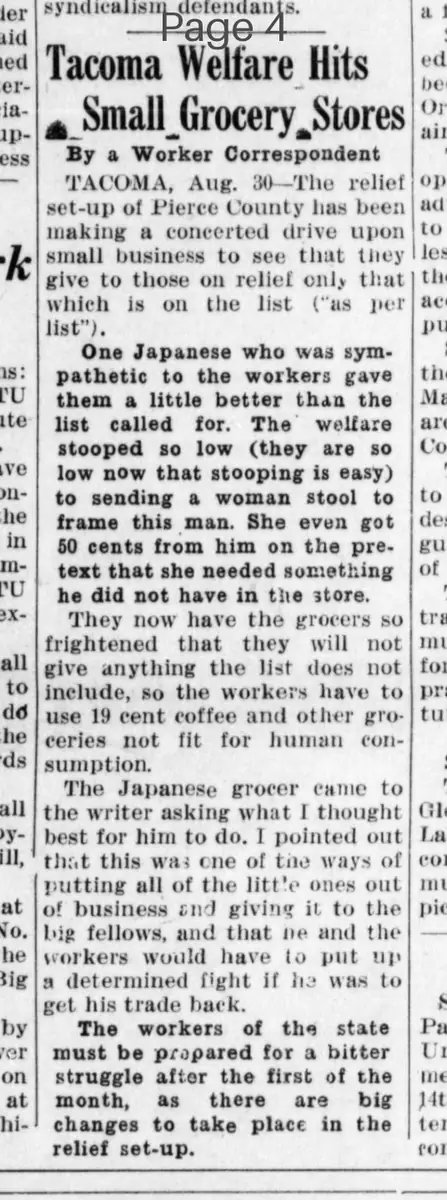
By a Worker Correspondent
TACOMA, Aug. 30—The relief set-up of Pierce County has been making a concerted drive upon small business to see that they give to those on relief only that which is on the list ("as per list").
One Japanese who was sympathetic to the workers gave them a little better than the list called for. The welfare stooped so low (they are so low now that stooping is easy) to sending a woman stool to frame this man. She even got 50 cents from him on the pretext that she needed something he did not have in the store.
They now have the grocers so frightened that they will not give anything the list does not include, so the workers have to use 19 cent coffee and other groceries not fit for human consumption.
The Japanese grocer came to the writer asking what I thought best for him to do. I pointed out that this was one of the ways of putting all of the little ones out of business and giving it to the big fellows, and that he and the workers would have to put up a determined fight if he was to get his trade back.
The workers of the state must be prepared for a bitter struggle after the first of the month, as there are big changes to take place in the relief set-up.
What sub-type of article is it?
What themes does it cover?
What keywords are associated?
What entities or persons were involved?
Where did it happen?
Story Details
Key Persons
Location
Tacoma, Pierce County
Event Date
Aug. 30
Story Details
Welfare authorities in Pierce County target small grocers to enforce strict adherence to relief lists; a sympathetic Japanese grocer is framed by a female informant who extracts money under false pretenses, frightening merchants and forcing relief recipients to accept substandard goods, while foreshadowing broader struggles for workers.