Thank you for visiting SNEWPapers!
Sign up free
Keowee Courier
Walhalla, Pickens, Oconee County, Pickens County, South Carolina
What is this article about?
A convention of Kentucky's Friends of Emancipation met in Frankfort on April 25, 1849, presided by Col. Henry Clay. They resolved against increasing or perpetuating slavery, advocating gradual emancipation with compensation and removal of freed slaves, and prohibiting further slave imports in the new constitution. Attended by 150 delegates from 23 counties, mostly slaveholders. The Lexington Observer opposed making it an election issue.
Clipping
OCR Quality
Full Text
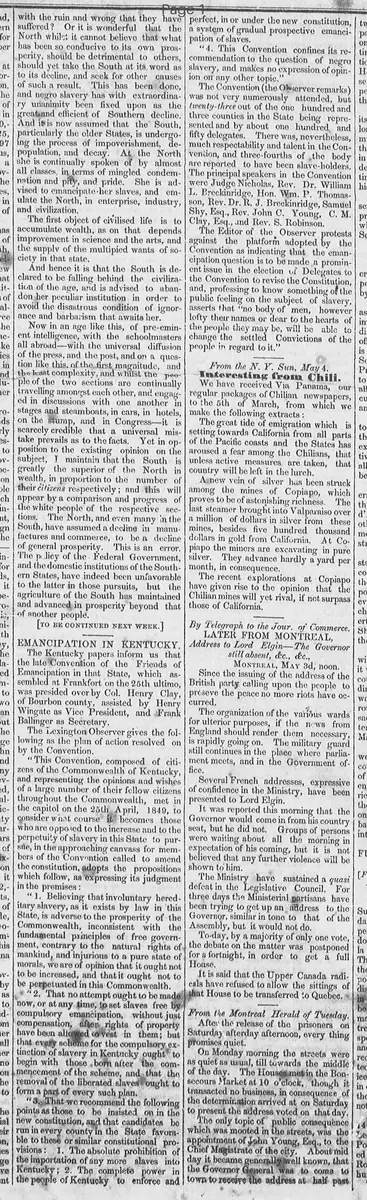
The Kentucky papers inform us that
the late Convention of the Friends of
Emancipation in that State, which as-
sembled at Frankfort on the 25th ultimo,
was presided over by Col. Henry Clay,
of Bourbon county, assisted by Henry
Wingate as Vice President, and Frank
Ballinger as Secretary.
The Lexington Observer gives the fol-
lowing as the plan of action resolved on
by the Convention.
"This Convention, composed of citi-
zens of the Commonwealth of Kentucky,
and representing the opinions and wishes
of a large number of their fellow citizens
throughout the Commonwealth, met in
the capitol on the 25th April, 1849, to
consider what course it becomes those
who are opposed to the increase and to the
perpetuity of slavery in this State to pur-
sue, in the approaching canvass for mem-
bers of the Convention called to amend
the constitution, adopts the propositions
which follow, as expressing its judgment
in the premises:
"1. Believing that involuntary hered-
itary slavery, as it exists by law in this
State, is adverse to the prosperity of the
Commonwealth, inconsistent with the
fundamental principles of free govern-
ment, contrary to the natural rights of
mankind, and injurious to a pure state of
morals, we are of opinion that it ought not
to be increased, and that it ought not to
be perpetuated in this Commonwealth.
"2. That no attempt ought to be made
now, or at any time, to set slaves free by
compulsory emancipation, without just
compensation, after rights of property
have been allowed to vest in them; but
that every scheme for the compulsory ex-
tinction of slavery in Kentucky ought to
begin with those born after the com-
mencement of the scheme, and that the
removal of the liberated slaves ought to
form a part of every such plan.
"3. That we recommend the following
points as those to be insisted on in the
new constitution, and that candidates be
run in every county in the State favora-
ble to these or similar constitutional pro-
visions: 1. The absolute prohibition of
the importation of any more slaves into
Kentucky; 2. The complete power in
the people of Kentucky to enforce and
perfect, in or under the new constitution,
a system of gradual prospective emanci-
pation of slaves.
"4. This Convention confines its re-
commendation to the question of negro
slavery, and makes no expression of opin-
ion on any other topic."
The Convention (the Observer remarks)
was not very numerously attended, but
twenty-three out of the one hundred and
three counties in the State being repre-
sented and by about one hundred and
fifty delegates. There was, nevertheless,
much respectability and talent in the Con-
vention, and three-fourths of the body
are reported to have been slave-holders.
The principal speakers in the Convention
were Judge Nicholas, Rev. Dr. William
L. Breckinridge, Hon. Wm. P. Thom-
son, Rev. Dr. R. J. Breckinridge, Samuel
Shy, Esq., Rev. John C. Young, C. M.
Clay, Esq., and Rev. S. Robinson.
The Editor of the Observer protests
against the platform adopted by the
Convention as indicating that the eman-
cipation question is to be made a promin-
ent issue in the election of Delegates to
the Convention to revise the Constitution,
and, professing to know something of the
public feeling on the subject of slavery,
asserts that "no body of men, however
lofty their names or dear to the hearts of
the people they may be, will be able to
change the settled convictions of the
people in regard to it."
What sub-type of article is it?
What keywords are associated?
What entities or persons were involved?
Where did it happen?
Domestic News Details
Primary Location
Frankfort, Kentucky
Event Date
25th April, 1849
Key Persons
Outcome
convention adopted resolutions opposing increase and perpetuity of slavery, advocating gradual emancipation with compensation and removal of freed slaves, prohibition of slave imports, and running candidates supportive of these in constitutional convention elections. attended by 150 delegates from 23 counties, mostly slaveholders. lexington observer editor protested against making emancipation a prominent election issue, asserting public convictions on slavery unchangeable.
Event Details
The Convention of the Friends of Emancipation assembled at Frankfort, presided over by Col. Henry Clay of Bourbon county, with Henry Wingate as Vice President and Frank Ballinger as Secretary. It represented citizens opposed to increasing or perpetuating slavery, meeting to decide strategy for the upcoming canvass for members of the convention to amend the constitution. Resolutions expressed belief that slavery is adverse to prosperity, inconsistent with free government, contrary to natural rights, and injurious to morals; opposed compulsory emancipation without compensation; proposed schemes starting with those born after commencement and including removal of liberated slaves; recommended prohibiting slave importation and empowering gradual emancipation in the new constitution; confined to negro slavery.