Thank you for visiting SNEWPapers!
Sign up free
Editorial
May 13, 1808
Virginia Argus
Richmond, Virginia
What is this article about?
This editorial from the Aurora uses an ancient Greek allegory of Eurymedon saving Rhodes from famine to parallel the selfless virtue of Americans in the 1776 Revolution, which built the nation, contrasting it with America's diminished state after the 1800 policy shift and criticizing 'Syracusan speculators' opposing efforts to avert war.
Clipping
OCR Quality
95%
Excellent
Full Text
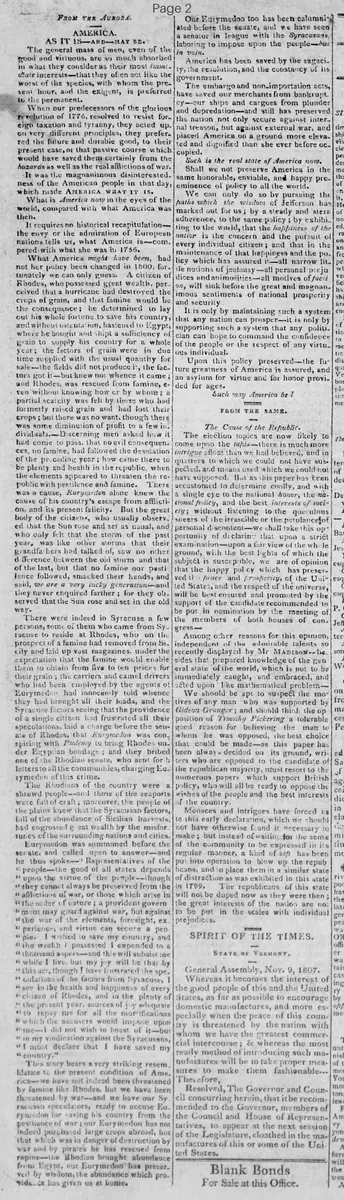
FROM THE AURORA
AMERICA.
AS IT IS—AND MAY BE.
The general mass of men, even of the good and virtuous, are so much absorbed in what they consider as their most immediate interests—that they often act like the worst of the species, with whom the present hour, and the exigent, is preferred to the permanent.
When our predecessors of the glorious revolution of 1776, resolved to resist foreign taxation and tyranny, they acted upon very different principles, they preferred the future and durable good, to their present ease, or that passive course which would have saved them certainly from the hazards as well as the real afflictions of war.
It was the magnanimous disinterestedness of the American people in that day, which made AMERICA WHAT IT IS.
What is America now in the eyes of the world, compared with what America was then.
It requires no historical recapitulation—the envy or the admiration of European nations tells us, what America is compared with what she was in 1756.
What America might have been, had not her policy been changed in 1800, fortunately we can only guess. A citizen of Rhodes, who possessed great wealth, perceived that a hurricane had destroyed the crops of grain, and that famine would be the consequence; he determined to lay out his whole fortune to save his country, and without ostentation, hastened to Egypt, where he bought and shipped a sufficiency of grain to supply his country for a whole year; the factors of grain were in due time supplied with the usual quantity for sale—the fields did not produce it, the factors got it—but knew not whence it came; and Rhodes, was rescued from famine, even without knowing how or by whom; a partial scarcity was felt by those who had formerly raised grain and had lost their crops; but there was no want, though there was some diminution of profit to a few individuals.—Discerning men asked how it had come to pass, that no evil consequences, no famine, had followed the desolation of the preceding year; how came there to be plenty and health in the republic, when the elements appeared to threaten the republic with pestilence and famine. There was a cause, Eurymedon alone knew the cause of his country's escape from affliction, and its present felicity. But the great body of the citizens, who usually observed that the Sun rose and set as usual, and who only felt that the storm of the past year, was like other storms that their grandfathers had talked of, saw no other difference between the old storm and that of the last, but that no famine nor pestilence followed, smacked their hands, and said, we are a very lucky generation—and they never enquired farther; for they observed that the Sun rose and set in the old way.
There were indeed in Syracuse a few persons, some of them who came from Syracuse to reside at Rhodes, who on the prospect of a famine had removed from Sicily and laid up vast magazines, under the expectation that the famine would enable them to obtain from five to ten prices for their grain; the carriers and camel drivers who had been employed by the agents of Eurymedon had innocently told whence they had brought all their loads, and the Syracuse factors seeing that the providence of a single citizen had frustrated all their speculations, laid a charge before the senate of Rhodes, that Eurymedon was conspiring with Ptolemy to bring Rhodes under Egyptian bondage; and they bribed one of the Rhodian senate, who sent for his letters to all the communities, charging Eurymedon of this crime.
The Rhodians of the country were a shrewd people—and those of the seaports were full of craft; moreover, the people of the plains knew that the Syracusan factors, full of the abundance of Sicilian harvests, had engrossed great wealth by the misfortunes of the surrounding nations and cities. Eurymedon was summoned before the senate, and called upon to answer—and he thus spoke—' Representatives of the people—the good of all states depends upon the virtue of the people—though they cannot always be preserved from the afflictions of war, or those which arise in the order of nature; a provident government may guard against war, but against the war of the elements, foresight, experience, and virtue can secure a people. I wished to save my Country, and the wealth I possessed I expended to a thousand aspers—and this will subsist me while I live. but my joy will be that by this act, though I have frustrated the speculations of the factors from Syracuse, I see in the health and happiness of every citizen of Rhodes, and in the plenty of the present year, sources of joy adequate to repay me for all the mortifications which the accusers would impose upon me. I did not wish to boast of it—but in my vindication against the Syracusans, I must declare that I have saved my country.'
This story bears a very striking resemblance to the present condition of America—we have not indeed been threatened by famine like Rhodes, but we have been threatened by war—and we have our Syracusan speculators, ready to accuse Eurymedon for saving his country from the pestilence of war; our Eurymedon has not indeed purchased large crops abroad, but that which was in danger of destruction by war and by pirates he has rescued from rapine—the Rhodian brought abundance from Egypt, our Eurymedon has preserved by wisdom, the abundance which providence has given us at home.
AMERICA.
AS IT IS—AND MAY BE.
The general mass of men, even of the good and virtuous, are so much absorbed in what they consider as their most immediate interests—that they often act like the worst of the species, with whom the present hour, and the exigent, is preferred to the permanent.
When our predecessors of the glorious revolution of 1776, resolved to resist foreign taxation and tyranny, they acted upon very different principles, they preferred the future and durable good, to their present ease, or that passive course which would have saved them certainly from the hazards as well as the real afflictions of war.
It was the magnanimous disinterestedness of the American people in that day, which made AMERICA WHAT IT IS.
What is America now in the eyes of the world, compared with what America was then.
It requires no historical recapitulation—the envy or the admiration of European nations tells us, what America is compared with what she was in 1756.
What America might have been, had not her policy been changed in 1800, fortunately we can only guess. A citizen of Rhodes, who possessed great wealth, perceived that a hurricane had destroyed the crops of grain, and that famine would be the consequence; he determined to lay out his whole fortune to save his country, and without ostentation, hastened to Egypt, where he bought and shipped a sufficiency of grain to supply his country for a whole year; the factors of grain were in due time supplied with the usual quantity for sale—the fields did not produce it, the factors got it—but knew not whence it came; and Rhodes, was rescued from famine, even without knowing how or by whom; a partial scarcity was felt by those who had formerly raised grain and had lost their crops; but there was no want, though there was some diminution of profit to a few individuals.—Discerning men asked how it had come to pass, that no evil consequences, no famine, had followed the desolation of the preceding year; how came there to be plenty and health in the republic, when the elements appeared to threaten the republic with pestilence and famine. There was a cause, Eurymedon alone knew the cause of his country's escape from affliction, and its present felicity. But the great body of the citizens, who usually observed that the Sun rose and set as usual, and who only felt that the storm of the past year, was like other storms that their grandfathers had talked of, saw no other difference between the old storm and that of the last, but that no famine nor pestilence followed, smacked their hands, and said, we are a very lucky generation—and they never enquired farther; for they observed that the Sun rose and set in the old way.
There were indeed in Syracuse a few persons, some of them who came from Syracuse to reside at Rhodes, who on the prospect of a famine had removed from Sicily and laid up vast magazines, under the expectation that the famine would enable them to obtain from five to ten prices for their grain; the carriers and camel drivers who had been employed by the agents of Eurymedon had innocently told whence they had brought all their loads, and the Syracuse factors seeing that the providence of a single citizen had frustrated all their speculations, laid a charge before the senate of Rhodes, that Eurymedon was conspiring with Ptolemy to bring Rhodes under Egyptian bondage; and they bribed one of the Rhodian senate, who sent for his letters to all the communities, charging Eurymedon of this crime.
The Rhodians of the country were a shrewd people—and those of the seaports were full of craft; moreover, the people of the plains knew that the Syracusan factors, full of the abundance of Sicilian harvests, had engrossed great wealth by the misfortunes of the surrounding nations and cities. Eurymedon was summoned before the senate, and called upon to answer—and he thus spoke—' Representatives of the people—the good of all states depends upon the virtue of the people—though they cannot always be preserved from the afflictions of war, or those which arise in the order of nature; a provident government may guard against war, but against the war of the elements, foresight, experience, and virtue can secure a people. I wished to save my Country, and the wealth I possessed I expended to a thousand aspers—and this will subsist me while I live. but my joy will be that by this act, though I have frustrated the speculations of the factors from Syracuse, I see in the health and happiness of every citizen of Rhodes, and in the plenty of the present year, sources of joy adequate to repay me for all the mortifications which the accusers would impose upon me. I did not wish to boast of it—but in my vindication against the Syracusans, I must declare that I have saved my country.'
This story bears a very striking resemblance to the present condition of America—we have not indeed been threatened by famine like Rhodes, but we have been threatened by war—and we have our Syracusan speculators, ready to accuse Eurymedon for saving his country from the pestilence of war; our Eurymedon has not indeed purchased large crops abroad, but that which was in danger of destruction by war and by pirates he has rescued from rapine—the Rhodian brought abundance from Egypt, our Eurymedon has preserved by wisdom, the abundance which providence has given us at home.
What sub-type of article is it?
Moral Or Religious
War Or Peace
Partisan Politics
What keywords are associated?
American Revolution
National Virtue
Threat Of War
Political Allegory
Disinterestedness
Speculators
Policy Change 1800
What entities or persons were involved?
American People
Predecessors Of 1776
Eurymedon
Syracusan Speculators
Editorial Details
Primary Topic
Allegory Of Revolutionary Virtue Preserving America From War
Stance / Tone
Praising Magnanimous Disinterestedness, Critical Of Speculators And Policy Change
Key Figures
American People
Predecessors Of 1776
Eurymedon
Syracusan Speculators
Key Arguments
General Masses Prioritize Immediate Interests Over Permanent Good
Revolutionary Americans Preferred Future Good Over Present Ease, Resisting Foreign Taxation
Magnanimous Disinterestedness Made America Great
America's Status Has Declined Since 1800 Policy Change
Eurymedon Saved Rhodes From Famine Selflessly, Frustrating Speculators
Speculators Accused Him Of Conspiracy Out Of Self Interest
Eurymedon Defended His Virtuous Act Before The Senate
Analogy: America Threatened By War, Speculators Oppose Savior Figure