Thank you for visiting SNEWPapers!
Sign up free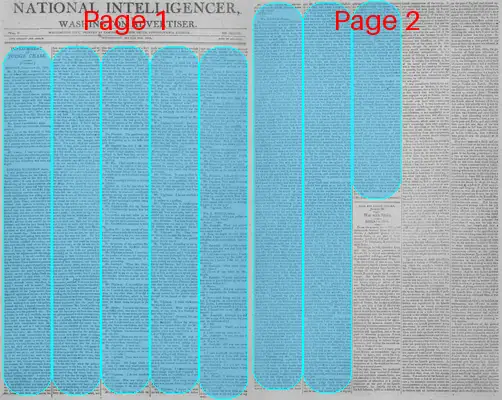
The National Intelligencer And Washington Advertiser
Washington, District Of Columbia
What is this article about?
Testimony from witnesses Edward Tilghman, Wm. S. Biddle, and W.M. Rawle in the impeachment trial of Judge Samuel Chase, detailing events during the 1800 treason trial of John Fries in Philadelphia, including the court's written opinion on law, counsel's refusal to defend, and trial proceedings.
Merged-components note: These components form a continuous narrative detailing the impeachment trial proceedings of Judge Chase, including witness testimonies and cross-examinations, spanning multiple columns and pages.
Clippings
1 of 2
OCR Quality
Full Text
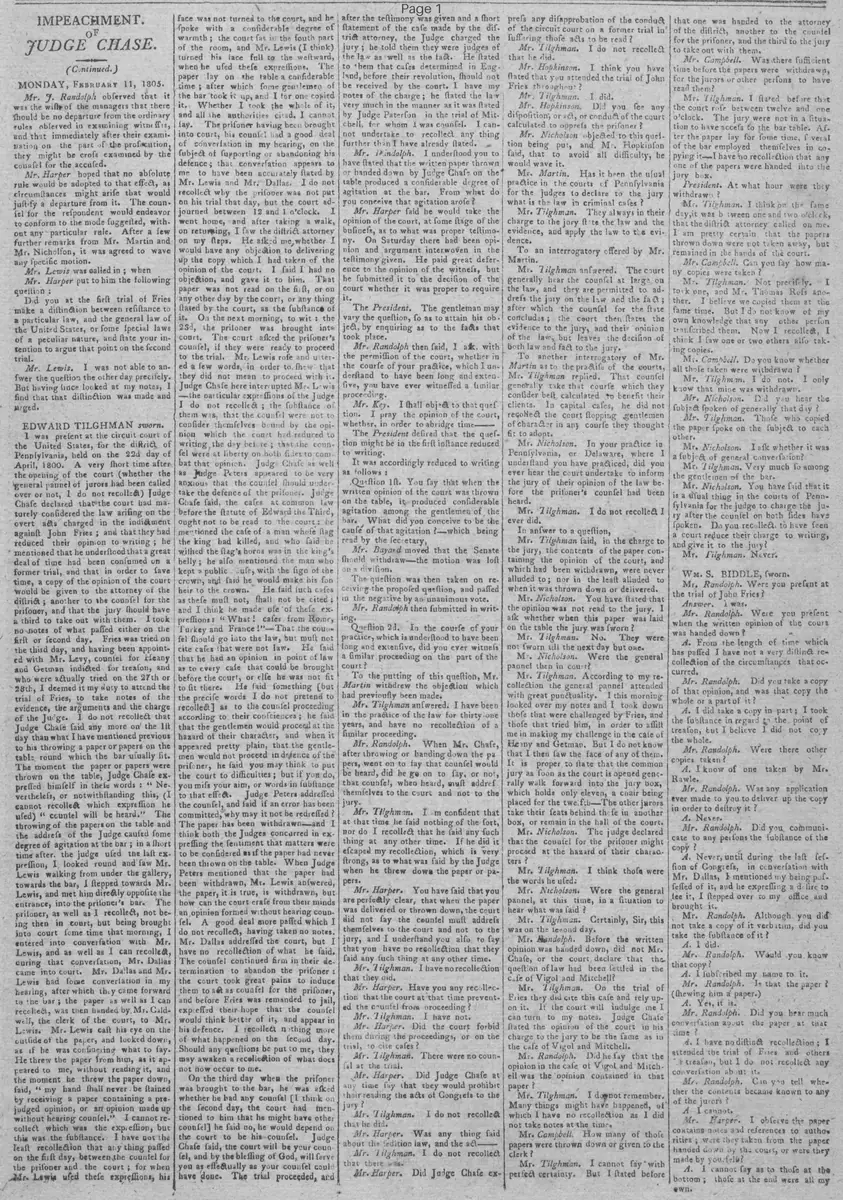
OF
JUDGE CHASE.
(Continued.)
MONDAY, FEBRUARY 11, 1805.
Mr. J. Randolph observed that it was the will of the managers that there should be no departure from the ordinary rules observed in examining witnesses, and that immediately after their examination on the part of the prosecution, they might be cross examined by the counsel for the accused.
Mr. Harper hoped that no absolute rule would be adopted to that effect, as circumstances might arise that would justify a departure from it. The counsel for the respondent would endeavor to conform to the mode suggested, without any particular rule. After a few further remarks from Mr. Martin and Mr. Nicholson, it was agreed to waive any specific motion.
Mr. Lewis was called in; when Mr. Harper put to him the following question:
Did you at the first trial of Fries make a distinction between resistance to a particular law, and the general law of the United States, or some special laws of a peculiar nature, and state your intention to argue that point on the second trial?
Mr. Lewis. I was not able to answer the question the other day precisely. But having since looked at my notes, I find that that distinction was made and argued.
EDWARD TILGHMAN sworn.
I was present at the circuit court of the United States, for the district of Pennsylvania, held on the 22d day of April, 1800. A very short time after the opening of the court (whether the general panel of jurors had been called over or not, I do not recollect) Judge Chase declared that the court had maturely considered the law arising on the overt acts charged in the indictment against John Fries; and that they had reduced their opinion to writing; he mentioned that he understood that a great deal of time had been consumed on a former trial, and that in order to save time, a copy of the opinion of the court would be given to the attorney of the district; another to the counsel for the prisoner, and that the jury should have a third to take out with them. I took no notes of what passed either on the first or second day. Fries was tried on the third day, and having been appointed with Mr. Levy, counsel for Henny and Getman indicted for treason, and who were actually tried on the 27th or 28th, I deemed it my duty to attend the trial of Fries, to take notes of the evidence, the arguments and the charge of the Judge. I do not recollect that Judge Chase said any more on the first day than what I have mentioned previous to his throwing a paper or papers on the table round which the bar usually sit.
The moment the paper or papers were thrown on the table, Judge Chase expressed himself in these words: "Nevertheless, or notwithstanding this, (I cannot recollect which expression he used) "counsel will be heard." The throwing of the papers on the table and the address of the Judge caused some degree of agitation at the bar; in a short time after, the judge used the last expression, I looked round and saw Mr. Lewis walking from under the gallery, towards the bar, I stepped towards Mr. Lewis, and met him directly opposite the entrance, into the prisoner's bar. The prisoner, as well as I recollect, not being then in court, but being brought into court some time that morning, I entered into conversation with Mr. Lewis, and as well as I can recollect, during that conversation, Mr. Dallas came into court. Mr. Dallas and Mr. Lewis had some conversation in my hearing, after which they came forward to the bar; the paper as well as I can recollect, was then handed by Mr. Caldwell, the clerk of the court, to Mr. Lewis. Mr. Lewis cast his eye on the outside of the paper, and looked down, as if he was considering what to say. He threw the paper from him, as it appeared to me, without reading it, and the moment he threw the paper down, said, "my hand shall never be tainted by receiving a paper containing a prejudged opinion, or an opinion made up without hearing counsel." I cannot recollect which was the expression, but this was the substance. I have not the least recollection that any thing passed on the first day, between the Counsel for the prisoner and the court; for when Mr. Lewis used these expressions, his face was not turned to the court, and he spoke with a considerable degree of warmth; the court sat in the south part of the room, and Mr. Lewis (I think) turned his face full to the westward. when he used these expressions. The paper lay on the table a considerable time; after which some gentlemen of the bar took it up, and I for one copied it. Whether I took the whole of it, and all the authorities cited, I cannot say. The prisoner having been brought into court, his counsel had a good deal of conversation in my hearing, on the subject of supporting or abandoning his defence; that conversation appears to me to have been accurately stated by Mr. Lewis and Mr. Dallas. I do not recollect why the prisoner was not put on his trial that day, but the court adjourned between 12 and 1 o'clock. I went home, and after taking a walk, on returning, I saw the district attorney on my steps. He asked me whether I would have any objection to delivering up the copy which I had taken of the opinion of the court. I said I had no objection, and gave it to him. That paper was not read on the first, or on any other day by the court, or any thing stated by the court, as the substance of it. On the next morning, to wit: the 23d, the prisoner was brought into court. The court asked the prisoner's counsel, if they were ready to proceed to the trial. Mr. Lewis rose and uttered a few words. in order to, shew that they did not mean to proceed with it. Judge Chase here interrupted Mr. Lewis—the particular expressions of the Judge I do not recollect; the substance of them was, that the counsel were not to consider themselves bound by the opinion which the court had reduced to writing the day before; that the counsel were at liberty on both sides to combat that opinion. Judge Chase as well as Judge Peters appeared to be very anxious that the counsel should undertake the defence of the prisoner. Judge Chase said, the cases at common law before the statute of Edward the Third, ought not to be read to the court: he mentioned the case of a man whose stag the king had killed, and who said he wished the stag's horns was in the king's belly; he also mentioned the man who kept a public house, with the sign of the crown, and said he would make his son heir to the crown. He said such cases as these must not, shall not be cited: and I think he made use of these expressions: "What! cases from Rome, Turkey and France!"—That the counsel should go into the law, but must not cite cases that were not law. He said that he had an opinion in point of law as to every case that could be brought before the court, or else he was not fit to sit there. He said something [but the precise words I do not pretend to recollect] as to the counsel proceeding according to their consciences; he said that the gentlemen would proceed at the hazard of their character, and when it appeared pretty plain, that the gentlemen would not proceed in defence of the prisoner, he said you may think to put the court to difficulties; but if you do, you miss your aim, or words in substance to that effect. Judge Peters addressed the counsel, and said if an error has been committed, why may it not be redressed? The paper has been withdrawn—and I think both the Judges concurred in expressing the sentiment that matters were to be considered as if the paper had never been shown on the table. When Judge Peters mentioned that the paper had been withdrawn, Mr. Lewis answered, the paper, it is true, is withdrawn, but how can the court erase from their minds an opinion formed without hearing counsel. A good deal more passed which I do not recollect, having taken no notes. Mr. Dallas addressed the court, but I have no recollection of what he said. The counsel continued firm in their determination to abandon the prisoner: the court took great pains to induce them to act as counsel for the prisoner, and before Fries was remanded to jail, expressed their hope that the counsel would think better of it, and appear in his defence. I recollect nothing more of what happened on the second day. Should any questions be put to me, they may awaken a recollection of what does not now occur to me.
On the third day when the prisoner was brought to the bar, he was asked whether he had any counsel [I think on the second day, the court had mentioned to him that he might have other counsel] he said no, he would depend on the court to be his counsel. Judge Chase said, the court will be your counsel, and by the blessing of God, will serve you as effectually as your counsel could have done. The trial proceeded, and after the testimony was given and a short statement of the case made by the district attorney, the Judge charged the jury; he told them they were judges of the law as well as the fact. He stated to them that cases determined in England, before their revolution, should not be received by the court. I have my notes of the charge: he stated the law very much in the manner as it was stated by Judge Paterson in the trial of Mitchell, for whom I was counsel. I cannot undertake to recollect any thing further than I have already stated.
Mr. Randolph. I understood you to have stated that the written paper thrown or handed down by Judge Chase on the table produced a considerable degree of agitation at the bar. From what do you conceive that agitation arose?
Mr. Harper said he would take the opinion of the court, at some stage of the business, as to what was proper testimony. On Saturday there had been opinion and argument interwoven in the testimony given. He paid great deference to the opinion of the witness. but he submitted it to the decision of the court whether it was proper to require it.
The President. The gentleman may vary the question, so as to attain his object, by enquiring as to the facts that took place.
Mr. Randolph then said. I ask, with the permission of the court, whether in the course of your practice, which I understand to have been long and extensive, you have ever witnessed a similar proceeding.
Mr. Key. I shall object to that question. I pray the opinion of the Court, whether. in order to abridge time—
The President desired that the question might be in the first instance reduced to writing.
It was accordingly reduced to writing as follows:
Question 1st. You say that when the written opinion of the court was thrown on the table, it produced considerable agitation among the gentlemen of the bar. What did you conceive to be the cause of that agitation?—which being read by the secretary,
Mr. Bayard moved that the Senate should withdraw—the motion was lost on a division.
The question was then taken on receiving the proposed question, and passed in the negative by an unanimous vote.
Mr. Randolph then submitted in writing:
Question 2d. In the course of your practice, which is understood to have been long and extensive, did you ever witness a similar proceeding on the part of the court?
To the putting of this question, Mr. Martin withdrew the objection which had previously been made.
Mr. Tilghman answered. I have been in the practice of the law for thirty-one years, and have no recollection of a similar proceeding.
Mr. Randolph.
When Mr. Chase, after throwing or handing down the papers, went on to say that counsel would be heard, did he go on to say, or not, that counsel, when heard, must address themselves to the Court and not to the jury.
Mr. Tilghman. I am confident that at that time he said nothing of the sort, nor do I recollect that he said any such thing at any other time. If he did it escaped my recollection, which is very strong, as to what was said by the Judge when he threw down the paper or papers.
Mr. Harper. You have said that you are perfectly clear, that when the paper was delivered or thrown down, the Court did not say the counsel must address themselves to the court and not to the jury, and I understand you also to say that you have no recollection that they said any such thing at any other time.
Mr. Tilghman. I have no recollection that they said.
Mr. Harper. Have you any recollection that the court at that time prevented the counsel from proceeding?.
Mr. Tilghman. I have not.
Mr. Harper. Did the court forbid them during the proceedings, or on the trial, to cite cases?
Mr. Tilghman. There were no counsel at the trial.
Mr. Harper. Did Judge Chase at any time say that they would prohibit their reading the acts of Congress to the jury?
Mr. Tilghman. I do not recollect that he did.
Mr. Harper. Was any thing said about the sedition law, and the act—
Mr. Tilghman. I do not recollect that there was.
Mr. Harper. Did Judge Chase express any disapprobation of the conduct of the circuit court on a former trial in suffering those acts to be read?
Mr. Tilghman. I do not recollect that he did.
Mr. Hopkinson. I think you have stated that you attended the trial of John Fries throughout?
Mr. Tilghman. I did.
Mr. Hopkinson. Did you see any disposition, or act, or conduct of the court calculated to oppress the prisoner?
Mr. Nicholson objected to this question being put, and Mr. Hopkinson said, that to avoid all difficulty, he would waive it.
Mr. Martin. Has it been the usual practice in the courts of Pennsylvania for the judges to declare to the jury what is the law in criminal cases?
Mr. Tilghman. They always in their charge to the jury state the law and the evidence, and apply the law to the evidence.
To an interrogatory offered by Mr. Martin.
Mr. Tilghman answered. The court generally hear the counsel at large on the law, and they are permitted to address the jury on the law and the fact; after which the counsel for the state concludes: the court then states the evidence to the jury, and their opinion of the law, but leaves the decision of both law and fact to the jury.
To another interrogatory of Mr. Martin as to the practice of the courts,
Mr. Tilghman replied. That counsel generally take that course which they consider best calculated to benefit their clients. In capital cases. he did not recollect the court stopping gentlemen of character in any course they thought fit to adopt.
Mr. Nicholson. In your practice in Pennsylvania, or Delaware, where I understand you have practiced, did you ever hear the court undertake to inform the jury of their opinion of the law before the prisoner's counsel had been heard.
Mr. Tilghman. I do not recollect I ever did.
In answer to a question,
Mr. Tilghman said, in the charge to the jury, the contents of the paper containing the opinion of the court, and which had been withdrawn were never alluded to: nor in the least alluded to when it was thrown down or delivered.
Mr. Nicholson. You have stated that the opinion was not read to the jury. I ask whether when this paper was laid on the table the jury was sworn?
Mr. Tilghman. No. They were not sworn till the next day but one.
Mr. Nicholson. Were the general panel then in court?
Mr. Tilghman. According to my recollection the general panel attended with great punctuality. I this morning looked over my notes and I took down those that were challenged by Fries, and those that tried him, in order to assist me in making my challenge in the case of Henny and Getman, But I do not know that I then saw the face of any of them. It is proper to state that the common jury as soon as the court is opened generally walk forward into the jury box, which holds only eleven, a chair being placed for the twelfth—The other jurors take their seats behind these in another box, or remain in the hall of the court.
Mr. Nicholson. The judge declared that the counsel for the prisoner might proceed at the hazard of their characters?
Mr. Tilghman. I think those were the words he used:
Mr. Nicholson. Were the general panel, at this time, in a situation to hear what was said?
Mr. Tilghman. Certainly, Sir, this was on the second day.
Mr. Randolph. Before the written opinion was handed down, did not Mr. Chase, or the court declare that the question of law had been settled in the case of Vigol and Mitchell?
Mr. Tilghman. On the trial of Fries they did cite this case and rely upon it. If the court will indulge me I can turn to my notes. Judge Chase stated the opinion of the court in his charge to the jury to be the same as in the case of Vigol and Mitchell.
Mr. Randolph. Did he say that the opinion in the case of Vigol and Mitchell was the opinion contained in that paper?
Mr. Tilghman. I do not remember. Many things might have happened, of which I have no recollection as I did not take notes at the time.
Mr. Campbell. How many of those papers were thrown down or given to the clerk?
Mr. Tilghman. I cannot say with perfect certainty. But I stated before that one was handed to the attorney of the district, another to the counsel for the prisoner, and the third to the jury to take out with them.
Mr. Campbell. Was there sufficient time before the papers were withdrawn, for the jurors or other persons to have read them?
Mr. Tilghman. I stated before that the court rose between twelve and one o'clock. The jury were not in a situation to have access to the bar table. After the paper lay or some time, several of the bar employed themselves in copying it--I have no recollection that any one of the papers were handed into the jury box.
President. At what hour were they withdrawn?
Mr. Tilghman. I think on the same day,it was between one and two o'clock, that the district attorney called on me. I am pretty certain that the papers thrown down were not taken away, but remained in the hands of the court.
Mr. Campbell. Can you say how many copies were taken?
Mr. Tilghman. Not precisely. I took one. and Mr. Thomas Ross another. I believe we copied them at the same time. But I do not know of my own knowledge that any other person transcribed them. Now I recollect, I think I saw one or two others also taking copies.
Mr. Campbell. Do you know whether all those taken were withdrawn
Mr. Tilghman. I do not. I only know that mine was withdrawn.
Mr. Nicholson. Did you hear the subject spoken of generally that day?
Mr. Tilghman. Those who copied the paper spoke on the subject to each other.
Mr. Nicholson. I ask whether it was a subject of general conversation?
Mr. Tilghman. Very much so among the gentlemen of the bar.
Mr. Nicholson. You have said that it is usual thing in the courts of Pennsylvania for the judge to charge the jury after the counsel on both sides have spoken. Do you recollect. to have seen a court reduce their charge to writing, and give it to the jury?
Mr. Tilghman. Never.
WM. S. BIDDLE. sworn.
Mr. Randolph. Were you present at the trial of John Fries?
Answer. I was.
Mr. Randolph. Were you present when the written opinion of the court was handed down?
A. From the length of time which has passed I have not a very distinct recollection of the circumstances that occurred.
Mr. Randolph. Did you take a copy of that opinion, and was that copy the whole or a part of it?
A. I did take a Copy in part; I took the substance in regard to the. point of treason, but I believe I did not copy the whole.
Mr. Randolph. Were there other copies taken?
A. I know of one taken by Mr. Rawle.
Mr. Randolph. Was any application ever made to you to deliver up the copy in order to destroy it?
A. Never.
Mr. Randolph. Did you communicate to any persons the substance of the copy?
A. Never, until during the last session of Congress, in conversation with Mr. Dallas, I mentioned my being possessed of it, and he expressing a desire to see it, I stepped over to my office and brought it.
Mr. Randolph. Although you did not take a copy of it verbatim, did you take the substance of it?
A. I did.
Mr. Randolph. Would you know that copy?
A. I subscribed my name to it.
Mr. Randolph. Is that the paper? (showing him a paper.)
A. Yes. it is.
Mr. Randolph. Did you hear much conversation about the paper at that time?
A. I have no distinct recollection: I attended the trial of Fries and others for treason, but I do not recollect any conversation about it.
Mr. Randolph. Can you tell whether the contents became known to any of the jurors?
A I cannot.
Mr. Harper. I observe the paper contains notes and references to authorities ; were they taken from the paper handed down by the court, or were they made by yourself?
A, I cannot say as to those at the bottom; those at the end were all my own.
Mr. Martin. Do you know whether the judges or the district attorney knew you had a copy?
A. I do not.
W. M. RAWLE affirmed.
The circuit court of the United States at Philadelphia in April 1800. As the former proceedings in relation to the prisoners indicted for treason were considered at an end, except from the intervention of an act of Congress, it appeared to me most regular to quash all the previous proceedings. I made a motion to this effect, which was granted. On the same day the court charged the grand jury, and I sent to them bills against John Fries, and other persons charged with treason and other offences. The bill against John Fries was returned on the 16th as a true bill, and he was immediately brought up, arraigned and pleaded not guilty. Messrs. Lewis and Dallas appeared as counsel for Fries. Copies of the indictment, and lists of the jurors and witnesses were furnished to Fries as directed by law. The bringing on the trial was postponed on account of the absence of George Mitchell, whom I deemed to be a material witness. According to my best recollection it was not intended that John Fries should be tried on the said, the first day alluded to. I cannot say that John Fries was then at the bar. That circumstance does not appear on the minutes of the clerk of the court. It was certainly not my intention that he should have been brought up, but he may possibly have been brought through mistake. Shortly after the court met, judge Chase observed, that as much time had been lost on the former trial or trials, the court had determined to express their opinion in writing, on the point of law, that they might not be misunderstood; that they had therefore committed that opinion to writing, and that the clerk had made copies of it, one of which should be given to the district attorney, one to the counsel for the prisoner; and one the jury should take out for them; as these words were pronounced several papers, I think three, were handed down or thrown down, as it were, my back was to the court, and whether this was done by judge Chase or the clerk, I know not. I immediately took up the one intended for me and began to read it, but casting my eyes to the opposite side of the table, I saw Mr. Lewis with another copy before him, looking at it, apparently, with great indignation, and then throwing it on the table. I am pretty clear that nothing passed between the court and the counsel in the course of that morning. I observed much agitation among the gentlemen of the bar, who were conversing with each other with apparent warmth; but having at that time, a very great burthen of criminal prosecutions on me, my attention was much engaged, and I did not hear distinctly what was said, nor did I know, until the court rose that there was a probability of the Counsel for John Fries declining to act. I think that twenty-one persons were that day brought before the court charged with seditious combinations, and who submitted to the Court. The court rose pretty early in the morning, and intimated that I should not call any witnesses in relation to the submissions until the trials for treason were over. When the court rose I learnt from several gentlemen, that Mr. Lewis and Mr. Dallas were disgusted with the conduct of the court, and meant to decline acting as counsel for Fries, and I have an indistinct recollection that I heard something of this kind drop from Mr. Dallas himself. I went home, and had been there but a few minutes, when judge Chase and judge Peters came in. We went into another room, and judge Peters began by expressing a good deal of uneasiness, from an apprehension that the gentlemen assigned as Counsel for John Fries would not go on. Judge Chase said he could not suppose that that would be the consequence. I supported the idea which judge P. ters had expressed; I told him the gentlemen of the Philadelphia bar were men of much independence of character, and that unless those papers were withdrawn, and the business conducted as usual at our bar, they probably would decline from conducting the defence. My recollection at this distance of time cannot be very distinct, but I am pretty well satisfied that judge Chase expressed his regret that the conduct of the court should be so taken, and said, that he did not mean, that any thing which he had said should preclude the counsel from making a defence in the usual manner. Judge Peters asked if I would consent to go out, and undertake to recover the papers. I said I had no objection, and both the judges concurred in requesting me to do so. I recollected seeing Mr. Edward Tilghman and Mr. Thomas Ross engaged in making copies--I did not recollect to have seen any others so engaged. I went to their houses and asked for the copies, which were readily given, and took them to Mr. Caldwell, clerk of the court. I asked him if he had noticed any others to have been taken? He said, he thought a copy had been taken by Mr. William Meredith. I desired him to go to him and endeavor to recall it. I did not know
that Mr. Biddle, who was then a student in my office, had taken a copy in part, or I would have desired him to give it up. From some circumstances which I do not recollect, I find that I did not hand my own copy to Mr. Caldwell, I now have it in my possession. The paper was not read, I think, by any but those who transcribed it, and I entertained an anxious hope, after what had taken place, that the gentlemen would proceed with the defence of the prisoner. I shall now take the liberty of referring to some original notes made by me at the time-from which I can state what passed the following morning-So far as they go, I believe them accurate, though they may not enable me to relate all that was said. On the 23d April, John Fries was brought and put to the bar, Messrs. Lewis and Dallas attending. The court asked if we were ready to proceed. Mr. Lewis rose and said, If employed by the prisoner, I should think myself bound to proceed, but being assigned.-he was here interrupted by judge Chase, who said, "you are not bound by the opinion delivered yesterday, you may contest it on both sides." Mr. Lewis answered, I understood that the court had made up their minds, and as the prisoner's counsel have a right to make a full defence, and address the jury both on the law and the fact, it would place me in too degrading a situation, and therefore I will not proceed. Judge Chase answered with apparent impatience _You are at liberty to proceed as you think proper, and address the jury and lay down the law as you think proper. Mr. Lewis answered with considerable emphasis, I will never address the court in a criminal case on a question of law. He then took a pretty extensive view on the propriety of going into cases decided before the revolution. and said, if he was precluded from shewing that the judges since the revolution in England had considered themselves bound by the decisions before the revolution. which ought not to be the doctrine in this Country, he must decline acting as counsel for the prisoner. Judge Chase answered, Sir, you must do as you please. Mr. Dallas then addressed the court. He contended that the rights of advocates had been encroached upon by the proceedings of the day before. He went into a general view of the ground taken by Mr. Lewis. and concluded with his determination not to proceed as counsel for John Fries. Judge Chase then observed—no opinion has been given as to facts in this case. I would not let the witnesses be examined in the combination cases be cause I would not let the jury hear them before the trial of Fries came on. As to the law I knew that the trial before had taken nine days-that many common law cases were cited, such as wishing a tag's horns in the king's belly, and that of a man's saying he would make his son heir to the crown : such cases ought not, shall not go to the jury. No case can come before me on which I have not a decided opinion as to the law, otherwise I should not be fit to preside here I have always conducted myself with candor, and I mean, gentlemen, to have you trouble. It is not respectful nor is it the duty of counsel, to say they have a right to offer any thing they please. What! decisions in Rome. France, Turkey? No lawyer will say that common law cases are law under the statute of Edward the third, nor justify those judges who overstep the statute of William, and over rule the necessity of having two witnesses to one overt act, and admit hearsay testimony to prove matters of fact. It is the duty of counsel to lay down the law, but not to read cases that are not law. Having thus explained the meaning of the court. you will stand acquitted or condemned to your own consciences, as you think proper to act. But, gentlemen, do as you please. The course will be, the district attorney will open the law, state his case, and produce his witnesses. You are at liberty to controvert the law as to the matter, but the manner must be regulated by the court. Judge Peters said you are to consider every thing done yesterday as withdrawn. Mr. Lewis replied, true, Sir, the papers are withdrawn, but the sentiments still remain, I shall not therefore act. Mr. Dallas expressed the same determination, which I did not take down. A pause, for a few moments, took place, when Judge Chase said you cannot put the court into a difficulty, by this conduct, gentlemen--you do not know me if you think so ; and desiring the persons between him and the prisoner to stand aside, and addressing himself to John Fries, he asked, are you desirous of having other counsel assigned you, or will you go on to trial without. John Fries, after a pause, said he did not know what to do; he would leave it to the court. Under these circumstances I felt a repugnance to go on with the trial, not wishing to act in a case so extremely singular. I therefore moved to postpone the trial to the next day,-the Court readily concurred, and Fries was remanded to jail. On the 24th Fries was brought to the bar again. Judge Chase asked him if he had any counsel. He told the court that he relied on them as his counsel, and he expressed himself with a degree
of firmness and composure that convinced me that his decision was formed on mature reflection. Then, Judge Chase answered, by the blessing of God we will be your counsel/ and do you as much justice as those assigned you. The jury were then called over, and the court took pains to inform Fries of his right to challenge 35 without cause; and as many others as he could shew cause against. In every instance they appeared extremely anxious that he should defend himself. There were one or two friends near him, I believe, to aid him in his challenges. After the jurors had been severally passed by him, and before they were sworn, the court directed that they should severally be asked whether they had delivered an opinion on the subject. The first juror said he had not. and was sworn the second said he had ; he was then sworn to make true answers : and he declared that he had in a conversation said that these men ought to be punished the court directed this person to be set aside, and he was not sworn on the trial. The court afterwards directed the question to be some what altered,- "Have you formed or delivered an opinion &c. ?" Before this question was put to more than three persons, it was again altered, and put in these words: "Have you formed and delivered any opinion?" Three. including the one already mentioned. answered affirmatively. and were set aside. The prisoner challenged. without cause, thirty-four of the panel. Twelve jurors were then sworn, and I opened the case in a very brief manner, laid down the law, and adduced the testimony. The trial lasted till the afternoon, and till the next day ; the court retired twice for refreshment and repose. John Fries called no witnesses. But at the end of the examination of each witness called on the part of the prosecution. Judge Chase reminded him that he had a right to put any question to the witness that he thought proper, and told him to be cautious not to put any question the answer to which might injure him. When the evidence on the part of the prosecution had closed, John Fries expressed his determination to call none on his part. I then addressed the jury in as brief a manner as I could, consistent with the duty I had to perform, for I severely felt the unpleasantness of the situation in which I stood, acting against a man tried on a capital charge without professional assistance. The court then charged the jury, who retired, and in about half an hour returned with a verdict of guilty. These are all the general facts I recollect in relation to the trial.
(Mr. Rawle's testimony to be continued.)
What sub-type of article is it?
What themes does it cover?
What keywords are associated?
What entities or persons were involved?
Where did it happen?
Story Details
Key Persons
Location
Circuit Court Of The United States, For The District Of Pennsylvania
Event Date
Monday, February 11, 1805
Story Details
Witnesses testify in Judge Chase's impeachment trial about his actions in the 1800 treason trial of John Fries, including presenting a pre-written opinion on law, counsel's refusal to defend Fries due to perceived prejudgment, withdrawal of the opinion, and Fries proceeding without counsel, resulting in a guilty verdict.