Thank you for visiting SNEWPapers!
Sign up free
Daily Sitka Sentinel And The Arrowhead Press
Sitka, Alaska
What is this article about?
The annual Fish & Wildlife Service hearing in Juneau, Alaska, discussed salmon run conditions across regions like Bristol Bay, Kodiak, and Southeast Alaska, and herring fishery management. Officials reported declines and improvements, fishermen urged conservation measures including predator control and stream stocking, and proposed limiting herring catches to 10,000 barrels per area.
Merged-components note: This is a single continued article about the Fish & Wildlife Service hearing on salmon and herring, split across columns on page 1 and continued on page 4.
Clippings
1 of 2
OCR Quality
Full Text
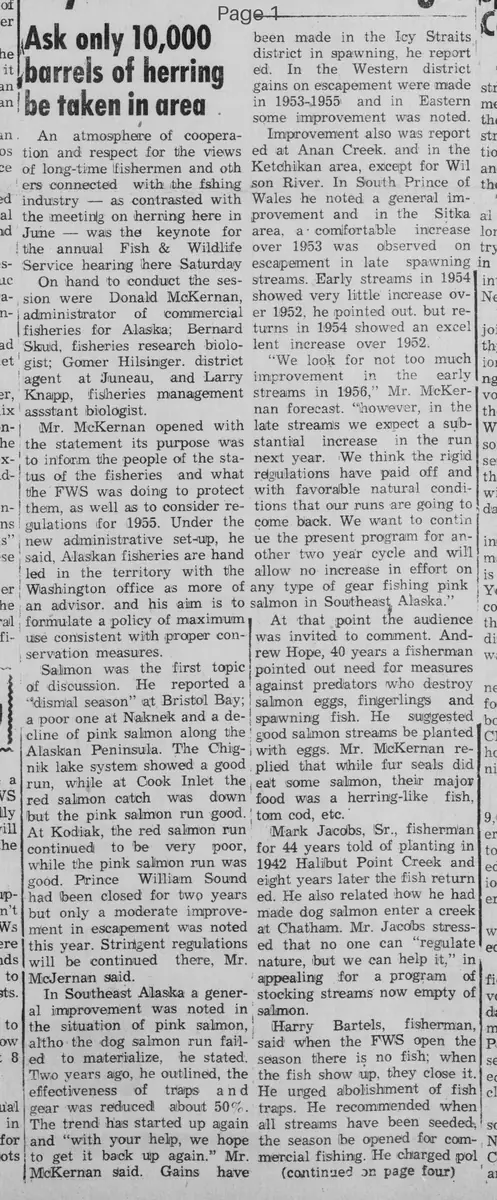
An atmosphere of cooperation and respect for the views of long-time fishermen and others connected with the fishing industry -- as contrasted with the meeting on herring here in June -- was the keynote for the annual Fish & Wildlife Service hearing here Saturday.
On hand to conduct the session were Donald McKernan, administrator of commercial fisheries for Alaska; Bernard Skud, fisheries research biologist; Gomer Hilsinger, district agent at Juneau, and Larry Knapp, fisheries management assistant biologist.
Mr. McKernan opened with the statement its purpose was to inform the people of the status of the fisheries and what the FWS was doing to protect them, as well as to consider regulations for 1955. Under the new administrative set-up, he said, Alaskan fisheries are handled in the territory with the Washington office as more of an advisor, and his aim is to formulate a policy of maximum use consistent with proper conservation measures.
Salmon was the first topic of discussion. He reported a dismal season at Bristol Bay; a poor one at Naknek and a decline of pink salmon along the Alaskan Peninsula. The Chignik lake system showed a good run, while at Cook Inlet the red salmon catch was down but the pink salmon run good.
At Kodiak, the red salmon run continued to be very poor, while the pink salmon run was good. Prince William Sound had been closed for two years but only a moderate improvement in escapement was noted this year. Stringent regulations will be continued there, Mr. McKernan said.
In Southeast Alaska a general improvement was noted in the situation of pink salmon, altho the dog salmon run failed to materialize, he stated.
Two years ago, he outlined, the effectiveness of traps and gear was reduced about 50%. The trend has started up again and "with your help, we hope to get it back up again." Mr. McKernan said. Gains have been made in the Icy Straits district in spawning, he reported. In the Western district gains on escapement were made in 1953-1955 and in Eastern some improvement was noted.
Improvement also was reported at Anan Creek, and in the Ketchikan area, except for Wilson River. In South Prince of Wales he noted a general improvement and in the Sitka area, a comfortable increase over 1953 was observed on escapement in late spawning streams. Early streams in 1954 showed very little increase over 1952, he pointed out, but returns in 1954 showed an excellent increase over 1952.
"We look for not too much improvement in the early streams in 1956," Mr. McKernan forecast. "However, in the late streams we expect a substantial increase in the run next year. We think the rigid regulations have paid off and with favorable natural conditions that our runs are going to come back. We want to continue the present program for another two year cycle and will allow no increase in effort on any type of gear fishing pink salmon in Southeast Alaska."
At that point the audience was invited to comment. Andrew Hope, 40 years a fisherman pointed out need for measures against predators who destroy salmon eggs, fingerlings and spawning fish. He suggested good salmon streams be planted with eggs. Mr. McKernan replied that while fur seals did eat some salmon, their major food was a herring-like fish, tom cod, etc.
Mark Jacobs, Sr., fisherman for 44 years told of planting in 1942 Halibut Point Creek and eight years later the fish returned. He also related how he had made dog salmon enter a creek at Chatham. Mr. Jacobs stressed that no one can "regulate nature, but we can help it." in appealing for a program of stocking streams now empty of salmon.
Harry Bartels, fisherman, said when the FWS open the season there is no fish; when the fish show up, they close it. He urged abolishment of fish traps. He recommended when all streams have been seeded the season be opened for commercial fishing. He charged pol (continued on page four)
FWS hearing
Politics had influenced some FWS decisions in the past, pointing to an incident at Klawock. He also stated many boats had more gear than that allowed by law during the last season.
Mr. McKernan replied that size of gear will be looked into carefully the coming season. Also that if any member of his staff was involved in political activities or acting as the result of political pressure, the incident should be reported to him; if guilty, the person in question would be fired.
"I look at the problem of the gear fight like this," said the fisheries head. "I think it is bad for a conservation agency to get into the gear fight. I would like to stay out of the gear fight and think about the conservation of the fish. It is a political, economic and social problem, but in the fisheries the idea is to get fish back and not worry over who is going to catch the last fish."
He then interjected a bit of humor into the hearings by defining an expert as: ex equaling an unknown quantity and "spurt" a drip under pressure.
William Sutton, a fisherman for many years, next spoke. He told of his experiences in the Bristol Bay area, that there was a good run there after the war years as well as in Southeastern Alaska; now Bristol Bay fishing is at a new low. He asked why Japanese were permitted to catch American fish on the high seas, they are getting most of the fish which should come to Alaska.
Mr. McKernan answered that this was a very serious problem that in 1954 Japanese took between 40 and 50 million fish on the high seas and about 55 million this year. Most were taken close to the shore of Kamchatka as they fish to within 20 miles of the Kamchatka Peninsula.
The Japanese, he said, claim these are Russian fish; the U.S. feels at least some of them are American fish. However, all parties have agreed that if it can be proven American fish are being taken, the Japanese have signed a treaty to cease fishing there. A tagging program is underway now in an attempt to identify these fish.
Pete Haugen of Marine Supply Co. and an Alaskan since 1918, asked that regulations be more flexible; FWS agents on the ground should have authority to extend or curtail season based on actual inspection. He was informed the FWS could open or close a season on 36 hours notice, the time it took to get the order published in the Federal Register.
Andrew Wanamaker of Juneau asked three questions: what good comes from fish weirs, is it true Japanese fishermen use very large nets and do the FWS close fish traps as often as they stop other types of gear from operating. Mr. McKernan explained weirs were placed on test streams in different areas to give positive knowledge of the number of fish migrating in that area. The FWS, he said, are working on other means of counting fish. He agreed that Japanese gillnets are very long and stated traps are never open when seiners are prohibited from fishing the same area.
Next speaker was David Howard, Sr., who asked what possibility there was of getting areas open for fall fishing of chums, if the run showed up well. In reply, Mr. McKernan said chum runs were very low this year; however, if there is evidence of a big run the FWS will want these fish harvested so if the run is good, they will allow more fishing. Present indications are not for a big chum run, he said.
HERRING SITUATION
The session then turned its attention to herring, a matter on which Mr. McKernan commented "we know you people have very definite ideas and we know you are experienced in this field. My mind is still open and we don't know much about Alaska herring yet. I will be very happy to consider all the evidence you have. I am here to show you why we have done what we have done, but my mind is not closed and I am willing to consider all angles of this herring situation."
"The purpose of our policy," he continued, "is to make our supplies of fish available for maximum utilization consistent with the best management practices." He went on to say the 1955 regulations provided for a 50,000 barrel limit in the Shelikof area and another 50,000 barrels in another area to the south. Herring seiners were finally 9,000 barrels short of this quota in the south. He related he knew local fishermen felt there was evidence the decline of herring parallels the decline of salmon, but stated scientific data did not indicate this. There are four major spawning areas in Alaska, he stated, and the majority of herring taken came from Shelikof Bay.
Studies have shown that herring do not migrate to any considerable extent, he explained, some 60 to 100 miles being the usual distance, and the stocks of herring are fairly well segregated. Commercial fishing for many years has been on the Sitka population of herring. Records indicate tremendous fluctuations since 1929 in the Sitka herring population.
Also records indicate the Sitka population of herring this year is high. However, violent fluctuations in herring population are characteristic of this type of fish, he explained.
Production of herring has remained about steady in British Columbia since 1910, he stated, while herring population has fluctuated with the years. In general there does not appear to be any relationship between troll caught salmon and herring fluctuations, as salmon catches have remained fairly constant.
Also herring fluctuate widely, too, in success of spawning on the beach. Some seasons are dominant year classes; others are nearly a complete failure. The Canadians use the theory that the maximum yield of herring will be best maintained by maximum fishing. As explanation for the smaller runs of herring, he said we think a series of poor spawning years is the reason for the lack of herring.
Mr. Skud then presented a number of charts and graphs backing up the FWS thinking on herring, its relation to salmon, area of spawning this year, etc. In summarizing the presentation Mr. McKernan said: "It looks to us as though herring populations are subject to violent fluctuations independent of fishing, and we think when these populations are abundant, they should be harvested. We think the present fishery is a minute fishery. We propose to continue restricting purse seining on herring. We are expanding our research work into the spawning, dominant year class etc. and hope to learn more all the time about these relationships."
Mrs. Sarvela asked the herring fishery be protected on the spawning grounds, as local fishermen believe the Sitka population of herring is the only large school outside of Tongass Narrows. If this Sitka herring population was left alone, it might again be abundant as in the early days.
Mr. Skud stated 70 to 80 per cent of commercial herring taken has been from the Sitka population (but the past year the FWS forced the herring seiners to fish other areas and also to fish later than usual.
Myrtle Sarvela of the Northern Fishing Vessel Owners seiners Assn. stated the fishermen appreciated what the biologists have done and appreciated the FWS advice, but "our herring population in Southeast Alaska was destroyed before you (McKernan) got this evidence." She read from a book published in 1885 describing the abundance of herring present here then, and from the governor's report of 1920 to support the contention herring had always existed here in huge quantities.
L. C. Berg told of Wrangell Narrows teeming with herring and asserted the reduction plants have depleted the supply. Andrew Wanamaker, stating there was almost no herring spawn in Juneau this year, said if they were all netted before spawning, there would be no more herring.
Pete Crews, a troller, stated he believed king salmon followed herring schools; when the spawning grounds were killed off, an area took years to build back up. Chatham Straits once were filled with herring, but the runs were depleted by reduction plants, he contended.
Pete Haugen told of precautions taken in Canada to preserve herring runs. Adolph Thomsen, who has fished since 1917, said there had been no herring in Tenakee Inlet since intensive fishing for reduction purposes there in 1938.
In conclusion Mrs. Sarvela asked that new regulations be drawn so that no more than 10,000 barrels were taken in any one area as a "means of saving our herring population."
What sub-type of article is it?
What keywords are associated?
What entities or persons were involved?
Where did it happen?
Domestic News Details
Primary Location
Juneau, Alaska
Event Date
Saturday
Key Persons
Outcome
discussions led to proposals for continued stringent salmon regulations, no increase in pink salmon fishing effort, and a suggested limit of 10,000 barrels of herring per area; japanese high seas fishing noted as a concern with tagging program underway.
Event Details
The annual FWS hearing focused on salmon run reports showing declines in areas like Bristol Bay and Kodiak, improvements in Southeast Alaska, and herring population fluctuations. Fishermen commented on conservation needs, predator control, stream stocking, gear regulations, political influences, and Japanese fishing impacts.