Thank you for visiting SNEWPapers!
Sign up free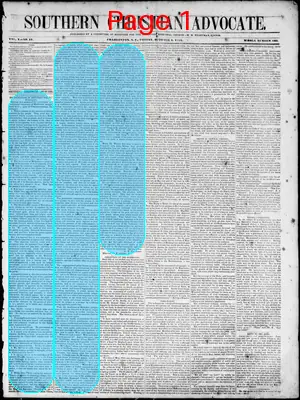
Story
October 8, 1841
Southern Christian Advocate
Charleston, Charleston County, South Carolina
What is this article about?
An article defending the democratic elements of Methodist church polity, contrasting it with episcopal, presbyterial, and congregational systems, emphasizing equity, scriptural basis, and historical purity. Authored by A. N. Fillmore in 1841.
Clipping
OCR Quality
98%
Excellent
Full Text
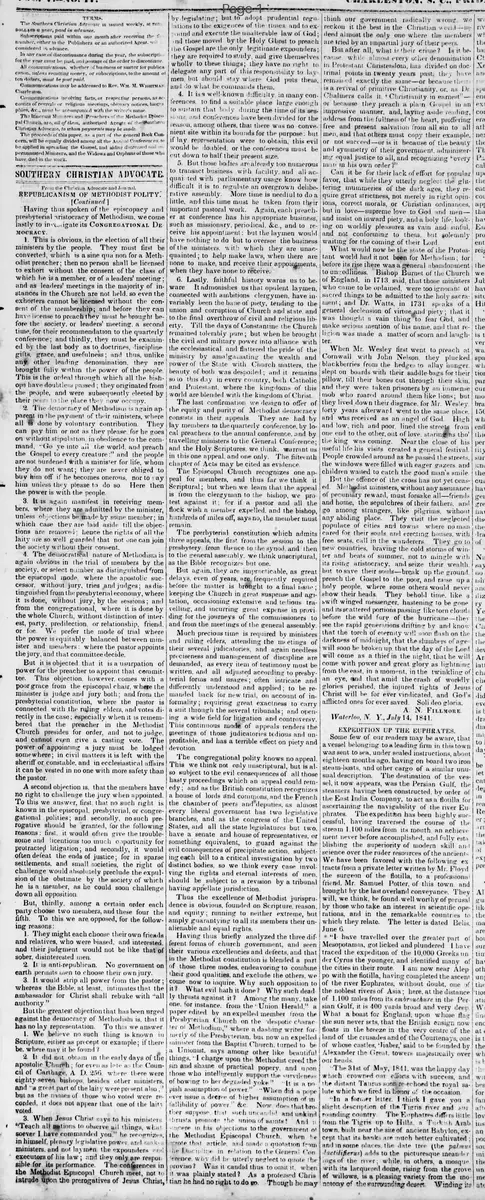
SOUTHERN CHRISTIAN ADVOCATE
From the Christian Advocate and Journal.
REPUBLICANISM OF METHODIST POLITY.
[Continued]
Having thus spoken of the episcopacy and presbyterial aristocracy of Methodism, we come lastly to investigate its Congregational Democracy.
1. This is obvious, in the election of all their ministers by the people. They must first be converted, which is a sine qua non for a Methodist preacher; then no person shall be licensed to exhort without the consent of the class of which he is a member, or of a leaders' meeting: and as leaders' meetings in the majority of instances in the Church are not held, so even the exhorters cannot be licensed without the consent of the membership; and before they can have license to preach they must be brought before the society, or leaders' meeting, a second time, for their recommendation to the quarterly conference: and thirdly, they must be examined by the last body as to doctrines, discipline, gifts, grace, and usefulness: and thus, unlike any other leading denomination, they are brought fully within the power of the people.
This is the ordeal through which all the bishops have doubtless passed; they originated from the people, and were subsequently elected by their peers to the place they now occupy.
2. The democracy of Methodism is again apparent in the payment of their ministers, where all is done by voluntary contribution. They can pay him or not as they please for he goes on without stipulation, in obedience to the command, "Go ye into all the world, and preach the Gospel to every creature:" and the people are not burdened with a minister for life, whom they do not want; they are never obliged to buy him off if he becomes onerous, nor to pay him unless they please to do so. Here then the power is with the people.
3. It is again manifest in receiving members, where they are admitted by the minister, unless objections be made by some member; in which case they are laid aside till the objections are removed; hence the rights of all the laity are so well guarded that not one can join the society without their consent.
4. The democratical nature of Methodism is again obvious in the trial of members by the society, or select number as distinguished from the episcopal mode, where the apostolic successor, without jury, tries and judges; as distinguished from the presbyterial economy, where it is done, without jury, by the sessions; and from the congregational, where it is done by the whole Church, without distinction of interest, party, predilection, or relationship, friend or foe. We prefer the mode of trial where the power is equitably balanced between minister and members: where the pastor appoints the jury, and that committee decide.
But it is objected that it is a usurpation of power for the preacher to appoint that committee. This objection, however, comes with a poor grace from the episcopal chair, where the minister is judge and jury both: and from the presbyterial constitution, where the pastor is connected with the ruling elders, and votes directly in the case; especially when it is remembered that the preacher in the Methodist Church presides for order, and not to judge, and cannot even give a casting vote. The power of appointing a jury must be lodged somewhere; in civil matters it is left with the sheriff or constable, and in ecclesiastical affairs it can be vested in no one with more safety than the pastor.
A second objection is, that the members have no right to challenge the jury when appointed. To this we answer, first, that no such right is known in the episcopal, presbyterial, or congregational polities; and secondly, no such prerogative should be granted, for the following reasons: first, it would often give the troublesome and licentious too much opportunity for protracted litigation; and secondly, it would often defeat the ends of justice; for in sparse settlements, and small societies, the right of challenge would absolutely preclude the expulsion of the obstinate by the society of which he is a member, as he could soon challenge down all opposition.
But, thirdly, among a certain order each party choose two members, and these four the fifth. To this we are opposed, for the following reasons:
1. They might each choose their own friends and relatives, who were biased, and interested, and their judgment would not be like that of sober, disinterested men.
2. It is anti-republican. No government on earth permits men to choose their own jury.
3. It would strip all power from the pastor; whereas the Bible, at least, intimates that the ambassador for Christ shall rebuke with "all authority."
But the greatest objection that has been urged against the democracy of Methodism is, that it has no lay representation. To this we answer:
I. We believe no such thing is known in Scripture, either as precept or example; if there be, where may it be found?
2. It did not obtain in the early days of the apostolic Church; for even as late as the Council of Carthage, A. D. 256, where there were eighty-seven bishops, besides other ministers, and "a great part of the laity were present also, but as the names of those who voted were recorded, it does not appear that one of the laity voted."
3. When Jesus Christ says to his ministers "Teach all nations to observe all things, whatsoever I have commanded you," he recognizes, in himself, plenary legislative power and makes ministers, and not laymen the expounders and executors of his law; and they only are responsible for its performance. The conferences in the Methodist Episcopal Church meet, not to intrude upon the prerogatives of Jesus Christ by legislating; but to adopt prudential regulations to the exigencies of the times, and to expound and execute the unalterable law of God; and those moved by the Holy Ghost to preach the Gospel are the only legitimate expounders; they are required to study, and give themselves wholly to these things; they have no right to delegate any part of this responsibility to laymen, but should stay where God puts them, and do what he commands them.
4. It is a well-known difficulty in many conferences, to find a suitable place large enough to sustain that body during the time of its sessions, and conferences have been divided for the reason, among others, that there was no convenient site within its bounds for the purpose: but if lay representation were to obtain, this evil would be doubled, or the conferences must be cut down to half their present size.
5. But those bodies are already too numerous to transact business with facility, and all acquainted with parliamentary usage know how difficult it is to regulate an overgrown deliberative assembly. More time is needful to do a little, and this time must be taken from their important pastoral work. Again, each preacher at conference has his appropriate business, such as missionary, periodical, &c., and to receive his appointment: but the laymen would have nothing to do but to oversee the business of the ministers, with which they are unacquainted; to help make laws, when there are none to make, and receive their appointments, when they have none to receive.
6. Lastly, faithful history warns us to beware. It admonishes us that opulent laymen, connected with ambitious clergymen, have invariably been the bane of piety, tending to the union and corruption of Church and state, and to the final overthrow of civil and religious liberty. Till the days of Constantine the Church remained tolerably pure; but when he brought the civil and military power into alliance with the ecclesiastical and flattered the pride of the ministry by amalgamating the wealth and power of the State with Church matters, the beauty of both was despoiled; and it remains so to this day in every country, both Catholic and Protestant, where the kingdoms of this world are blended with the kingdom of Christ.
The last confirmation we design to offer of the equity and purity of Methodist democracy consists in their appeals. They are had by lay members to the quarterly conference, by local preachers to the annual conference, and by travelling ministers to the General Conference; and the Holy Scriptures, we think, warrant us in this one appeal, and one only. The fifteenth chapter of Acts may be cited as evidence.
The Episcopal Church recognizes one appeal for members, and thus far we think it Scriptural; but when we learn that the appeal is from the clergyman to the bishop, we protest against it; for if a pastor and all the flock wish a member expelled, and the bishop, hundreds of miles off, says no, the member must remain.
The presbyterial constitution which admits three appeals, the first from the session to the presbytery, from thence to the synod, and then to the general assembly, we think unscriptural, as the Bible recognizes but one. But again, they are impracticable, as great delays, even of years, are frequently required before the matter is brought to a final issue; keeping the Church in great suspense and agitation, occasioning extensive and tedious travelling, and incurring great expense in providing for the journeys of the commissioners to and from the meetings of the general assembly. Much precious time is required by ministers and ruling elders, attending the meetings of their several judicatories, and again needless preciseness and management of discipline are demanded, as every item of testimony must be written, and all adjusted according to presbyterial forms and usages; often intricate and differently understood and applied; to be remanded back for new trial, on account of informality; requiring great exactness to carry a suit through the several tribunals; and opening a wide field for litigation and controversy. This continuous mode of appeals renders the meetings of those judicatories tedious and unprofitable, and has a terrible effect on piety and devotion.
The congregational polity knows no appeal. This we think not only unscriptural, but is also subject to the evil consequences of all those hasty proceedings which an appeal could remedy; and as the British constitution recognizes a house of lords and commons, and the French the chamber of peers and deputies, as almost every liberal government has two legislative branches, and as the congress of the United States, and all the state legislatures but two, have a senate and house of representatives, or something equivalent, to guard against the evil consequences of precipitate action, subjecting each bill to a critical investigation by two distinct bodies, so we think every case involving the rights and eternal interests of men, should be subject to a revision by a tribunal having appellate jurisdiction.
Thus the excellence of Methodist jurisprudence is obvious, founded on Scripture, reason, and equity; running to neither extreme, but amply guaranteeing to all its members their unalienable and equal rights.
Having thus briefly analyzed the three different forms of church government, and seen their various excellencies and defects, and that in the Methodist constitution is blended a part of those three modes, endeavoring to combine their good qualities, and exclude the others, we come now to inquire, Why such opposition to it? What evil hath it done? Why such deadly thrusts against it? Among the many, take one, for instance, from the "Union Herald," a paper edited by an expelled member from the Presbyterian Church on the despotic character of Methodism," where a dashing writer, formerly of the Presbyterian, but now an expelled minister from the Baptist Church, turned to be a Unionist, says among other like beautiful things, "I charge upon the Methodist creed the sin and shame of practical popery, and upon those who intelligently support the servileness of bowing to her degraded yoke" "It is a popish assumption of power." "When did a pope ever issue a decree of higher assumption of infallibility of power" &c. Now does that brother suppose, that such uncandid and unkind thrusts promote the union of saints! And sincere in his objections to the government of the Methodist Episcopal Church, when he wrote that article, and made a quotation from the Discipline in relation to the General Conference, why did he utterly neglect to quote the proviso? Was it candid thus to omit it, when it was plainly stated? As a professed Christian he had no right to do so. Though he may think our government radically wrong, we reckon it the best in the Christian world—indeed almost the only one where the members are tried by an impartial jury of their peers.
But after all, what is their crime? Is it because while almost every other denomination in Protestant Christendom, has divided on doctrinal points in twenty years past, they have remained exactly the same—or because theirs is a revival of primitive Christianity, or, as Dr. Chalmers calls it "Christianity in earnest"—or because they preach a plain Gospel in an impressive manner, and, laying aside reading, address from the fullness of the heart, proffering free and present salvation from all sin to all men, and that others must copy their example, or not succeed—or is it because of the beauty and symmetry of their government, administering equal justice to all, and recognizing "every man in his own order?"
Can it be for their lack of effort for popular favor, that while they utterly neglect the glittering mummeries of the dark ages, they require great strictness, not merely in right opinions, correct morals, or Christian ordinances, but in love—supreme love to God and men—and insist on inward piety, and a holy life, looking on worldly pleasures as vain and sinful, and not conforming to them, but solemnly waiting for the coming of their Lord?
What would now be the state of the Protestant world had it not been for Methodism: for before its rise there was a general abandonment to ungodliness. "Bishop Burnet of the Church of England, in 1713, said, that those ministers who came to be ordained, were too ignorant of sacred things to be admitted to the holy sacrament; and Dr. Watts, in 1731 speaks of a general declension of virtue and piety; that it was thought a vain thing to fear God, and make serious mention of his name, and that religion was made a matter of scorn and laughter."
When Mr. Wesley first went to preach at Cornwall with John Nelson, they plucked blackberries from the hedges to allay hunger, slept on boards with their saddle-bags for their pillow, till their bones cut through their skin, and they were taken prisoners by an immense mob who roared around them like lions; but they lived down their disgrace, for Mr. Wesley forty years afterward, went to the same place, and was received as an angel of God. High and low, rich and poor, lined the streets from one end to the other, out of love, staring as tho' the king was coming. Near the close of his useful life his visits created a general festival. People crowded around as he passed the streets, the windows were filled with eager gazers and children wanted to catch the good man's smile.
But the offence of the cross has not yet ceased. Methodist ministers, without any assurance of pecuniary reward, must forsake all—friends and home, the sepulchres of their fathers, and go among strangers, like pilgrims, without any abiding place. They visit the neglected populace of cities and towns where no man cared for their souls and erecting houses, with free seats, call in the wanderers. They go to new countries, braving the cold storms of winter and heats of summer, not to mingle with its rising aristocracy, and seize their wealth but to save their souls—break up the ground, preach the Gospel to the poor, and raise up a holy people, where some others would never show their heads. They behold time, like a swift winged messenger, hastening to be gone and its scattered portions passing like torn clouds before the wild fury of the hurricane—they see the rapid generations drifting by and know that the torch of eternity will soon flash on the darkness of midnight, that the slumbers of ages will soon be broken up, that the day of the Lord will come as a thief in the night, that he will come with power and great glory as lightning from the east, in a moment, in the twinkling of an eye, and that amid the crash of worldly glories perished, the injured rights of Jesus Christ will be for ever vindicated, and God's afflicted ones for ever saved. Soli deo gloria.
A. N. FILLMORE
Waterloo, N. Y., July 14, 1841.
From the Christian Advocate and Journal.
REPUBLICANISM OF METHODIST POLITY.
[Continued]
Having thus spoken of the episcopacy and presbyterial aristocracy of Methodism, we come lastly to investigate its Congregational Democracy.
1. This is obvious, in the election of all their ministers by the people. They must first be converted, which is a sine qua non for a Methodist preacher; then no person shall be licensed to exhort without the consent of the class of which he is a member, or of a leaders' meeting: and as leaders' meetings in the majority of instances in the Church are not held, so even the exhorters cannot be licensed without the consent of the membership; and before they can have license to preach they must be brought before the society, or leaders' meeting, a second time, for their recommendation to the quarterly conference: and thirdly, they must be examined by the last body as to doctrines, discipline, gifts, grace, and usefulness: and thus, unlike any other leading denomination, they are brought fully within the power of the people.
This is the ordeal through which all the bishops have doubtless passed; they originated from the people, and were subsequently elected by their peers to the place they now occupy.
2. The democracy of Methodism is again apparent in the payment of their ministers, where all is done by voluntary contribution. They can pay him or not as they please for he goes on without stipulation, in obedience to the command, "Go ye into all the world, and preach the Gospel to every creature:" and the people are not burdened with a minister for life, whom they do not want; they are never obliged to buy him off if he becomes onerous, nor to pay him unless they please to do so. Here then the power is with the people.
3. It is again manifest in receiving members, where they are admitted by the minister, unless objections be made by some member; in which case they are laid aside till the objections are removed; hence the rights of all the laity are so well guarded that not one can join the society without their consent.
4. The democratical nature of Methodism is again obvious in the trial of members by the society, or select number as distinguished from the episcopal mode, where the apostolic successor, without jury, tries and judges; as distinguished from the presbyterial economy, where it is done, without jury, by the sessions; and from the congregational, where it is done by the whole Church, without distinction of interest, party, predilection, or relationship, friend or foe. We prefer the mode of trial where the power is equitably balanced between minister and members: where the pastor appoints the jury, and that committee decide.
But it is objected that it is a usurpation of power for the preacher to appoint that committee. This objection, however, comes with a poor grace from the episcopal chair, where the minister is judge and jury both: and from the presbyterial constitution, where the pastor is connected with the ruling elders, and votes directly in the case; especially when it is remembered that the preacher in the Methodist Church presides for order, and not to judge, and cannot even give a casting vote. The power of appointing a jury must be lodged somewhere; in civil matters it is left with the sheriff or constable, and in ecclesiastical affairs it can be vested in no one with more safety than the pastor.
A second objection is, that the members have no right to challenge the jury when appointed. To this we answer, first, that no such right is known in the episcopal, presbyterial, or congregational polities; and secondly, no such prerogative should be granted, for the following reasons: first, it would often give the troublesome and licentious too much opportunity for protracted litigation; and secondly, it would often defeat the ends of justice; for in sparse settlements, and small societies, the right of challenge would absolutely preclude the expulsion of the obstinate by the society of which he is a member, as he could soon challenge down all opposition.
But, thirdly, among a certain order each party choose two members, and these four the fifth. To this we are opposed, for the following reasons:
1. They might each choose their own friends and relatives, who were biased, and interested, and their judgment would not be like that of sober, disinterested men.
2. It is anti-republican. No government on earth permits men to choose their own jury.
3. It would strip all power from the pastor; whereas the Bible, at least, intimates that the ambassador for Christ shall rebuke with "all authority."
But the greatest objection that has been urged against the democracy of Methodism is, that it has no lay representation. To this we answer:
I. We believe no such thing is known in Scripture, either as precept or example; if there be, where may it be found?
2. It did not obtain in the early days of the apostolic Church; for even as late as the Council of Carthage, A. D. 256, where there were eighty-seven bishops, besides other ministers, and "a great part of the laity were present also, but as the names of those who voted were recorded, it does not appear that one of the laity voted."
3. When Jesus Christ says to his ministers "Teach all nations to observe all things, whatsoever I have commanded you," he recognizes, in himself, plenary legislative power and makes ministers, and not laymen the expounders and executors of his law; and they only are responsible for its performance. The conferences in the Methodist Episcopal Church meet, not to intrude upon the prerogatives of Jesus Christ by legislating; but to adopt prudential regulations to the exigencies of the times, and to expound and execute the unalterable law of God; and those moved by the Holy Ghost to preach the Gospel are the only legitimate expounders; they are required to study, and give themselves wholly to these things; they have no right to delegate any part of this responsibility to laymen, but should stay where God puts them, and do what he commands them.
4. It is a well-known difficulty in many conferences, to find a suitable place large enough to sustain that body during the time of its sessions, and conferences have been divided for the reason, among others, that there was no convenient site within its bounds for the purpose: but if lay representation were to obtain, this evil would be doubled, or the conferences must be cut down to half their present size.
5. But those bodies are already too numerous to transact business with facility, and all acquainted with parliamentary usage know how difficult it is to regulate an overgrown deliberative assembly. More time is needful to do a little, and this time must be taken from their important pastoral work. Again, each preacher at conference has his appropriate business, such as missionary, periodical, &c., and to receive his appointment: but the laymen would have nothing to do but to oversee the business of the ministers, with which they are unacquainted; to help make laws, when there are none to make, and receive their appointments, when they have none to receive.
6. Lastly, faithful history warns us to beware. It admonishes us that opulent laymen, connected with ambitious clergymen, have invariably been the bane of piety, tending to the union and corruption of Church and state, and to the final overthrow of civil and religious liberty. Till the days of Constantine the Church remained tolerably pure; but when he brought the civil and military power into alliance with the ecclesiastical and flattered the pride of the ministry by amalgamating the wealth and power of the State with Church matters, the beauty of both was despoiled; and it remains so to this day in every country, both Catholic and Protestant, where the kingdoms of this world are blended with the kingdom of Christ.
The last confirmation we design to offer of the equity and purity of Methodist democracy consists in their appeals. They are had by lay members to the quarterly conference, by local preachers to the annual conference, and by travelling ministers to the General Conference; and the Holy Scriptures, we think, warrant us in this one appeal, and one only. The fifteenth chapter of Acts may be cited as evidence.
The Episcopal Church recognizes one appeal for members, and thus far we think it Scriptural; but when we learn that the appeal is from the clergyman to the bishop, we protest against it; for if a pastor and all the flock wish a member expelled, and the bishop, hundreds of miles off, says no, the member must remain.
The presbyterial constitution which admits three appeals, the first from the session to the presbytery, from thence to the synod, and then to the general assembly, we think unscriptural, as the Bible recognizes but one. But again, they are impracticable, as great delays, even of years, are frequently required before the matter is brought to a final issue; keeping the Church in great suspense and agitation, occasioning extensive and tedious travelling, and incurring great expense in providing for the journeys of the commissioners to and from the meetings of the general assembly. Much precious time is required by ministers and ruling elders, attending the meetings of their several judicatories, and again needless preciseness and management of discipline are demanded, as every item of testimony must be written, and all adjusted according to presbyterial forms and usages; often intricate and differently understood and applied; to be remanded back for new trial, on account of informality; requiring great exactness to carry a suit through the several tribunals; and opening a wide field for litigation and controversy. This continuous mode of appeals renders the meetings of those judicatories tedious and unprofitable, and has a terrible effect on piety and devotion.
The congregational polity knows no appeal. This we think not only unscriptural, but is also subject to the evil consequences of all those hasty proceedings which an appeal could remedy; and as the British constitution recognizes a house of lords and commons, and the French the chamber of peers and deputies, as almost every liberal government has two legislative branches, and as the congress of the United States, and all the state legislatures but two, have a senate and house of representatives, or something equivalent, to guard against the evil consequences of precipitate action, subjecting each bill to a critical investigation by two distinct bodies, so we think every case involving the rights and eternal interests of men, should be subject to a revision by a tribunal having appellate jurisdiction.
Thus the excellence of Methodist jurisprudence is obvious, founded on Scripture, reason, and equity; running to neither extreme, but amply guaranteeing to all its members their unalienable and equal rights.
Having thus briefly analyzed the three different forms of church government, and seen their various excellencies and defects, and that in the Methodist constitution is blended a part of those three modes, endeavoring to combine their good qualities, and exclude the others, we come now to inquire, Why such opposition to it? What evil hath it done? Why such deadly thrusts against it? Among the many, take one, for instance, from the "Union Herald," a paper edited by an expelled member from the Presbyterian Church on the despotic character of Methodism," where a dashing writer, formerly of the Presbyterian, but now an expelled minister from the Baptist Church, turned to be a Unionist, says among other like beautiful things, "I charge upon the Methodist creed the sin and shame of practical popery, and upon those who intelligently support the servileness of bowing to her degraded yoke" "It is a popish assumption of power." "When did a pope ever issue a decree of higher assumption of infallibility of power" &c. Now does that brother suppose, that such uncandid and unkind thrusts promote the union of saints! And sincere in his objections to the government of the Methodist Episcopal Church, when he wrote that article, and made a quotation from the Discipline in relation to the General Conference, why did he utterly neglect to quote the proviso? Was it candid thus to omit it, when it was plainly stated? As a professed Christian he had no right to do so. Though he may think our government radically wrong, we reckon it the best in the Christian world—indeed almost the only one where the members are tried by an impartial jury of their peers.
But after all, what is their crime? Is it because while almost every other denomination in Protestant Christendom, has divided on doctrinal points in twenty years past, they have remained exactly the same—or because theirs is a revival of primitive Christianity, or, as Dr. Chalmers calls it "Christianity in earnest"—or because they preach a plain Gospel in an impressive manner, and, laying aside reading, address from the fullness of the heart, proffering free and present salvation from all sin to all men, and that others must copy their example, or not succeed—or is it because of the beauty and symmetry of their government, administering equal justice to all, and recognizing "every man in his own order?"
Can it be for their lack of effort for popular favor, that while they utterly neglect the glittering mummeries of the dark ages, they require great strictness, not merely in right opinions, correct morals, or Christian ordinances, but in love—supreme love to God and men—and insist on inward piety, and a holy life, looking on worldly pleasures as vain and sinful, and not conforming to them, but solemnly waiting for the coming of their Lord?
What would now be the state of the Protestant world had it not been for Methodism: for before its rise there was a general abandonment to ungodliness. "Bishop Burnet of the Church of England, in 1713, said, that those ministers who came to be ordained, were too ignorant of sacred things to be admitted to the holy sacrament; and Dr. Watts, in 1731 speaks of a general declension of virtue and piety; that it was thought a vain thing to fear God, and make serious mention of his name, and that religion was made a matter of scorn and laughter."
When Mr. Wesley first went to preach at Cornwall with John Nelson, they plucked blackberries from the hedges to allay hunger, slept on boards with their saddle-bags for their pillow, till their bones cut through their skin, and they were taken prisoners by an immense mob who roared around them like lions; but they lived down their disgrace, for Mr. Wesley forty years afterward, went to the same place, and was received as an angel of God. High and low, rich and poor, lined the streets from one end to the other, out of love, staring as tho' the king was coming. Near the close of his useful life his visits created a general festival. People crowded around as he passed the streets, the windows were filled with eager gazers and children wanted to catch the good man's smile.
But the offence of the cross has not yet ceased. Methodist ministers, without any assurance of pecuniary reward, must forsake all—friends and home, the sepulchres of their fathers, and go among strangers, like pilgrims, without any abiding place. They visit the neglected populace of cities and towns where no man cared for their souls and erecting houses, with free seats, call in the wanderers. They go to new countries, braving the cold storms of winter and heats of summer, not to mingle with its rising aristocracy, and seize their wealth but to save their souls—break up the ground, preach the Gospel to the poor, and raise up a holy people, where some others would never show their heads. They behold time, like a swift winged messenger, hastening to be gone and its scattered portions passing like torn clouds before the wild fury of the hurricane—they see the rapid generations drifting by and know that the torch of eternity will soon flash on the darkness of midnight, that the slumbers of ages will soon be broken up, that the day of the Lord will come as a thief in the night, that he will come with power and great glory as lightning from the east, in a moment, in the twinkling of an eye, and that amid the crash of worldly glories perished, the injured rights of Jesus Christ will be for ever vindicated, and God's afflicted ones for ever saved. Soli deo gloria.
A. N. FILLMORE
Waterloo, N. Y., July 14, 1841.
What sub-type of article is it?
Historical Event
Biography
What themes does it cover?
Moral Virtue
Justice
Providence Divine
What keywords are associated?
Methodist Polity
Church Democracy
Wesley Ministry
Religious Government
Scriptural Appeals
Historical Methodism
What entities or persons were involved?
A. N. Fillmore
John Wesley
John Nelson
Bishop Burnet
Dr. Watts
Dr. Chalmers
Where did it happen?
Waterloo, N. Y.
Story Details
Key Persons
A. N. Fillmore
John Wesley
John Nelson
Bishop Burnet
Dr. Watts
Dr. Chalmers
Location
Waterloo, N. Y.
Event Date
July 14, 1841
Story Details
Defense of Methodist church polity's democratic features, including minister election, voluntary payment, member admission and trials, lack of lay representation, and appeals, contrasted with other denominations; historical anecdotes of Wesley's ministry and pre-Methodist decline.